
The supposed decline in Canada’s labour productivity growth, particularly relative to the United States, has become a key national policy obsession. But the data is uncertain or ambiguous at best, comparisons are often misleading, and, most importantly, the entire debate distracts us from what really drives improved living standards for everyone.
We need to look at a broader range of indicators to monitor economic well-being and grapple with Canada’s deeper economic challenges. The standard recipe of lower taxes, reduced regulations and freer trade just doesn’t work as promised.
Despite solid critiques from such as Canadian economist Jim Stanford or U.S. economist Joseph Stiglitz, the notion of gross domestic product per capita as a measure of productivity or economic success marches on.
To illustrate how the conventional dogma works, just look at a recent editorial in The Globe and Mail, which warns about the growing government deficits, and hence inevitable large tax increases or spending cuts. To avoid those hard choices, the familiar solution gets trotted out: “reigniting economic growth” through improved “labour productivity.” Then comes the well-known recipe of “reducing taxes, tearing down inter-provincial barriers, and de-regulation.”
The challenge, alas, is more complex.
Uncertain data
While productivity seems a useful concept when considering efficiency at a factory level, extending it to the economy introduces a whole set of problems. It was never intended to serve as a proxy for national well-being.
The standard productivity measure neglects structural issues like the economy’s shift from manufacturing to services, or how the natural resource sector produces little in terms of added value and remains vulnerable to price volatility. And how to measure productivity in the large public sector – education, healthcare, social services?
Rather, we should treat the somewhat abstract aggregate GDP per capita figure as a rough indicator of direction, rather than elevate it to gospel.
Misleading comparisons
It is tempting to analyze trends over time or compare Canada to other countries. The typical conclusion is that we are “falling further behind.” But it’s just not that simple.
For example, the impact of inflation needs to be removed from a series of annual GDP figures to generate real data in constant dollars. And yet, the choice of which price index to use can have a major impact on the result. Even the alarmist commentator Andrew Coyne acknowledged a few years ago that using a consumer price index instead of a producer price index changes a decline in Canadian productivity over the past nine years to a small gain!
Moreover, comparing across countries presents a statistical challenge. In a detailed 2014 report, Statistics Canada calculated that – after taking into account terms of trade, investment income and resource prices – Canadian growth in real income per capita was actually much higher than in the United States between 2002 and 2012. So much for the big panic.
 Intuitively, it makes sense that an economy such as the United States with a higher proportion of more expensive private services will have a higher GDP per capita than Canada’s. The point is that big policy changes can’t be driven by comparisons that are so uncertain and inherently limiting.
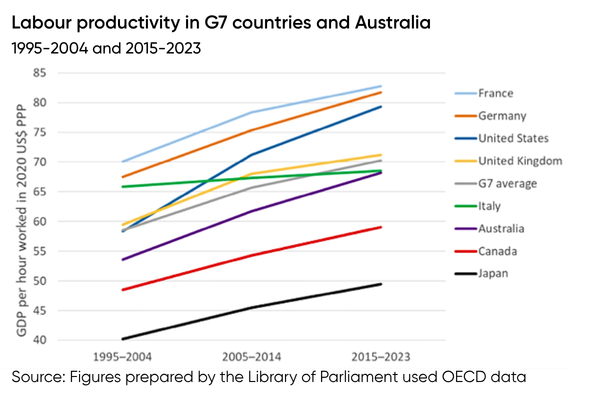
An analysis using data from the Organisation for Economic Co-operation and Development shows that Canada’s labour productivity does trend lower than other Group of Seven countries over the last three decade-long intervals.
But take note of the two countries at the top of the pack. Aren’t France and Germany afflicted with high taxes, stifling bureaucracy and long vacations? They both have challenges, and neither are paradise by any means, but we should be looking to those countries for lessons instead of to Alabama, with its anti-union policies, deep rural poverty, hospital closures and low-wage economy.
The real questions
So, where do we go from here? Why, despite its imprecision and blinkered scope, does the GDP per capita measure rebound continuously, as one of those “zombie ideas” popularized by Paul Krugman that are immune to contrary evidence while suiting a particular political agenda. Yes, there are legitimate concerns about Canada’s low growth, declining rates of business investment and inadequate innovation. But we need to look beyond the simple productivity narrative and consider structural causes, such as Canada’s low value-added natural resource exports, the foreign ownership of much of the manufacturing sector (we have the subsidiaries, or “branch plants,” while major investment or R&D decisions are made at head offices elsewhere) or the protected oligopolies in key industries (finance, telecom, grocery), instead of simply “improving the investment climate.”
By constraining the conversation, we avoid confronting the real choices in front of us. We have made those choices before, and we can see their consequences clearly.
RELATED STORIES



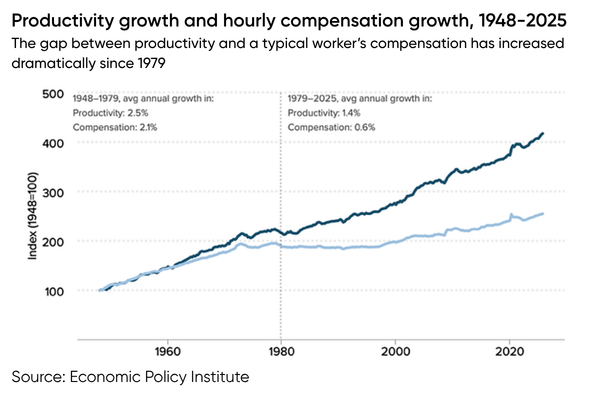 For example, this chart shows that productivity growth de-linked from real wage growth in the United States around the time of Ronald Reagan’s neoliberal program, whose policy choices weakened labour unions, reduced taxes on high incomes and removed large parts of the social safety net. The increase in productivity created wealth, but it went upwards to the top 10%. This outcome then leads directly to the populist and authoritarian backlash affecting so much of U.S. society. Similar trends, albeit less extreme, are underway in Canada.
Assuming that our common goal is an economy that innovates, provides good-quality employment and generates sustainable increase in social well-being, we need to monitor what really matters and measure policy against a broader range of indicators. In that spirit, a “beyond GDP” initiative launched in Quebec in 2022 draws together a broad coalition of 15 civil society organizations. They have developed a set of about 70 indicators, grouped in 10 themes, to portray and measure well-being across economic, social and environmental dimensions. Each year the data is updated, and the concept is used by various levels of government to measure progress. The G15+ initiative now needs to be extended nationwide with greater media attention, since it highlights elements of well-being that are often neglected.
The Canadian difference

Canada’s historical choices for public services to provide shared needs has created a distinct culture and contrast with that in the United States. But this key element in our success is increasingly at risk. One repeated claim is that “we can’t afford it anymore.” But is that really the case? Most people are aware of the poor state of our infrastructure, inadequate social services and pressures of an aging population, plus the huge challenge of the transition to renewable energies. Those expenditures will put further strain on the deficit. Reversing previous tax cuts to generate revenue for such priorities should not be dismissed as impossible. A study of the large cuts in federal income tax (personal and corporate) dating from the late 1990s, calculated the “lost” revenue to the federal government in 2016 at roughly $94 billion. For one year.
Another recent report in Quebec estimated the loss in Quebec revenue from tax cuts since the late 1980s at $12 billion per year. They suggested a partial return to earlier tax rates, and that, if focused only on the top third of income earners, would generate an additional $3 billion per year.
Finally, there remains the environmental crisis. The obsession with GDP growth increasingly ignores the reality of resource limits. A recent report from the Potsdam Institute for Climate Impact Research estimated that our collective economic activities are already exceeding seven of nine planetary boundaries.
And yet, the drumbeat continues for the same old orthodoxy: all our problems can be fixed, we’re told, with a return to higher economic growth. But the facts don’t bear that out. What if the realistic and sustainable route is one of continued low growth? We need to adapt our economic systems to live within our planetary boundaries. There is an urgent need to slow down, produce less of the harmful goods and more of what we need to be sustainable, and improve quality of life by redistributing and expanding public services.
When we challenge the productivity panic and growth mantra, we create space and vision to imagine alternative options for a sustainable future.
Stefan Harpe managed impact investments for funds based in Africa, the Netherlands and Canada. He is an amateur economist, lively skeptic and lives in Montreal.
The Weekly Roundup
Get all our stories in one place, every Wednesday at noon EST.