

The federal government’s decision to repeal the electric vehicle sales mandate in August may slow adoption, but the data shows that the future is still inevitably electric.
According to Statistics Canada, zero-emission-vehicle sales were up nearly 75% across the country in March 2026 compared to March 2025. That’s ahead of an expected influx of 49,000 Chinese EVs annually, giving consumers access to more diverse and affordable options. If sales keep going up at this compound rate, we’d reach 100% of all sales by 2030. By contrast, the consumer intelligence firm JD Power is currently predicting a quarter of Canadian sales will be all-electric by then. At the more modest growth rate of 6% per year, we’d get to 100% by 2040.
The challenge
Corporate Knights’ Climate Dollars research puts the full electrification of Canadian road transportation at about $339 billion in capital investment over the transition period. More than half of that total is for truck electrification. The personal-vehicle component, including charging infrastructure, is about $46 billion, or about $1.5-1.8 billion per year, with an additional $35 billion premium to make the charging network vehicle-to-grid capable.
But the potential environmental upsides of a full shift to electric vehicles is well worth that cost. The economic sectors responsible for the most greenhouse gases in Canada in 2021 were oil and gas (28%, or 189 million metric tons of carbon dioxide equivalent) and transport (22%, or 150 mt CO2e). The carbon eliminated from those sectors in an all-EV landscape would surpass France’s total domestic carbon footprint. (Some of these emissions will shift to electricity, and we’ll continue to export oil and gas, but we would still see only a fraction of today’s emissions.)
Some communities aren’t content with going at the government’s speed to meet the 100% EV objective, choosing instead to put up the money themselves. Community bonds offer a viable – in some cases preferable – path for mobilizing community funds, particularly when it comes to EV projects such as charging stations and electrified public transportation. Unlike large-scale government programs and commercial consortium networks such as IONNA (backed by BMW, GM, Honda, Hyundai, Kia, Mercedes-Benz, Stellantis and Toyota to rival Tesla’s charging network), this tested social finance tool can not only accelerate the EV transition but also ensure communities benefit directly from the infrastructure and financial gains.
The opportunity
Community bonds may not be well known, but they have been proven effective all over the world for bringing community projects to life, and doing so in a way that engages and benefits people locally. For low-density rural and Indigenous communities, it’s one of the only viable ways to pay for EV infrastructure.
The most notable Canadian example of community bonds used for EV infrastructure is the Earth Day Canada EcoCharge project launched in 2020, which aimed to deploy more than 100 fast-charging stations across IGA grocery store locations in Quebec and New Brunswick.
The thinking behind the project was that grocery stores are the anchor for a variety of communities, and a full charge would take about the same time as a grocery run (20-30 minutes).
Earth Day representatives coordinated government funding from Natural Resources Canada, institutional support from Investissement Québec, Fondaction and IGA, as well as a $2-million community bond campaign managed by Tapestry Community Capital.
Community bonds were offered at a minimum investment of $1,000 with two different repayment schedules: one with a 4% annual interest rate on a seven-year commitment and another that accrued 3.5% with a five-year pledge.
The interest and community contribution weren’t the only benefits. Investors in the $10,000+ category were offered 10 free hours of charging, and a $25,000+ investment guaranteed the placement of your name on a windshield wash dispenser at one of the charging stations.
The campaign raised $1.1 million from 130 investors, including a $300,000 investment from the Trottier Family Foundation, which donated its earned interest back to the community.
The momentum
There are even more successful examples of community-funded EV and clean-energy infrastructure projects in the UK and U.S.
Local Climate Bonds (LCB) were used in UK communities in 2020 to finance a variety of community-oriented net-zero projects, including chargers and community minibus fleet electrification. Unlike the EcoCharge project, the minimum investment for these bonds was £5 (approximately CAD$9) per person.
The Bus2Grid project in Williamsfield, Illinois, deployed electric buses with solar power infrastructure, funded in part by several small school districts. Williamsfield reported a 94% reduction in fuel costs, in large part due to its use of a bidirectional vehicle-to-grid (V2G) charging infrastructure that sends energy back to the grid during peak hours.
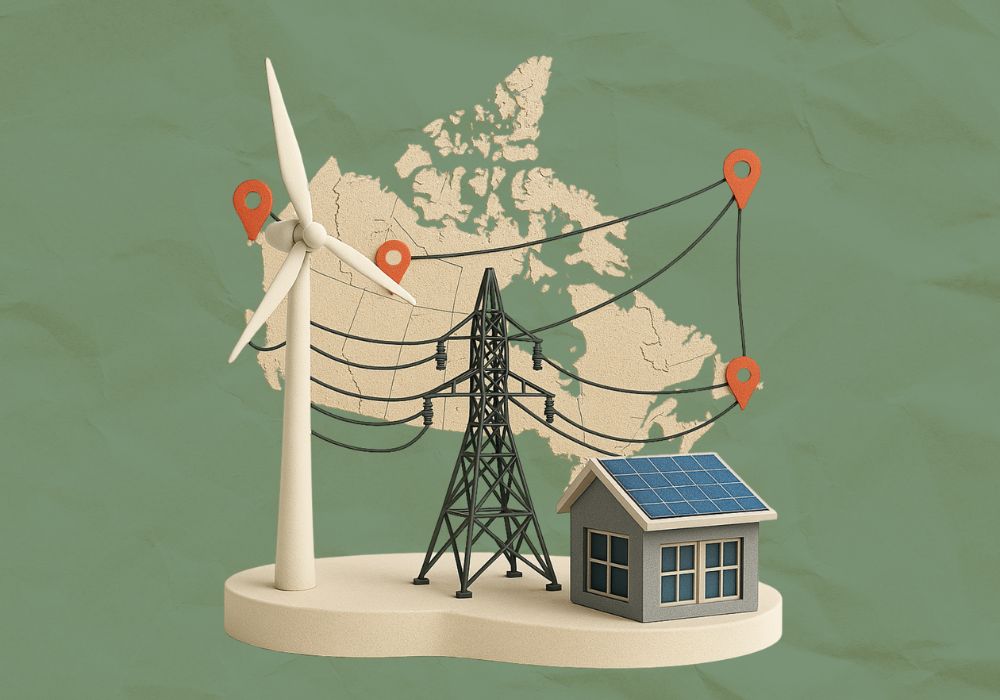
V2G can sweeten the value proposition of a community-led EV infrastructure. Using batteries from personal EVs to fuel the grid in Canada could reduce utility costs by $310 billion as compared with dedicated utility batteries, according to Torrie. In peak energy times in a community, energy is sourced from personal vehicles. In non-peak times, such as overnight, the charger switches back to charging the car battery until it’s full.
This could make grids more reliable and attract investment from utility companies, reducing their costs and adding excess capacity in peak hours.
RELATED STORIES:

Canada’s first V2G pilot project was launched by BC Hydro in 2023, using medium-sized and heavy-duty vehicles. According to BC Hydro, a typical electric bus battery contains enough energy to power 24 electrically heated homes for nearly two hours.
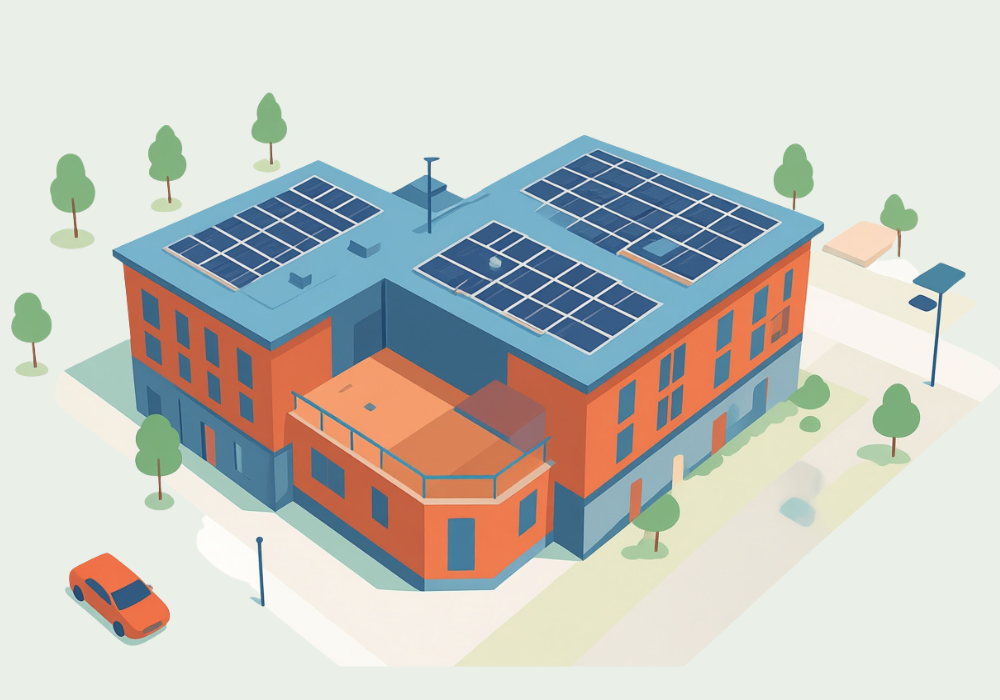
In Toronto in 2022, SWTCH Energy, an EV charging company, launched a pilot to test the viability of V2G charging in combination with car sharing at Tridel’s Bianca Condos in the Annex neighbourhood. Fifteen chargers powered bookable Nissan Leaf vehicles, eliminating more than 5,800 kilograms of CO2e.
Neither of these pilots were community funded, but the multi-unit residential setting that both projects tested lends well to co-op or affordable-housing community bond models.
Co-op-owned EV car-share programs offer another community-centred opportunity. In B.C., Modo operates a member-owned car-sharing service that is integrating electric vehicles into its fleet across the Lower Mainland, Vancouver Island, Squamish and the Okanagan, giving residents affordable access to zero-emission mobility.
But co-ops aren’t the only way to make EV infrastructure more equitable. Charge Up, an initiative led by the Canadian non-profit Indigenous Clean Energy, used community equity and local debt to cover the remaining 25% of a project aimed at creating a “national Indigenous electric highway” for First Nation, Inuit and Métis communities. (The 75% anchor investment came from National Resources Canada’s Zero Emission Vehicle Infrastructure Program, or ZEVIP.) The investment opportunity was aimed at community organizations such as Indigenous governments, Friendship Centres and registered Indigenous businesses rather than individuals. According to Charge Up’s terms, the participating Indigenous communities will retain 100% of charging revenues.
What’s next?
The environmental, financial and technological efficacy of community-funded EV infrastructure have been proven several times over. But there are still few signs of broader adoption. What’s the holdup?
In part, it’s a question of supply. There’s a reason the SWTCH project used Nissan Leaf cars exclusively: They were the only viable option for a condo building. Aside from the Ford F-150 pickup truck, the Leaf was the only vehicle at the time set up for V2G charging. This has changed in recent years, but it still isn’t the industry standard.
There are also upgrades required for the chargers themselves. Since V2G isn’t the norm, adding that capability to a national charging network is estimated to cost up to $35 billion over 25 years, writes Corporate Knights director of research Ralph Torrie. For communities to transition to an EV-friendly ecosystem, they will need a greater supply of both vehicles and charging infrastructure that are set up to adapt to the community’s grid.
The business model is also unpredictable when you’re dealing with a commodity in electricity that fluctuates in value. Hepburn Energy, a 15-year-old clean energy cooperative in Victoria, Australia, was faced at one point with “negative pricing” in Australia’s National Electricity Market. In other words, it had to pay for supplying excess energy to the grid. Hepburn found a solution for storing the energy, and it led the cooperative to diversify its energy sources, but not without an unanticipated capital investment.
Fluctuating costs could impact the already thin margins of any EV-related community initiative, from chargers to community buses, which would in turn risk the bondholders’ returns and future sustainability of the assets. Having trustworthy intermediaries and airtight social-finance mechanisms to account for these variances is crucial for attracting capital.
These growing pains are expected with any major paradigm shift. The more community-funded EV pilots and projects are launched across the world, the more reliable suppliers, intermediaries and finance models will emerge. And with that reliability will come a stronger willingness for community members to contribute capital, and for government and industry to both match that investment and guarantee returns. The network effect is inevitable.
Stephen Baldwin is a business and technology journalist in Canada, and a project director at Imagine Canada.
The Weekly Roundup
Get all our stories in one place, every Wednesday at noon EST.