
To achieve its energy transition, Canada will need to deliver some enormous projects: transmission lines, utility-scale wind farms, hydroelectric facilities and other infrastructure measured in billions of dollars. But much of the transition will look very different. It will consist of heat pumps installed in houses and apartment buildings; insulation and electrical upgrades; solar panels on rooftops and community land; electric cars, vans and trucks; charging stations; batteries; and increasingly sophisticated local electricity systems connecting them all.
Corporate Knights’ Climate Dollars analysis estimates that putting Canada on a deep-decarbonization pathway will require $2.17 trillion of capital investment through 2050, an average of $86 billion a year. About 42% is in technologies that use energy – in buildings, vehicles and industry – and the rest in the electricity system that supplies them.
That sounds intimidating. But it also describes one of the largest opportunities for community economic development Canada has seen in generations. We have the capital. The questions are who will own the assets that $2 trillion buys, who will finance them, who will do the work and where the economic returns will go?
Community finance will not fund the entire transition. But it is unusually well suited to an important part of it: assets that can be owned by communities, cooperatives, Indigenous nations, non-profits and other local institutions, and infrastructure embedded in the places where Canadians live and work.
A transition built from the bottom up
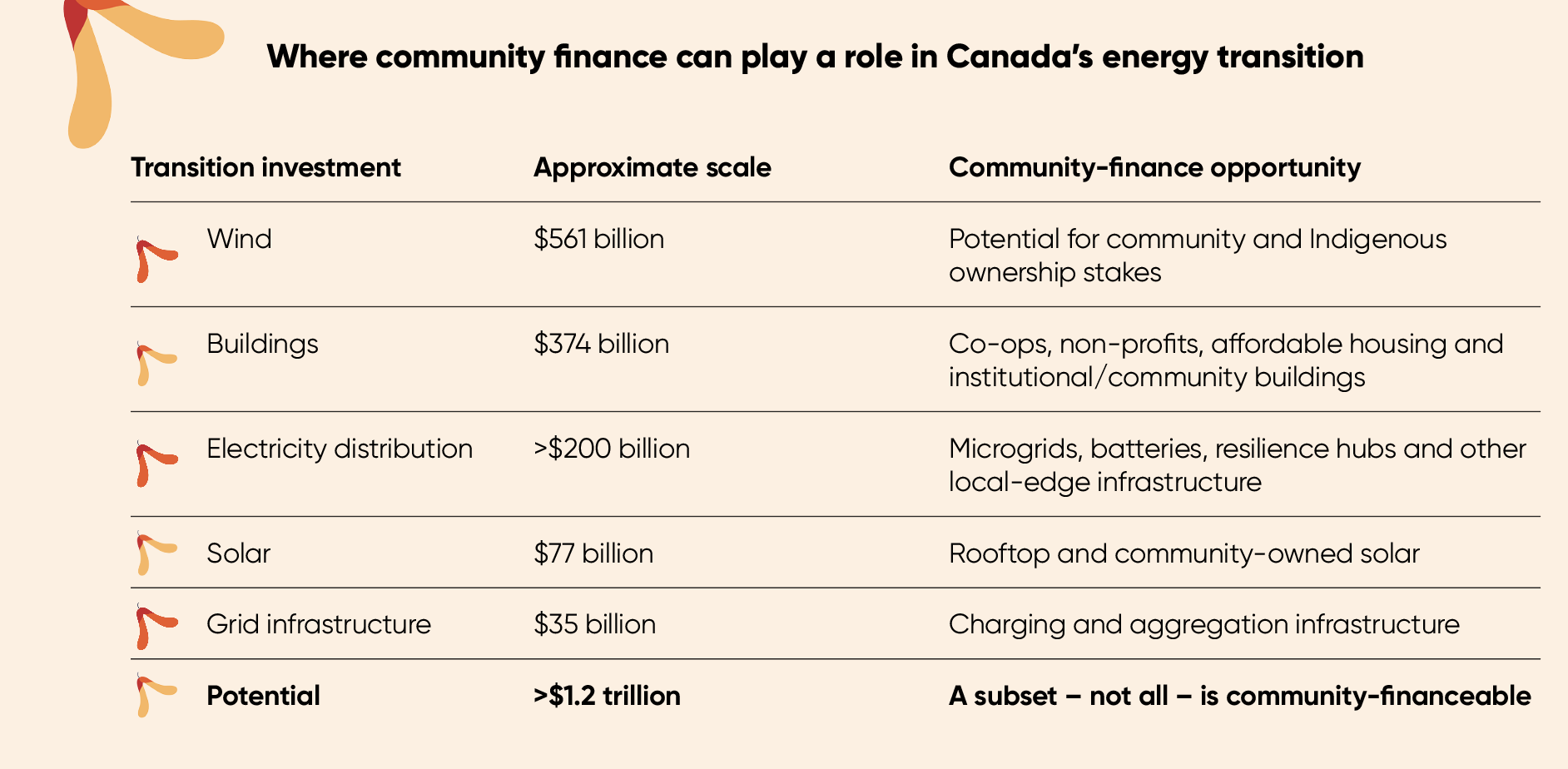
Corporate Knights modelling identifies more than $1.2 trillion of investment through 2050 in asset classes where some degree of local or community participation is at least conceivable: wind and solar generation, building decarbonization, vehicle-to-grid infrastructure and electricity distribution.
This is emphatically not a projection of investment in community bonds and cooperative shares. Most utility distribution will stay on regulated balance sheets. Much wind investment will be conventionally financed. Privately owned houses and businesses will often use mortgages, loans or corporate capital. But the number reveals the scale of the territory in which community finance can operate.
A renewable electricity system is inherently more geographically distributed than the fossil-fuel system it replaces. Wind and solar harvest energy over large areas. Buildings become energy assets. Vehicles become potential storage resources. Batteries, chargers, microgrids and local electricity networks tie them together.
That creates an opening for a form of finance whose defining characteristic is also proximity: connecting investors with identifiable assets in their own communities.
Reducing transaction costs
Conventional finance works extremely well for large, standardized transactions. The distributed transition presents a different problem: thousands or millions of smaller projects involving different owners, technologies, buildings and local conditions. To a large centralized financial institution, that variation can look like transaction cost. Community institutions can bring local knowledge, while aggregation can create the scale that conventional capital requires.
Financing one building retrofit may be inefficient; financing 20 or 50 together can diversify risk and reduce transaction costs. The same principle can apply to affordable housing, apartment-building chargers, rooftop solar, batteries or local fleets. The unit of finance does not have to be the unit of technology.
From buying fuel to building capital
There is another reason community finance fits the transition so well: what all this investment replaces.
Canadians currently spend about $235 billion a year on energy, including $179 billion on natural gas and petroleum products. Some of that is concentrated in industry, agriculture and long-haul transportation and cannot sensibly be assigned to a typical community. But residential heating, personal transportation, commercial buildings, and local delivery and service vehicles are closely connected to community life.
Canadian households spend more than $41 billion a year on energy for personal vehicles. Add the light and medium commercial trucks that overwhelmingly serve local economies – delivery vehicles, tradespeople’s trucks and service fleets – and the total reaches about $65 billion annually. For a population-equivalent community of 50,000, that represents an energy bill of roughly $83 million a year.
In the Climate Dollars low-carbon scenario, those vehicles are electrified and the comparable energy bill falls to about $19 million a year.
The transition does require capital. Electric vehicles must be bought, chargers installed and electricity networks strengthened. But the economic mechanism is fundamentally different. A litre of gasoline is bought, burned and gone; another must be bought tomorrow. Investment in charging infrastructure, electrical equipment, solar panels, batteries or building improvements creates assets that provide services for years.
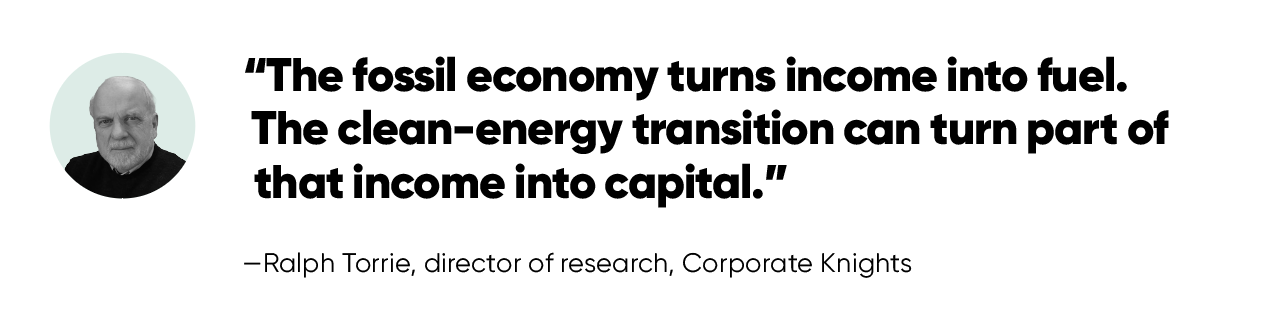
The fossil economy turns income into fuel. The clean-energy transition can turn part of that income into capital.
One address at a time
Buildings make the same point at even greater scale. Corporate Knights estimates that decarbonizing Canada’s residential buildings requires roughly $183 billion in incremental capital through 2050. Commercial buildings add another $191 billion, bringing the building total to approximately $374 billion.
But physically there is no $374-billion building project. There are millions of projects: houses, apartment buildings, schools, community centres, clinics, shops, offices and warehouses.
Someone has to assess those buildings, insulate them, upgrade electrical systems, and install and maintain new equipment. A heat pump in Regina cannot be installed by an electrician in Shenzhen. A building envelope in Sudbury cannot be insulated remotely from New York. Canada will import some of the technology, but much of the construction, installation, electrical work, project management and maintenance must happen where the buildings are.
That makes the transition an engine of local economic activity. It also illustrates why ownership matters. A corporate office tower will generally be financed conventionally. A school, community centre, non-profit property, housing co-op or affordable-housing portfolio may be a much more natural candidate for a community bond or another community-finance structure. The technology may be similar; the ownership determines the financing opportunity.
Where community finance fits
Community finance works best where four things line up: an investable asset, a credible issuer, a dependable repayment stream and a meaningful community ownership opportunity. That could mean a community or Indigenous stake in a wind or solar project, retrofits to affordable or cooperative housing, rooftop solar on community buildings, a local charging network, a community battery or microgrid. It does not mean financing every household EV, private commercial building or major transmission line. The opportunity is narrower than the $1.2-trillion physical universe – but it could still be very large.
Ownership is what makes this economically significant. A wind farm produces the same electrons and roughly the same construction employment whether it is owned by a multinational corporation, pension fund, municipality, Indigenous nation or local cooperative. But ownership determines who receives the returns after the construction crews leave.
RELATED STORIES


Community bonds and community equity allow residents and local institutions to participate not merely as consumers or workers, but as investors. Interest can flow to local bondholders, and surpluses earned by community organizations can be reinvested locally. That does not mean every dollar stays local: equipment, insurance, expertise and other inputs will often come from elsewhere. The point is to capture a larger share of the value created by the transition in the communities where the assets are located.
Ownership can also affect whether people see themselves as hosts to the transition or participants in it. Research on renewable-energy projects has found greater acceptance and perceptions of fairness where communities have meaningful ownership or participation. Community ownership does not eliminate legitimate disputes over development. But it can help determine whether people experience the energy transition as something happening to them, or as something they are helping to build.
Community finance is best understood as a complement to conventional capital, not a substitute for it. A community or Indigenous ownership stake may represent only part of a project’s financing. Community capital can demonstrate participation, provide an equity or subordinated tranche, or aggregate smaller projects; banks, governments, utilities and institutional investors can finance the balance.
Canada does not suffer from a simple shortage of capital. The challenge is getting capital into the right assets, at the right scale and through structures capable of financing a highly distributed transition. Community finance is one tool for doing that.
Think globally, invest locally
For more than a century, communities have bought a continuing stream of fuels: coal, natural gas, gasoline and diesel. The clean-energy system is different: more capital-intensive, less fuel-intensive and much more distributed.
A dollar spent on fuel purchases something that is consumed. A dollar invested in a building renovation, solar installation, battery or charging system helps create an asset that remains.
Whether those assets simply happen to be located in communities or actually help build community wealth will depend partly on who owns and finances them. Community finance will never fund the whole transition. It does not need to. Its role is to connect local capital and local ownership to the parts of the transition where that connection creates additional economic and social value.
An energy system becoming more distributed physically needs a financial architecture capable of being distributed as well.
Ralph Torrie is the director of research at Corporate Knights.
The Weekly Roundup
Get all our stories in one place, every Wednesday at noon EST.