Most of the Avro Arrow’s last remnants sit at the bottom of Lake Ontario. Several models of the supersonic interceptor jet ended up in the lake during flight testing in the 1950s, of which only one has since been dredged up. The five completed aircraft were cut up with blowtorches, and the site of the Orenda testing facility where Avro tested its Canadian-built engines is now an unmarked field divided by Highway 400.
The abrupt cancellation of the landmark aerospace program in 1959 remains one of the most controversial decisions in Canadian industrial history. So it’s curious that one of the most ambitious industrial projects in Canada today is named after a project the country tried to bury.
Launched in 2020, Project Arrow aimed to build the first Canadian-made zero-emission concept vehicle, from critical minerals to manufacturing to automotive software. The name “was one of the most important non-technical decisions we made,” says Flavio Volpe, president of the Automotive Parts Manufacturers’ Association (APMA), who spearheaded Project Arrow. “We immediately made it Canadian, we immediately put a chip on our shoulder, and we immediately made it fail-proof.” In other words, the potential embarrassment of a failure named after another failure is a powerful incentive.
Volpe emphasizes that despite Canadians’ collective memory, the Avro Arrow was not a failure. “It was a demonstration of Canadian capability. It flew twice as high and twice as fast as anything else at the time, and the technology that came out of it ended up feeding into the Mercury and Apollo space programs, and into the Concorde.”
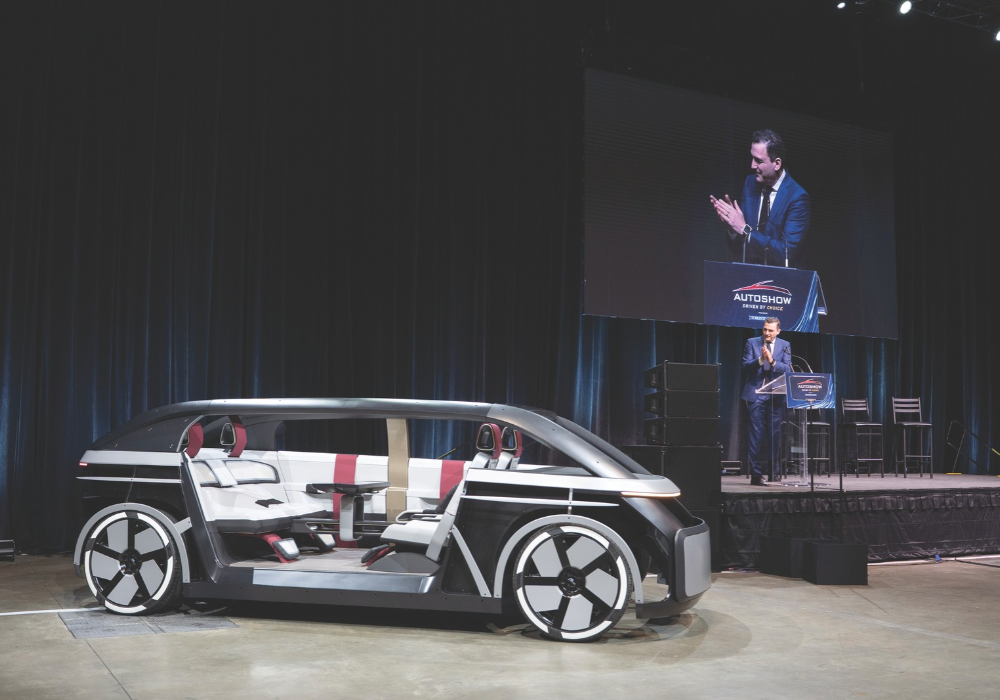
Project Arrow was born of a challenge issued by former prime minister Justin Trudeau in 2019, in which he called on industry leaders to join the race to net-zero emissions by 2050. The goal was not to launch a commercial vehicle but to demonstrate the strength of Canada’s EV supply chain to the world. However, once the idea became a reality at the 2023 Consumer Electronics Show in Las Vegas – one of the world’s largest trade shows – the conversations grew more ambitious. In February 2026, Project Arrow displayed its Vector and Borealis models at the Canadian International AutoShow in Toronto.
When it was created, the question was: Can we build EVs? Can we attract EV investment to Canada? Now the question is: Can our auto industry survive at all, in any form? —Dimitry Anastakis, professor of Canadian business history, University of Toronto
The Vector is a sporty 650-horsepower crossover prototype with an estimated 550-kilometre range, while Borealis is a driverless shuttle concept with a targeted range of 1,500 kilometres. (The range of an average EV today is around 500 kilometres.) Both cars are built on 3D-printed chassis.
The prototypes are the result of about $31 million in total funding between Arrow 1.0 and Arrow 2.0 – a mix of self-funding from APMA companies, along with federal, provincial and municipal funding. To put that number in perspective, the U.S. EV company Rivian had raised roughly US$450 million in equity and debt by the time it revealed its first vehicles in 2018.
With 2.0 nearing completion, Volpe is at work planning 3.0. Whether he and the APMA can convince government, industry and the investment community to dig deeper into their pockets could signal whether Canada is retreating from or reaffirming its ambitious EV and climate targets.
Defining an industry’s future
Volpe is as blunt and gregarious as Canadian industrialist Crawford Gordon Jr., Avro Arrow’s champion, but without the corporate polish. He swears occasionally, has a thick, scruffy beard, and transitions easily between CNN interviews, factory floors, auto shows and parliamentary hearings. He became a member of the Order of Canada in 2023.
Despite his role spearheading Project Arrow, the electric concept car rarely comes up in his interviews on Canadian news broadcasts. That may be because so much has changed since the 2021 launch. Coming out of COVID, there was a spirit of economic optimism and innovation in North America and, in the Biden-Trudeau era, a clear commitment across the continent to meet global emissions targets. At COP28 in Dubai in 2023, Volpe shared onstage Arrow 2.0’s plans to explore hydrogen fuel cells and integrate vehicle-to-grid technology that enables EV chargers to send power back to the grid.
When Donald Trump took office in 2025, the United States made a U-turn on zero-emission vehicles, repealing EV incentives and mandates and withdrawing from the Paris climate deal. Next, the Trump administration started a trade war.
Since then, Volpe has been front and centre advocating for an auto sector that could be on the hook for tens of billions of dollars per year in tariffs. The impact on this industry may be the most notable “rupture,” in Prime Minister Mark Carney’s words, in Canada’s economic relationship with the United States.
“The circumstances around [Project Arrow] have changed so much that the question it was originally built to answer has changed entirely,” says Dimitry Anastakis, a professor of Canadian business history at the University of Toronto and the author of several books on Canada’s auto industry. “When it was created, the question was: Can we build EVs? Can we attract EV investment to Canada? Now the question is: Can our auto industry survive at all, in any form?”
EV-capable
Canada doesn’t have a mass-market automaker, but it’s been building mass-market hybrid vehicles since 2014 and fully electric vehicles since 2022. Stellantis’s Windsor plant began producing the fully electric Dodge Charger Daytona in December 2024 and built the Chrysler Pacifica Plug-In Hybrid until 2025. Toyota builds the hybrid Lexus and RAV4, and Honda builds the CR-V and Civic hybrids.
While the country has demonstrated its capacity to build today’s EVs, Project Arrow asked a different question: Does Canada have the resources, talent and facilities to develop the car of the future?
Every Arrow prototype was built in Ontario Tech University’s ACE facility in Oshawa. Formerly the General Motors of Canada Automotive Centre of Excellence, ACE – with an initial price tag of $100 million – contains an enormous wind and climatic testing chamber with a full climate range of -40°C to +60°C that can replicate conditions of rain, snow and high humidity, and a “moving ground plane” purchased from NASA. ACE claims to be the only facility in the world that combines all of these capabilities.
While Ontario Tech plays a central role, it’s one of several colleges and universities involved in Project Arrow, including the University of Western Ontario. There, professor Mohamed Zaki’s team designed the Borealis model for Level 5 automation – or cars that operate without steering wheels, and therefore without drivers. Several of his team members are international students, and he recruited at least one of them from the United States specifically for this project.
‘Canada isn’t entitled to have an auto industry’
Asked if there will be a Canadian EV automaker in the next five to 10 years, whether via Project Arrow or any other company or initiative, Volpe and Zaki answer unequivocally “yes.” Anastakis, however, is skeptical. The motivation and capability are there, but “we’re not in control of our own fate in the auto sector,” he says.
Along with Canada being subject to the whims of the U.S. auto industry and the Trump administration, Anastakis is discouraged by the influence of the domestic oil and gas industry. “There’s a pretty direct correlation between Big Oil’s support for Trump and Trump’s support for measures that slow down the EV rollout,” Anastakis says. “And in Canada, there’s a similar alignment. Where’s the biggest roadblock to embracing EV policy in this country coming from? Alberta.” He cites the Ford Oakville plant, which was slated for a $1.8-billion transformation into an EV hub, only to have those plans scrapped in 2024 and replaced with gas-powered Ford F-Series Super Duty truck production.
Volpe and Anastakis agree on one thing when it comes to Canada’s EV production future: the more realistic near-term path is military vehicles – and that’s expected to be the focus of Arrow 3.0. It’s an application that might draw less suspicion from taxpayers than another APMA-backed concept car. It also lines up with a spending commitment Canada is already on the hook for: to meet NATO’s new defence-spending target of 5% of gross domestic product, the country will need to spend tens of billions of dollars more per year.
There are added benefits to creating military EVs. Electric drivetrains make vehicle noise and heat harder to detect in stealth operations, cut down on vulnerable fuel-resupply convoys, and power onboard sensors and electronics that are increasingly important in modern defence.
Challenging history
In the epilogue for The Arrow, the Avro Arrow biopic starring Dan Aykroyd as Gordon Jr., viewers learn that the engineers who built the groundbreaking aircraft went on to lead some of the most important projects in aerospace history. Jim Chamberlin, chief of technical design, left Canada shortly after February 20, 1959 – known as “Black Friday,” when 14,000 Avro employees lost their jobs – to play a leading role in the Gemini and Apollo missions as NASA’s head of engineering, while James Floyd, vice president of engineering, worked in the United Kingdom on what became the Concorde jet.
For its proponents, even if Project Arrow follows the path of its namesake, the investment is worthwhile. The talent and innovation it’s building could help reshape an auto industry under threat. While the original Arrow was built to guard Canadian skies against Soviet bombers approaching from the north, Project Arrow could be a hedge against economic pressure from the south.
Stephen Baldwin is a business and technology journalist and a project director at Imagine Canada.
The Weekly Roundup
Get all our stories in one place, every Wednesday at noon EST.