
In July, one of Spain’s worst-ever wildfires raged west of Madrid. Authorities said it was beyond what firefighters could contain and, in some places, spread at a blistering speed of about 20 kilometres in half an hour. The wildfire consumed around 77,000 hectares of land, forced 87,000 people to be evacuated or locked down, and destroyed entire villages in its path. Residents said it felt like the end of the world, as reported by The Guardian.
2026 has been Europe’s worst wildfire year on record. By November 4, wildfires had burned about 704,000 hectares, roughly 82% more than the twenty-year average of 386,483 hectares for the same point in the year. As well as Spain, there have been intense fires in France, Croatia, Greece and Italy, as well as northern countries typically less affected by wildfires, such as Belgium, Germany and the United Kingdom.
As wildfires grow bigger and more frequent, investments are pouring into firefighting capacity. The European Union announced plans for a new firefighting fleet in the aftermath of the summer. Both the European Space Agency and XPrize Wildfire previously launched funding for early detection projects. But “that’s just chasing after the problem because the fire already started,” says Lindon Pronto, senior fire management expert and co-founder of the Fire Climate Resilience Initiative, in an interview. “Just because you detected [a wildfire] earlier doesn’t mean you’re preventing it.”
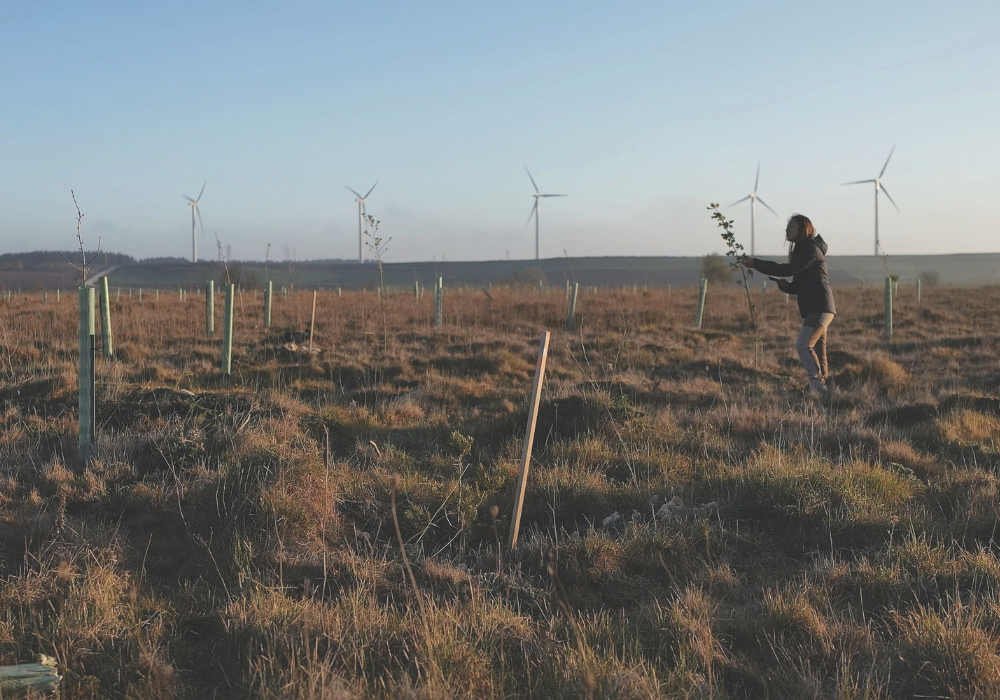
Minimizing wildfire impacts starts before anything is ablaze. Angela Iglesias Rodrigo, the head of Spain’s forest fire defence service, told the World Health Organization in July that many countries, including Spain, still focus too heavily on response, when what could help with wildfire preparedness is forest management. In a world that’s hotter, drier and easier to burn, how landscapes are managed and restored will play a key role in slowing future wildfires’ speed and spread. A small but emerging restoration-as-a-business industry in Europe is looking to do just that.
The need for careful design
The most pressing need after a wildfire is to reduce soil erosion. Depending on the intensity of the fire, root systems that normally hold soil in place are either damaged or destroyed. Any subsequent rainfall risks washing soil away and can cause cascading problems downstream – from contaminating water sources to harming marine wildlife.
Land Life, which describes itself as an end-to-end reforestation company, partners with corporations that fund restoration projects. For a project site dealing with the immediate aftermath of a wildfire, Land Life would first lay mulching, which consists of pieces of shredded bark or dead trees, to help protect the soil and promote regrowth. Once the soil is stabilized, it can take a year or more to see if the land regenerates on its own.
If there is a need to reforest, intentional landscape design can help with mitigating wildfires, says Francisco “Pancho” Purroy, regional director of Iberia at Land Life. “It’s all about forest management,” Purroy says. “Our task is to do resilience work and fire prevention work.” Designing a landscape to be more fire resilient includes planting native trees that are adapted to the local conditions as well as managing plant density from the shrubby understory to the leafy canopy. If there’s no design in place, a landscape could end up becoming what Purroy calls “a wheat field of pines” or a densely packed forest that could easily ignite. Fire breaks – gaps in vegetation that slow fire spread – are also an important part of a reforestation design.
A novel approach to tree planting
When it comes to the physical replanting, several businesses operate across Europe. Some use traditional manual labour, which is time-intensive and physically demanding, while others deploy seeding drones, which have mixed results at best, depending on the plant species.
Trovador, based in Portugal, takes a different approach. The company uses autonomous “robot dogs,” which are four-legged robots designed to move like dogs, with the aim of making tree planting faster, cheaper and safer on difficult-to-reach terrain, such as steep slopes. Sebastião Mendonça, who co-founded the company with Marta Bernardino in 2023, calls it “the first restoration machine which can fully adapt to nature.”
Unlike other technologies, such as drones, there are “algorithms that enable robots to assess what’s around them and for them to be able to deal with all types of obstacles,” Bernardino says. Robots that know, for example, if the ground is sandy or rocky will be better able to determine where a newly planted tree has the best chance at survival.
Currently, Trovador is working on its beta prototype and a pilot project in a fire-ravaged area of Mafra National Park in Portugal. They plan to partner with existing tree-planting companies to access hard-to-reach terrain or just plant faster and cheaper, Mendonça says.
Restoration as prevention
Both the European Commission and the World Economic Forum have said that industries relying on healthy landscapes should be incentivized to step in where public funding falls short. However, “very little from the industry side goes into this space of restoration and [building] back better,” says Alexander Held, senior expert of fire, silviculture and wildlife at the European Forest Institute.
With the European Commission estimating that wildfires will cost at least €2.5 billion per year, companies like Land Life and Trovador can help fill the gap where government funds cannot and introduce competition in an emerging market. “Nature restoration efforts will need to come not only from the public sector but from the private world, [which] needs to contribute much more,” Purroy says.
As wildfires grow more severe, so too will the costs. Companies with land, infrastructure or supply chains that rely on land in Europe have a lot to lose. Research suggests that for every €1 invested in wildfire prevention, €4 to €7 can be saved in response and recovery costs, according to a World Bank report. With that kind of return on investment, restoration companies are operating on solid ground.
Ashley Perl is a Canadian freelance journalist based in Stockholm.