
In David Cronenberg’s 2022 dystopian bio-thriller Crimes of the Future, select humans called “neo-organ generators” have evolved to spontaneously grow novel organs. Fleshy pod-like machines assist the generation process during sleep, and a national registry keeps records of the specimens. The purpose of the organs is unknown, but imagining the next evolutionary stage, a registry employee asks, “Do you think they could actually develop into a system of organs?” As in, could they interconnect and constitute a working body?
Change a few arthouse details and Cronenberg’s trademark body-tech interplay isn’t far off from a controversy involving a Bay Area biotech company, R3 Bio, earlier this year. The company’s founders reportedly discussed ambitions to develop “bodyoids,” or organ sacks, essentially non-sentient human clones with functional organs to be harvested, all toward the goal of extreme life extension. Need an organ replaced? Take it from your clone. R3 has also proposed developing monkey organ sacks for use in drug toxicity testing.
R3 subsequently denied it was ever working on such capabilities, and its website downplays “recent sensational media coverage.” Whether or not it is doing stealth research at the outer limits, its stated purpose is less science-fictional and represents work happening now: modelling human biology to advance non-animal methods (NAMs) in drug development. It’s a mission R3 shares with a growing class of young biotech companies.
Momentum for NAMs is picking up thanks to technology advancements and regulatory changes encouraging the movement away from animal testing. But it isn’t all about saving animals. Roughly 90% of drug candidates that make it to clinical trials fail to reach approval. One common, expensive snag is safety and efficacy issues that arise in human trials despite a drug clearing animal tests. So the parallel race is on to develop human-relevant methods that promise drug and chemical companies speed, savings and scale.
There isn’t yet a full-body simulation capable of capturing every aspect of human physiology. But an array of evolving methods combining human tissue and artificial intelligence is pushing healthcare into the future. And for all the anxiety around AI replacing humans, replacing lab animals is an outcome few will protest at this point, as long as what replaces them is better.
Science nonfiction
In future post-animal labs, researchers will test drugs and chemicals using methods that replicate human biology as closely as possible without using real humans. But before you simulate a full body, you start with organs, or rather models of them.
Boston-based Emulate was founded in 2013 by a team from Harvard University’s Wyss Institute to develop organ chips: thumb-sized devices containing living human tissue in a controlled environment. They represent “a home away from home for the cells,” as Geraldine Hamilton, former lead of the institute’s organ-on-a-chip program, put it in a TED Talk. The chips contain fluidic channels that supply organ cells with air and nutrients, and they can be used to mimic cellular events such as infection and toxicity.
In 2024, the company’s liver chip was the first organ-on-a-chip device to be accepted by the U.S. Food and Drug Administration’s (FDA) pilot program for qualifying innovative drug development tools. The program will evaluate whether the chip can reliably predict drug-induced liver injury, a major cause of drug-development failure. One study showed that Emulate’s liver chip correctly identified 87% of drugs known to cause liver injury in humans.
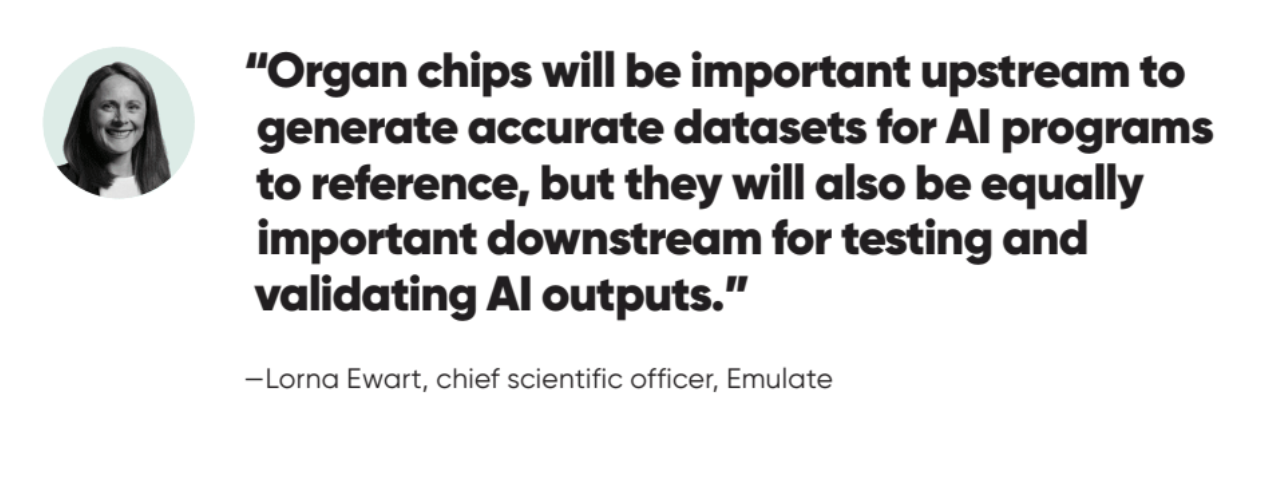
While organ chips are in vitro technology (live cells in a dish), they will also play a key role in silico (on a computer), says chief scientific officer Lorna Ewart. “Organ chips will be important upstream to generate accurate datasets for AI programs to reference, but they will also be equally important downstream for testing and validating AI outputs.”
AI is the next frontier in drug development, where flesh meets machine. Vivodyne, founded in 2020 by University of Pennsylvania bioengineers, uses robots, machine learning, human cells and organoids – miniature, lab-grown versions of organs – to generate massive amounts of biological data. The company describes itself as “rendering inaccurate animal testing obsolete.” Vivodyne recently announced what it calls “the world’s largest human biological datacenter,” an automated facility with 12 robotic labs that will perform experiments on more than three million human tissue samples per year, in a “self-driving experimentation loop.” Eight of the world’s largest pharmaceutical companies have paid for early access to the platform, Vivodyne has said.
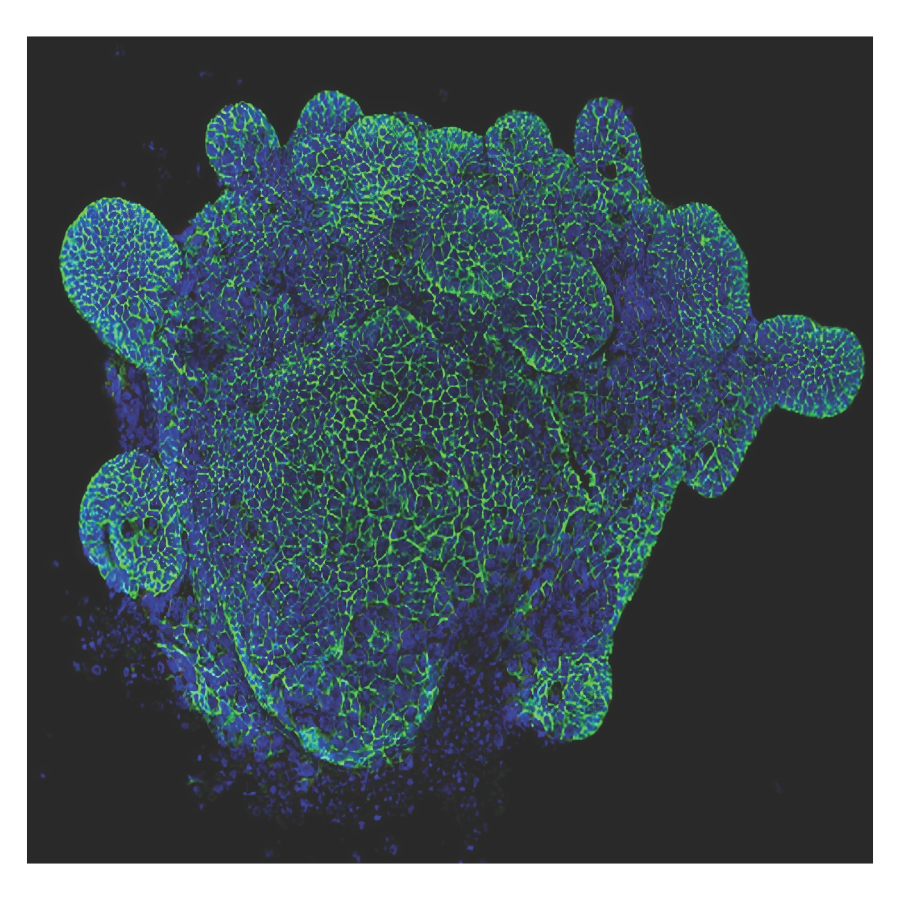
But not everything needs to be grown in a lab. In the case of the body’s largest organ, a French scientist saw an opportunity to use an abundant, largely untapped supply and work ex vivo (whole tissue outside the body). In 2006, Pascal Descargues was working on a genetic disorder that affects the immune system and causes red, scaly skin in babies. When translating findings to mice, progress halted because of differences between mouse and human skin. The solution, he has written, was obvious and simple.
Putting an upcycling twist on non-animal methods, Descargues developed a method for preserving human skin and founded Genoskin, which collects donated tissue left over from tummy tucks and facelifts and preserves it for research use. The available donor supply, he says, is enough to cover 10 football fields every year. “Today there is not one single tissue or 3D tissue or organoid we can produce massively like that.”
The models – thumb-sized cylinders of biostabilized skin – can be used to test things like vaccines, drugs, cosmetics and medical devices, and with greater efficiency, Descargues notes. One donor can yield 50 to 100 skin biopsies, whereas a lab would use one mouse for one condition.
Recently, the company has explored testing complex therapeutics like antibodies, an application useful in cancer or inflammatory disease research. Reproducing this test in vitro, Descargues says, is not doable. But the tissue isn’t perfect. Genoskin’s models come with a 10-day shelf life, something the company wants to increase to months, or even years, to work on longer-term biological responses.
The company runs facilities in Toulouse, France, and Salem, Massachusetts. The latter processes about a dozen donor samples per week, yielding 4,000 to 5,000 skin models per year. Descargues is not concerned about diminishing supply, either, for instance if obesity rates fall. “If it’s by drugs like GLP-1s,” he says, “it’s very good for us.” The potential impact on animals is also not lost on the public. People with scheduled tummy tucks write to the company wishing to donate their skin to spare animals from laboratories.
Will this time be different?
The promise of NAMs is that new, improved (and more humane) methods replace old ones. As Troy Seidle, former global head of animal-free science at Humane World for Animals, puts it, “the science will simply supersede in the way that planes, trains and automobiles have superseded the horse and buggy.”
But when?
In biomedical research, it’s a story that’s at least more than 40 years old. A 1983 Discover magazine cover story profiled early software designed to predict the toxicity of new chemical compounds by using pattern recognition. The transition away from animal testing was given a sense of urgency at the time: the article quotes a biophysicist warning that “buying and maintaining laboratory animals is quickly becoming a luxury many schools and research centers can’t afford.”
Did it come to pass? The figures reported at the time were more than 60 million animals used in the United States annually for experimental purposes. Recent figures suggest a reduction, but the lack of comprehensive statistics make progress difficult to measure. Global figures are even harder to collect, but the most comprehensive estimate available puts the number of animals undergoing scientific procedures at about 80 million a year, based on 2015 data (a 39% increase from an estimate based on 2005 data).
Even if 1980s computer software could have saved the animals, regulators have to be onside. The Discover article concluded with a prediction that the Food and Drug Administration would likely never lift its animal testing requirement. But in 2022, the impossible happened: Congress passed a bill explicitly authorizing the use of certain non-animal tests in drug development. Other U.S. federal agencies have recently made bold policy moves toward phasing out animal testing, as have regulators in Canada, the United Kingdom and the European Union.
But a more open regulatory environment doesn’t mean NAMs will replace animals overnight. It begins a validation and qualification process. Most agree that NAMs are baked into the future, but few will wager on a timeline. Are the replacements ready?
Ewart says the current era of NAMs is about the “co-existence of models” rather than universal replacement, noting that “whole-body integration,” simulating the body’s complex and interconnecting processes, remains difficult. Descargues says that replacing all animal studies on the FDA’s timeline of three to five years “to make animal studies the exception” is not realistic, but he notes that the regulatory change has shifted the conversation. “It’s not like animal studies are forbidden . . . but it opens a kind of competition.” According to Descargues, Genoskin has seen a 10-fold increase in revenue since the 2022 FDA legislation.
In addition to the scientific steps to NAM-validation, regulators have identified the importance of culture change, something Seidle says remains a hindrance. Even when a new method is validated, there’s still a “base, emotional fear response, that we’ve always done it this way, and not on my watch are we going to fundamentally upend the old paradigm.” The high bar for NAM-validation itself is flawed, he says. “It’s not a level playing field . . . we’re trying to validate [NAMs] against something that’s never gone through any kind of validation process, ever. It’s bananas.”
Skin in the game
A study of drug development failure estimates the average cost of developing a new drug at $1 to $2 billion and 10 to 15 years. The biotech firms that succeed in slashing the cost and time (and therefore risk) in getting drugs to market will become invaluable to pharmaceutical companies and constitute a growth market. A September 2026 Market Glass report of the global non-animal alternative testing market projects a 12.8% compound annual growth rate from 2024 to 2030, reaching US$4.5 billion.
In addition to funding pledges by regulators, recent fundraises for biotech firms may indicate investor confidence that animal testing is going the way of the dodo. In 2025, after 14 years of operating on revenue and science grants, Genoskin raised $8.7 million in Series A financing, led by the Toulouse-based and sustainability-focused portfolio management company OCCTE. The financing is being used to expand production sites and start producing human mast cells, which are involved in allergic and inflammatory reactions, on top of Genoskin’s existing repertoire.
In 2021, Emulate raised $82 million in Series E financing, led by Northpond Ventures, bringing its to-date total to nearly $225 million. Among Emulate’s scale-up plans is an extension into Asia-Pacific markets and the development of new capabilities for modelling immunology, brain and spinal cord inflammation, and tumours. Ewart says two factors have converged to stimulate investor interest in NAMs: global regulatory alignment and technological readiness.
Vivodyne’s San Francisco robotics lab was supported by a $40-million Series A fundraise, led by California VC firm Khosla Ventures. This followed a previous seed round of nearly the same amount. Khosla’s founder, in an essay weighing dystopian and utopian visions of AI, admits to likely job losses but argues an upside: AI will make “all expertise near free, most labor very cheap through bipedal and other robots, materials, from metals to drugs, much cheaper through better science discovery and resource discovery and much more.”
There’s a trade-off here. If the lab of the future looks like a dystopia, with its robots (instead of rodents), chips (instead of chimpanzees) and maybe, one day, bodyoids, to the animal looking back at empty cages, it’s utopia. To get there, Seidle says, and “do away with a vast amount of animal testing, you just need to flip the table and say, ‘New game.’”
Christopher St. Prince is a Canadian journalist and fiction writer.
The Weekly Roundup
Get all our stories in one place, every Wednesday at noon EST.