When the International Energy Agency (IEA) released its influential World Energy Outlook 2025 last November, it was clear that progress on the energy transition had slipped. None of the scenarios presented in the report kept global warming within the 1.5°C range by 2050 as per the 2015 Paris Agreement, and peak oil and gas had shifted farther into the future.
What a difference a year makes. Since the release of the IEA’s energy outlook, the electrification of road transportation – cars, bikes and motor bikes – has accelerated; solar power generated more electricity on the European Union grid than any other type of energy. Renewables now contribute more to global energy-supply growth than oil, gas or coal individually. Countries are finally pivoting away from fossil-fuel dependence with a heightened sense of urgency. The transition is most pronounced in China, which, in 2024, saw its annual demand for oil decline for the first time in 20 years; peak oil demand in China is expected to arrive before 2030.
Despite the uptick in the pace of the transition away from fossil power, the world is on track to add an unprecedented 300 billion cubic metres of liquefied natural gas (LNG) export capacity by 2030, representing a 50% increase in global supply. That will add more than 560 million metric tons of carbon dioxide equivalent to the atmosphere every year, which is equivalent to driving more than 130 million gas-powered cars, according to the U.S. Environmental Protection Agency’s Greenhouse Gas Equivalencies Calculator.
The looming LNG glut has broader economic implications, too. As Canada doubles down on pipelines and boosting production to deliver more oil and LNG onto an increasingly crowded export market, a larger question emerges: Does this strategy reflect the changing realities of both electrified energy and fossil-fuel markets?
 Demand is cooling
Demand growth for fossil fuels has already started to decelerate. At the global level, the rate of increased energy consumption in general slowed to 1.3% in 2025, just below the average for the previous decade. And of that increase, a mix of low-emission sources – solar, wind, nuclear, hydropower and other renewables – contributed nearly 60%. The share of solar photovoltaic and wind supplied 30% of the EU grid in 2025, surpassing that of fossil fuels for the first time.
Road transport is expected to drive the largest decline in future oil use. Already, this sector displaced 3.2 million barrels a day of road fuel in 2025, thanks to the combined impact of electrification and greater fuel efficiency.
According to the IEA’s “stated policies scenario” (STEPS), global demand for both coal and oil peaks around 2030, while demand for gas crests by 2035. (The STEPS modelling incorporates current climate policies as well as policies that have been formally put forward but not yet adopted.) Yet even with gas demand growing into the 2030s, the scenario shows that additional LNG production will flood the market, resulting in a 65-billion-cubic-metre surplus.
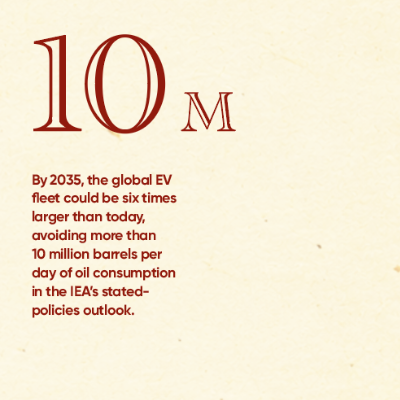
STEPS also posits that the global electric vehicle fleet could grow sixfold by 2035, thus avoiding more than 10 million barrels per day in oil consumption. Until recently, China was a voracious consumer of fossil fuels. Between 2005 and 2024, the country held the title of the world’s largest crude importer, accounting for more than half of the increase in oil demand worldwide. Yet China’s transport oil use plateaued in 2021. By 2024, EV adoption in China reduced gasoline consumption by as much as 12% relative to consumption prior to EV market penetration, which represents approximately 67.5 million tons of avoided carbon dioxide emissions – roughly 0.6% of China’s total emissions in 2023.

A 2026 report by economists at TD Bank forecasts total oil use in Asia to flatten over time, driven by rapid EV adoption and a gradual shift toward cleaner energy. For global oil markets, this receding demand signals a weakening of what had been one of the main sources of fossil-fuel growth for the past 20 years.
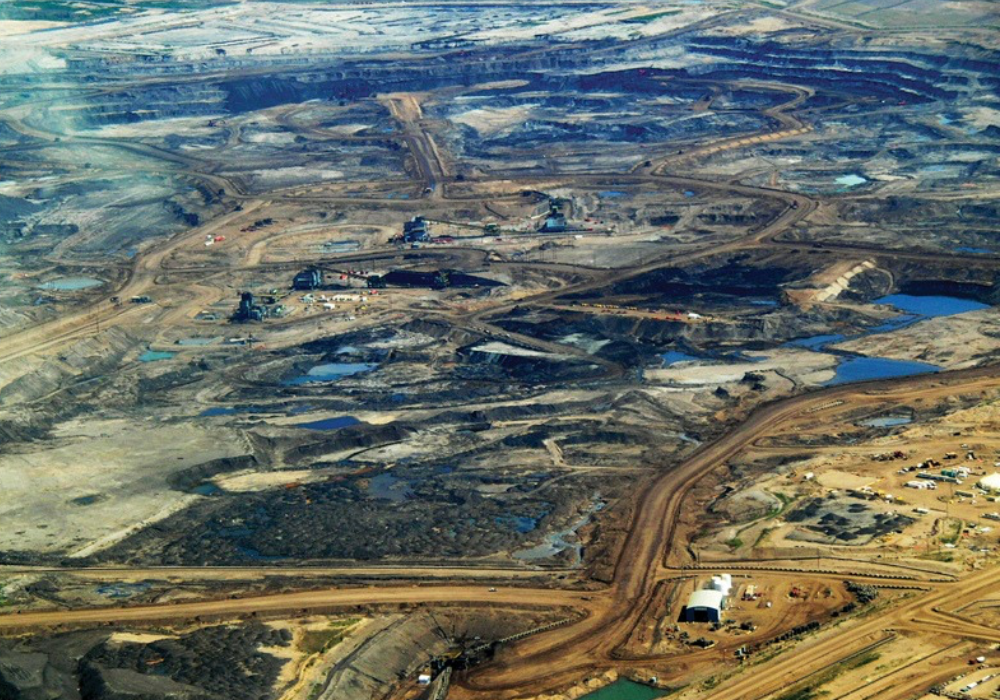
That matters for Alberta. The province’s oil-sands output is largely heavy crude, which can be processed only by specialized refineries. While global oil consumption may persist through petrochemicals and hard-to-electrify uses, the market for refined products such as gasoline and diesel is expected to shrink just as Canada plans to pump out more crude.
The domestic market mirrors the global. Canada will likely see substantial growth in electricity demand over the next two decades as a result of economy-wide electrification, according to the 2026 outlook published by the federal energy regulator. Its use of hydrocarbons, however, will remain relatively stable.
 Output is set to increase
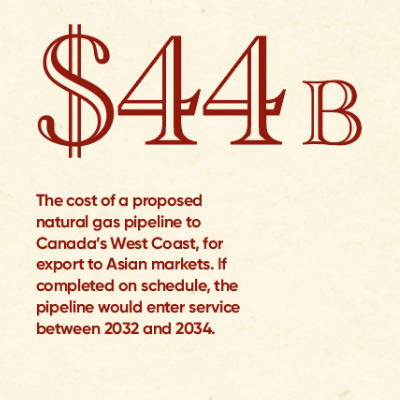
Even conservative scenarios depicting the pace of the energy transition have prompted some analysts to question the proposed Pacific Link pipeline. The 1,200- to 1,250-kilometre pipeline, now declared a project of national interest, is intended to carry up to one million barrels of crude a day from Alberta’s Western Canada Sedimentary Basin, northeast of Edmonton, to the Roberts Bank Terminal along British Columbia’s coast, just south of Vancouver.
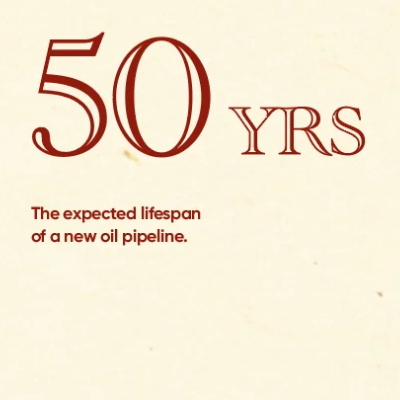
If built on the proposed timetable, the line would enter service between 2032 and 2034 and could operate for four or five decades. Its business case therefore rests on sustained demand for Canadian heavy crude well into the middle of the century. In the nearer term, Alberta Premier Danielle Smith has argued that it would help the province achieve its goal to double oil production and “strengthen access to growing Asian markets.”
But shifting demand in Asia makes that calculation a gamble. In a recent report put out by the Institute for Energy Economics and Financial Analysis (IEEFA), energy finance analyst Mark Kalegha and consultant Will Scargill argue that with China electrifying “significantly faster” than the rest of the world, oil-demand growth will likely plateau within a few years, followed by a decline.
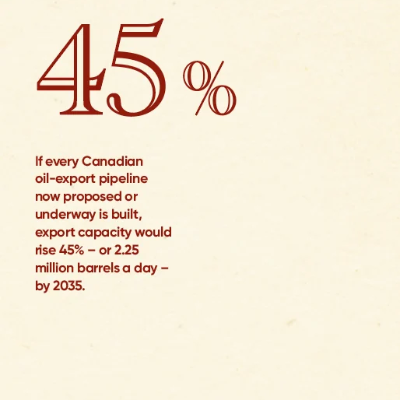
At least six different pipeline projects to move oil from Canada to the United States or export markets from the Pacific coast are under way or at the proposal stage. Should all projects be built, Canadian export pipeline capacity would increase by 45%, or 2.25 million barrels per day, by 2035, according to a Reuters calculation.
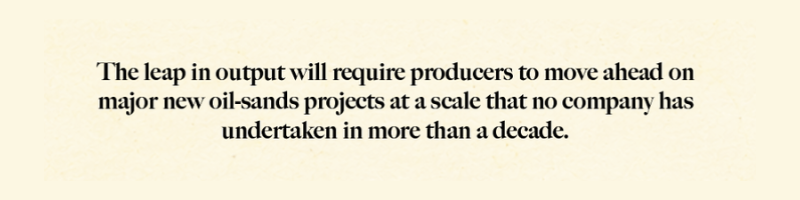
Maximizing that capacity would require oil supply to increase by more than a third by 2034, a near-doubling of its current annual average growth rate. The leap in output will require producers to move ahead on major new oil-sands projects at a scale that no company has undertaken in more than a decade.
“If we look at all the capacity project expansions that have been announced,” Kalegha says, “even under a higher demand scenario, which we think is not probable, there is enough brownfield expansion capacity [in Canada] to transport all [oil] production.”
Kalegha acknowledges the argument that Canada must diversify “at any cost” as the nation faces down a belligerent and increasingly protectionist trading partner in the United States. Even so, the authors of the IEEFA report counter, the price tag attached to the Pacific Link – up to $44 billion – may be too high. Oil producers pay the pipeline owner a fee for every barrel shipped. If those tolls exceed the higher prices producers can earn by reaching new overseas buyers, the project would leave them worse off.
 The push for pipelines
“Do we need more pipeline? Yes,” says Kevin Birn, chief analyst for Canadian oil markets at S&P Global. Canada needs spare capacity, he contends. “Western Canada will produce over five million barrels a day this year, and that is a staggering amount of oil. There are a multitude of pipelines that transport that oil to market, and when you have a system as large and complex as this, you introduce fragility. Any disruption in that system . . . can cause the system to back up.”
Birn co-authored Here We Are Again: Canada Needs More Pipeline Capacity with Celina Hwang, S&P Global’s director of crude oil markets. By as early as this winter, Birn and Hwang argue, supply could materially overtake export pipeline capacity if existing pipeline systems are not expanded. “What the world’s going to be looking for in 2035, 2040,” Birn says, “is replacing existing oil production with something from somewhere else, and those are the opportunities Canada is chasing.”
S&P Global Energy estimated that Western Canada had on average 4.6 million barrels of crude available for export per day. Nearly all of it flowed into the United States. But as that market becomes increasingly saturated with Canadian oil, producers are looking to Asia – especially China, which has the most specialized capacity to refine the heavy crude that Canada exports. S&P predicts that by 2030, Western Canadian export supply could exceed 5.2 million barrels per day, an increase of 650,000 barrels per day from current levels.
 In their report, Birn and Hwang concede that there is enough oil-storage capacity in Canada to cushion the impact if current pipeline space becomes insufficient. Producers could store excess barrels rather than sell them at a deeper discount. But storage is only a temporary fix, they say: the larger and more persistent the surplus, the faster tanks fill up. Once they do, the discount on Canadian crude could widen, reducing the prices producers receive.
Yet despite demands for more export capacity and strong government backing, proponents from the private sector were conspicuously absent in the months leading up to the pipeline submission – even though the prime minister has insisted that a private investor was part of the deal. The November 2025 federal–Alberta memorandum of understanding also outlined private-sector participation.
Instead, the development is being led by the federally owned Trans Mountain Corporation in partnership with the Alberta government’s Petroleum Marketing Commission; Calgary-based Pembina Pipeline holds a non-binding 10% stake.
Birn chalks up the private sector’s tepid response to the pipeline proposal to “bad memories.”
“I think private capital is skittish on Canada and its regulatory process,” he adds. “It wants to see certainty. At this point, it’s almost like governments have to prove the point by putting public capital at risk.”
 Public capital at risk
For some, the combination of credible scenarios of stalling fossil-fuel demand with a capital-intensive undertaking of significant size and complexity make the West Coast pipeline a less than compelling investment. Analysts at the Pembina Institute, a Calgary-based clean-energy think tank, argue that investor hesitancy is a logical response to market forces signalling “uncertainty around future demand, prices and the economics of long-term oil infrastructure,” adding that if private-sector players with expertise in the oil and gas industry consider the pipeline too risky to finance, that risk should not be shifted to taxpayers instead.
The energy shock brought on by the war in Iran and the closing of the Strait of Hormuz – cutting off nearly 20% of the world’s oil and gas supply – jolted global economies that relied on a steady supply of energy from the Middle East. The reaction has not merely been a rush to diversify sourcing options. Energy security came to be seen as an economic and strategic vulnerability, quickening the need to reduce dependency as much as possible.
As U.K. think tank Ember notes, the energy landscape is shifting. It is moving from a commodity-based system of extraction to a manufacturing one: solar panels, electric motors, batteries, all built on the production line. At the forefront of the energy revolution is Asia, where electrification rates are higher than in Europe or the United States and which is poised to lead the transition to a new, clean-energy economy.
Looking ahead at the next few decades of rapid change to the earth’s climate, Canada must choose where to place scarce capital in an energy system defined by rising electricity demand, increasing dominance by renewables and more competitive fossil-fuel markets. Right now is when oil and gas proponents have the best chance of justifying long-lived export infrastructure. It’s going to become a lot harder.
Victoria Foote is a writer and editor who specializes in clean energy and climate.
The Weekly Roundup
Get all our stories in one place, every Wednesday at noon EST.