Across the road from the Toronto Zoo, in a low, nondescript industrial building most visitors never see, elephant dung and unsold grocery-store produce are turning into electricity.
The facility belongs to ZooShare Biogas Co-Operative, and it exists because the Toronto Zoo, which owns the land ZooShare leases, wanted to stop sending animal and food waste to landfill. What ZooShare’s founders didn’t have, when the co-op formed in 2011, were the funds to build a plant. So, ZooShare turned to its neighbours.
Beginning in 2013, ZooShare sold community bonds – a debt instrument, similar to a conventional bond, that lets ordinary residents lend money to a local project and get repaid with interest over a set term. Still a fairly novel investment vehicle at the time, community bonds allowed the cooperative to borrow directly from the public instead of working with a traditional financial institution.
About 300 people backed the first $2.2-million raise. Two more rounds followed, and total bond financing eventually topped $4 million.
“Most of our membership are less concerned about the financial return,” says Rob Grand, ZooShare’s general manager. “The most important thing to our members is supporting their values through their investments.”
ZooShare is one of Canada’s best-known examples of a broader pattern of community financing for local energy systems. These small-scale pieces of distributed infrastructure like biogas plants and microgrids are often too small or unfamiliar for conventional lenders, which is exactly where tools like community bonds come in.
The challenge
Canada has committed to cutting emissions 40% to 45% below 2005 levels by 2030. One of the major culprits is organic waste. Municipal landfills generate about 23% of Canada’s methane emissions, and methane traps about 86 times more heat than carbon dioxide over 20 years. The federal government’s target is a 50% cut in landfill methane by 2030, a goal it cannot meet by capturing gas at existing dumps alone. This is where small, local infrastructure like ZooShare’s anaerobic digesters will play a role.
The opportunity
Community bonds draw on investors who care about local impact as much as return. Grand frames the model as a deliberate departure from how utilities typically work: “It’s less about extracting as much wealth from a commodity and more about how the community [can] work together to make energy equitable and democratic.”
Ownership matters, too. ZooShare has about 800 members who each get one vote and help elect the board, Grand says. Membership costs only $10, with no requirement to buy a bond. So far, every ZooShare bond offering has sold out, and the co-op built up a waiting list that Grand puts at north of 150 people. Transparency adds to the appeal. ZooShare shares quarterly performance updates with its members, holds an open annual meeting, and has a staffer who fields member questions year-round because, as Grand puts it, members are “not just financially invested, but also, I would say, emotionally invested in what the plant is doing.”
Basma Majerbi, an associate professor of finance at the University of Victoria, says community bonds are not just a source of capital but “can be looked at as an economic development strategy as well.” Majerbi, who also leads business and finance research for the university’s Accelerating Community Energy Transformation initiative, says community bonds don’t confer ownership the way a co-op share does. But this type of financing still lets people buy into a local project.
Community financing also tends to arrive exactly when it’s most needed, Majerbi adds – before a project has the revenue certainty a bank wants to see. “It fills a gap in the current financial system,” she says, “either because a project doesn’t have the right scale to warrant financing from a bank or it could be deemed too early, or a bit risky.”
The momentum
ZooShare’s plant came online in April 2021 after about two years of construction. It now converts about 15,000 tonnes of food waste and zoo manure every year into biogas burned for electricity, producing enough power for the equivalent of about 250 average Toronto homes. The leftover fertilizer, certified by the Canadian Food Inspection Agency, goes to farmers in the nearby Rouge Valley.
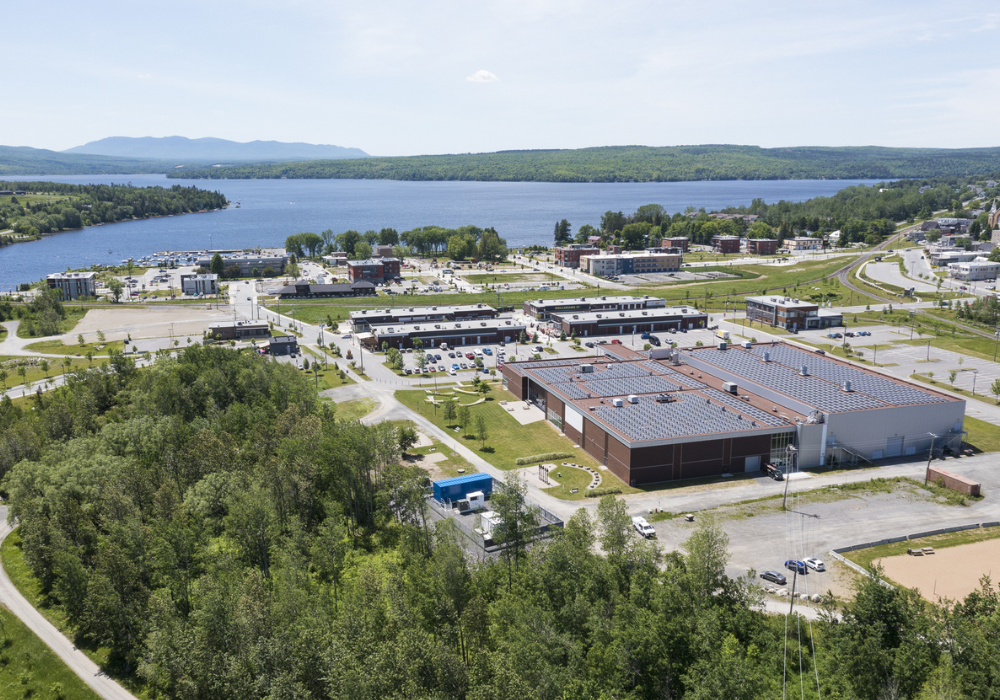
Across Canada, local energy systems like ZooShare’s biogas plant have found other avenues for community ownership, such as federal grants and utility partnerships rather than retail bonds. In northwestern Ontario, Kiashke Zaaging Anishinaabek spent years cut off from the provincial grid and dependent on diesel. In 2019, working with Ontario Power Generation, the community switched on a solar-and-battery microgrid it owns outright, expected to offset about 130,000 litres of diesel a year. In Quebec, the rebuilt downtown of Lac-Mégantic – devastated by a runaway oil train explosion in 2013 – now runs partly on a Hydro-Québec microgrid capable of “islanding,” or disconnecting entirely from the main grid to serve about 30 buildings on its own solar and battery power; Hydro-Québec is studying whether this model could serve other remote communities still burning diesel. And in June 2026, Ottawa committed $21.6 million to Sayisi Dene First Nation at Tadoule Lake, Manitoba, to build the province’s first integrated renewable microgrid, expected to cut about 500 tonnes of carbon dioxide every year once it comes online this fall.
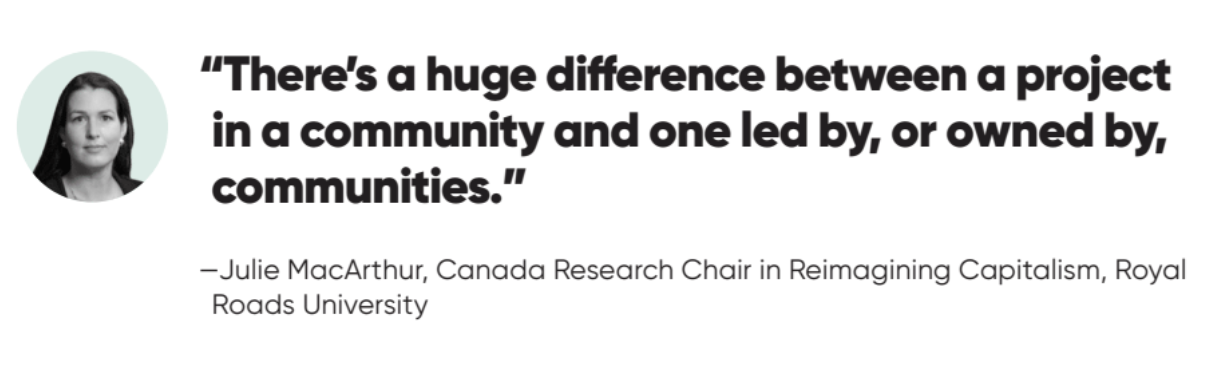
That pattern isn’t a coincidence, says Julie MacArthur, Canada Research Chair in Reimagining Capitalism at Royal Roads University and author of a history of Canadian energy co-ops. “Almost all the operating community microgrids that are owned, at least majority equity share, in Canada are Indigenous-led, rather than community-owned in the form of, let’s say, a cooperative,” MacArthur says. She cautions against taking every project labelled “community” at face value, noting that some are actually backed by a benefits agreement with a private developer, rather than actually owned and governed by the people living there. “There’s a huge difference between a project in a community and one led by, or owned by, communities.”
Next steps
Majerbi has spent the past year figuring out what’s stopping Canada from having hundreds of local energy systems, and her research suggests the biggest obstacle isn’t a shortage of capital so much as a shortage of information. Community groups, she’s found, tend to default to grants and stop looking. “There is a big information gap and knowledge gap about what exists,” she says. “A lot of organizations, especially community-based, often think about grants. They don’t necessarily think about the range of capital sources that may be available to them.” That gap led Majerbi to build the Community Energy Finance Navigator, a pilot database launched in May 2026 through UVic’s Impact Investing Hub that tracks how real community energy projects across the country have been financed, owned and structured. “It really solves an information problem,” she says. The pilot currently covers 86 projects, built from an extensive survey and cross-checked with the project teams themselves.
While the project is still in its early stages, Majerbi has already identified a key trend: almost no project relies on a single source of money. “Pretty much every project is a stack of different sources of capital,” she says – grants layered with loans, community bonds, co-op equity and private partnerships, sometimes with a loan guarantee or other incentive that unlocks the rest. But Canadian groups still have a lot of learning to do, she argues: “People create their own capital stack, but it’s not done in a very strategic way.” Majerbi is preparing to launch a national initiative aimed at scaling blended finance in Canada, with community energy as a major focus.
Her advice to a community just starting out echoes that same lesson: don’t treat financing as an afterthought. “I would put more strategic thinking around the financing from the very beginning rather than a last question after we define project parameters.”
Srivindhya Kolluru is a Toronto-based journalist covering business and personal finance.
The Weekly Roundup
Get all our stories in one place, every Wednesday at noon EST.