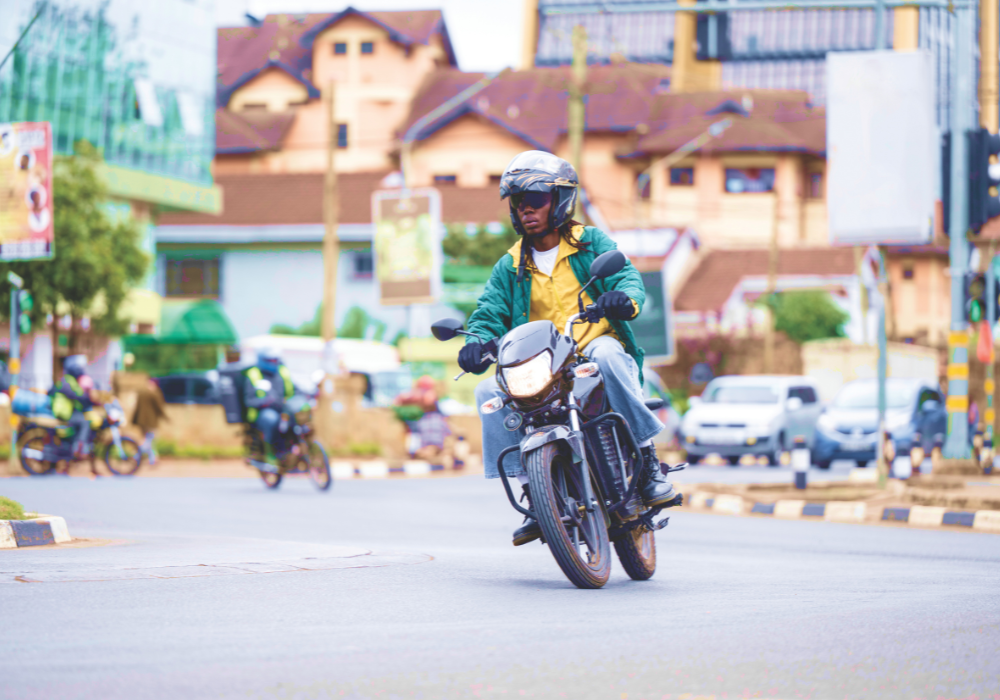
As the sun rises over the great Kilimanjaro, Thomas Kalasinga kick-starts his motorcycle – popularly known as a boda boda – outside his home in Njoro on the Kenyan border with Tanzania.
Kalasinga is a boda boda driver who earns a living by ferrying people and goods. Before he carries his first passenger, the 25-year-old stops at a gas station and pours $4.64 worth of fuel into his tank (all figures in U.S. dollars unless otherwise noted), money he earned the previous day. “On a bad day I spend up to 1,000 shillings [$7.70] on fuel, and with the current surging fuel prices, things are getting worse,” he says.
In April 2026, petrol and diesel prices in Kenya jumped sharply, hitting some of the highest levels in the country’s history. Based on recent reports from the Energy and Petroleum Regulatory Authority (EPRA), a Kenyan government agency, petrol was selling for between $1.52 and $1.59 per litre, and diesel was about the same. EPRA attributed the increase in local pump prices to the rising cost of imported petroleum products as a result of the Iran war. Kenya’s Ministry of Energy has since trimmed taxes, enabling prices to dip by a few cents. But this reduction has done little to improve the economic picture for many boda boda riders. “Things are usually bad, but even with the rising fuel prices, we cannot hike the fares we charge because we will lose clients,” Kalasinga explains.
Kalasinga’s story is echoed by hundreds of thousands of motorcycle riders across Kenya. Motorcycles have become the backbone of last-mile transport, supporting livelihoods, small businesses and urban mobility. But behind this economic engine lies a costly dependence on fossil fuels that is squeezing incomes and, in the process, locking riders into a cycle of poverty.
Kenyan boda boda riders spend up to 60% of their daily earnings on fuel, according to research by the asset-financing company Mogo. In Nairobi, where congestion forces riders to idle in traffic, fuel consumption is even higher.
“Fuel is our biggest enemy,” Kalasinga says. “You work the whole day, but at the end what remains is very little.”
The electric advantage
To improve their margins, boda boda drivers are turning to electrified transportation. The past few years have seen an increase in the number of electric motorcycles, especially among those providing taxi services. Data from Kenya’s transport sector show that total EV registrations rose from 65 in 2018 to 4,047 in 2023 across vehicle categories, including motorcycles.
Electric boda bodas have a clear advantage for drivers – lower fuel costs – while offering wider social benefits in the form of increased energy security and lowered pollution. In Nairobi, road transport is responsible for about 40% of fine particulate matter, which has been linked to respiratory illness, heart disease and premature deaths.
“[Electric vehicles] present environmental benefits because they produce zero tailpipe emissions and align with Kenya’s largely renewable electricity mix, which is over 90% green, driven by geothermal, hydro and wind,” explains Paul Mabonga, managing director of Sentimental Energy Ltd., a solar solutions company.
Drivers have doubts
But barriers have slowed the uptake of electric motorcycles. The high cost of batteries combined with lack of accessible and affordable charging infrastructure have prompted some riders to question the product. “There have been concerns about battery range, durability and service continuity affecting adoption, especially for those whose livelihoods rely on consistent daily uptime,” explains Winnie Miranyi, operations and research associate at Africa E-Mobility Alliance, an organization focused on accelerating the transition to electric and sustainable transport across Africa.
“Interest is there, but infrastructure is not,” says Joseph Mwangi, a Nairobi-based boda boda rider who last year abandoned his electric motorcycle and returned to a petrol-powered one. “Riders ask: Where will I charge? How long will it take? What happens if the battery fails?”
These are valid concerns. “Today, lack of accessible and affordable charging infrastructure is a major barrier to electric motorcycle adoption among boda boda riders in Kenya,” Mabonga says. “Most EV solutions target middle- and high-income consumers, leaving boda boda riders, who form the largest transport workforce, locked out.”
The rise of battery swapping
Spiro Kenya, an electric mobility company, believes it has a fix for poor charging infrastructure: battery swapping. Spiro offers a service where riders visit swap stations and exchange their batteries, keeping them on the road continuously. “Rather than waiting hours to charge, riders simply exchange a depleted battery for a fully charged one in under two minutes,” explains Raymond Robert Kitunga, deputy country head at Spiro Kenya.
According to Kitunga, a full charge costs approximately $2.23 if the battery is completely depleted. “If a rider swaps at 50%, they only pay half, about [$1.12],” he adds. Spiro’s battery-swapping service can save a rider roughly $23 compared to petrol over the course of a month, Kitunga says.
The model appears to be taking root. Currently, Spiro operates in 35 counties in Kenya, with more than 22,000 electric motorbikes on the road and more than 460 battery swap stations nationwide. Across Africa, the company has roughly 95,000 bikes.
Joel Musungu, a boda boda rider from Kimilili constituency, in the western part of Kenya, uses the service. He got his motorcycle in 2022 and hasn’t regretted it. “Now, I take home up to [$4.62] a day, compared to initially where I could only make a fraction of that.”
Not a panacea
There are certainly advantages, but there are also challenges. According to Miranyi with Africa E-Mobility Alliance, infrastructure availability and reliability continue to be a major barrier. The swap stations and charging points are largely confined to urban areas, she says. In Kimilili, a rural town, there is a single swapping station, for example. That can make for long queues, especially during blackouts or if the electrical grid is sluggish, Musungu explains.
It is a genuine challenge, Kitunga admits. The company has concentrated its infrastructure in urban areas, where the demand is highest. “Setting up a swapping station is capital-intensive. It involves both civil works [real estate] and electrical infrastructure, including coordination with partners like Kenya Power,” he explains. Spiro has also tried to address range anxiety through an app that shows users the availability and traffic of swap stations in real time. But the biggest challenges continue to be financing and affordability, according to Miranyi. “Although battery-swapping models help lower battery expenses, many riders still encounter difficulties in securing credit for the motorcycle itself, with prices remaining prohibitively high.”
Pauline Ongaji is an award-winning science journalist based in Nairobi, Kenya.
This story was jointly produced by Corporate Knights and The Energy Mix.
The Weekly Roundup
Get all our stories in one place, every Wednesday at noon EST.