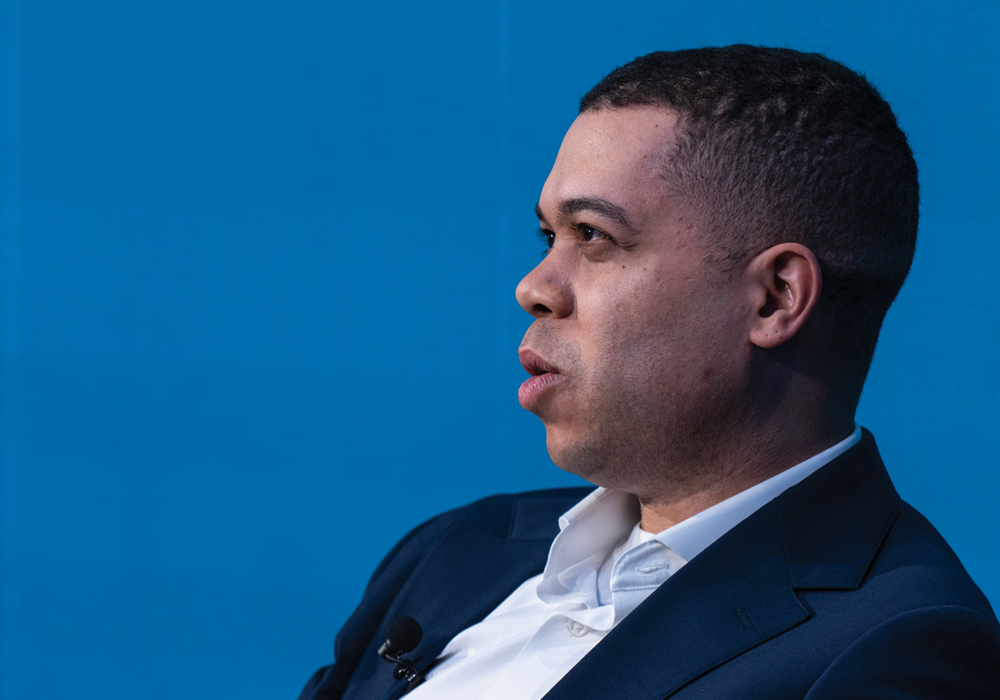
People know that protests need to be transformed, Iowa-based activist Micah Bornfree says – but activist movements still haven’t broken out of their old patterns. Bornfree (formerly Micah White) is one of the founders of Occupy Wall Street and the author of The End of Protest (2016), billed as “a new playbook for revolution.” To help find the path forward, he created Outcry, an artificial intelligence mentorship app for activists. We caught up with him to find out his thoughts on why protest movements fail, how activism can elicit joy, and what a privacy-based chatbot trained on conversations with activists might do to help.
Mark Mann: With Trump, the climate movement has seemed unable to provide much resistance. There’s a sense that the administration has run roughshod over the environmental movement. Is there a vacuum of power and influence in climate activism?
Micah Bornfree: It’s a good question. I mean, I think that what is going on specifically around the climate movement is we’re having a leadership transition. If you look at who was leading the climate movement in the last iteration – like 350.org and those types of organizations leading up to the Paris climate accords – that whole thing was a total failure. Because we’ve reached a point where it feels like the climate catastrophe already happened. The whole paradigm that we are working to prevent something that’s in the future [has] failed.
Now we’re trying to figure out, okay, the tipping point has already happened, what does activism for the climate mean? I don’t think we’ve had an organization or movement that’s stepped forward to provide an answer to that question, because a lot of the people who did the previous phase, have – rightly so, maybe – stepped back and realized that that didn’t work. It’s not a critique about them. Activism is largely failure, and we tried. That attempt was made, but the whole period basically from roughly the 1970s up until COVID, that period is now over. Something else has to emerge, so I think that’s where we’re at. But obviously something will emerge.
MM: Often the move that I hear is “Don’t worry, because now the energy transition is unfolding at speed, and nobody can stop it.” What do you think of that?
MB: That’s interesting. I don’t know exactly how I feel about it. I did notice that there was that moment where the UN climate panel got rid of their worst projection for the climate. Part of the argument is that, yeah, some changes have been made, and maybe that forestalls the worst possible situation. And then also we see now with the Iran war, ironically, and oil prices going up, and maybe the Strait of Hormuz will never return, so maybe we are already in this post-oil situation.
What is true is that we are in an unusual moment of historical transition, and it’s unclear what’s going to happen next. But I don’t think that it’s possible to sit back and trust that it’s all going to work out. I don’t think that that’s probably the best strategy, but I do think that we need a new leadership for the climate movement. Something fresh. What kind of movement do we need to build? I feel like it needs to be something that really tells a new story.
MM: Do you see that there’s a widespread strategic reckoning in protest movements and activist circles?
MB: That’s a hard question, because I want there to be one. When I first wrote my book in 2016, The End of Protest, I got an email from a prominent activist, and all it said was “Nooooo!!” There was a basic rejection of the argument that protests needed to change. I think now going forward, 10 years later, that argument is no longer even contested. I think a lot more people are, like, “Yeah, of course, let’s look at reality.” It’s so much more obvious, and it’s been absorbed. So I would say that people are more open and sympathetic to the idea that we do need to transform protests and how it needs to be done, but I don’t think that that means there’s an answer yet. So we still fall back on the old patterns.
MM: Some argue that the climate movement needs to fight harder, and some say we need to find things that are non-polarizing. What’s your sense of the “climate battle” framing? Is it useful, or is that one of the things that needs to change?
We want to give people the sensation of losing their fear, feeling suddenly optimistic that change is possible, and that we can achieve great things together.
MB: I’m more interested in the cat-and-mouse game of trying to create movements that are ostensibly non-political, and then eventually get politicized. Like, if you look at the early days of Occupy Wall Street, it’s hard to believe now in retrospect, but it really was non-political. You had left-wing and right-wing people there. You had End the Fed people, that was like a whole little sub-group, the libertarians with their signs. Rand Paul was there and Roseanne Barr. There’s a whole spectrum of people who just want change, right?
Obama oversaw the brutal dismantling of the Occupy movement, and then all the radical right elements went towards Trump, and all the radical left elements kind of floundered. I’m more interested in being, like, okay, let’s build something that’s non-political; they’re going to try to politicize it, but then let’s move on to the next thing. Personally, the fight frame doesn’t appeal to me, because it’s just tired. I feel tired already of the idea that I’m going to be fighting. Because it doesn’t feel exciting. I think the mood of Occupy was actually the opposite. It was like, oh, I’m losing my fear. That’s really what creates captivating movements. If you ask people, “Why did you go to the square?” They’d be, like, “Oh, I just walked by it, and I just felt alive, and I just kept coming back.” It’s beautiful. I think we want to give people in the sensation of losing their fear, feeling suddenly optimistic that change is possible, and that we can achieve great things together. And then knowing that they’re going to politicize it, because that’s how you defeat movements: “Are you sure you want to be marching with that person?”
MM: You’ve launched this AI mentor. AI is insanely controversial. Why do you believe in it?
MB: AI is many things. It’s like saying “computer” or “keyboard”; it can be used for many things. I started getting interested in AI about three years ago, shortly before ChatGPT came out. You had to apply to get beta access to the OpenAI platform, and I got in. Back then it was like a text generation [tool]; it wasn’t a chat interface. I saw the potential immediately, and then ChatGPT came out, and of course it has exploded, and everyone’s now using it, and it’s amazing. I think there are many things that AI can be.
Outcry is a local AI that runs on your device and it works without internet. It doesn’t use data centres. Of course, it comes with less intelligence because it’s running on your device, but it’s completely private. It’s trained on real activist conversations. So, we have a web version that does use data centres, [and] we use the output of those chats to train a local version that runs directly on your phone.
MM: Are people using it?
MB: Yeah! I mean, for the app version we’ve turned off all analytics; all I can see is downloads. But yeah, a few hundred people have downloaded it so far. I think that it will grow as it gets better. The reason why AI is so adopted is because it gives people something they need, so the minute Outcry starts giving people something they need, it will grow.
The first iteration is a chat interface, but what I think is ultimately the future is a coordination platform. Imagine an AI in your pocket [when you’re] in the midst of a protest or a movement or assembly of some kind, and it’s telling you about the next steps that can be made. But it’s talking to everyone individually. I think there’s just so much potential to it, and I know that activists are down on it, but yeah, as a technology, I think it’s fantastic.
Mark Mann is the managing editor of Corporate Knights.
The Weekly Roundup
Get all our stories in one place, every Wednesday at noon EST.