For those disillusioned by the slow, gruelling grind of the COP climate negotiations, the emergence of a second parallel track of international talks to accelerate progress is bringing hope for action on one of the thorniest issues of the environmental struggle.
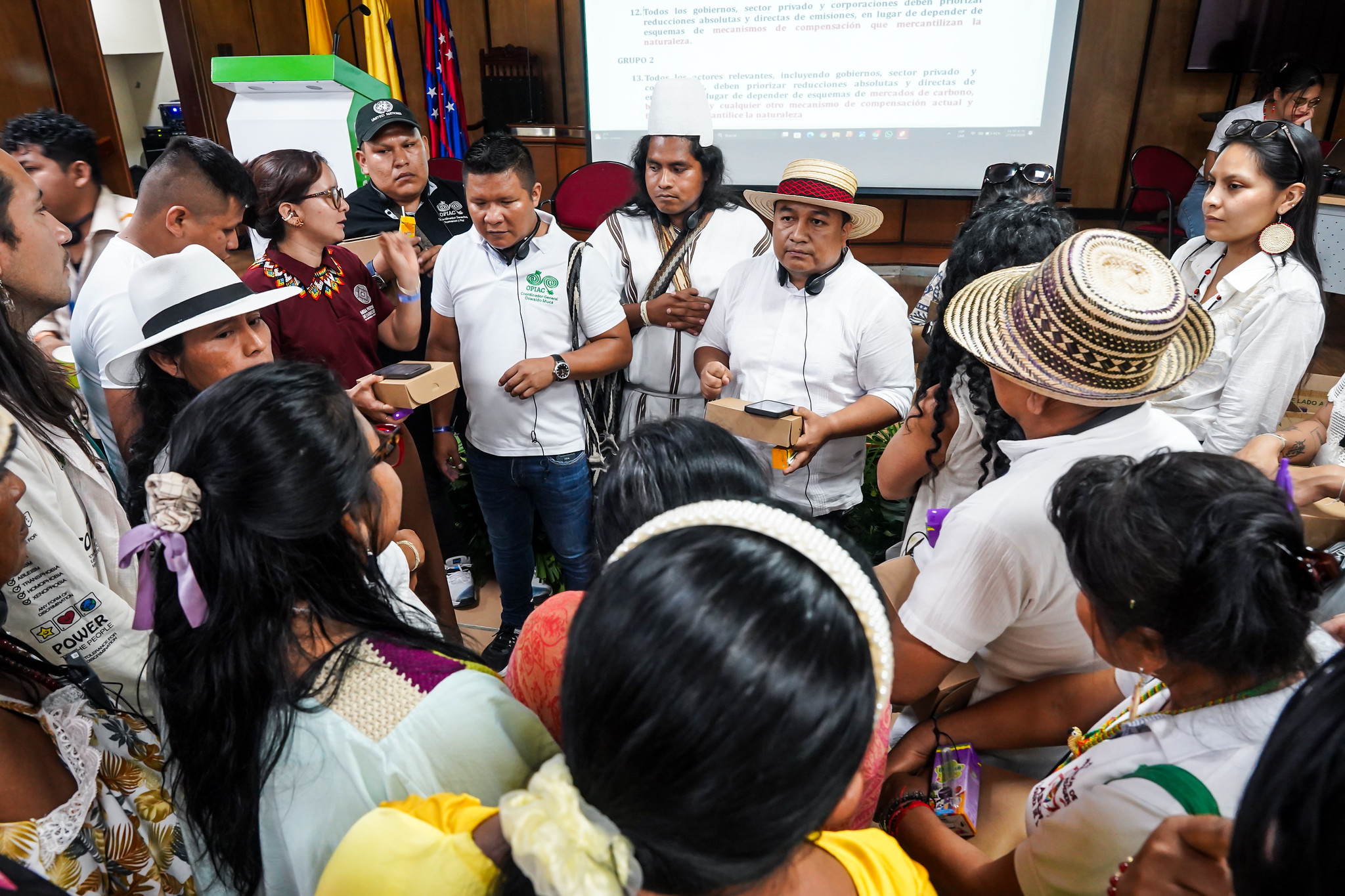
In April, 57 countries representing about one-third of global gross domestic product held the first-ever conference on Transitioning Away from Fossil Fuels (TAFF) in Santa Marta, the Colombian port city. Participants in the initiative, now dubbed the Santa Marta process, included subnational governments, nongovernmental organizations, scientists, trade unions, Indigenous Peoples and other groups. For many of them and other event observers, the meeting was historic.
“For three decades, global climate negotiations have focused on managing emissions while really ignoring the root cause: the unchecked proliferation of oil, coal and gas extraction,” says Tzeporah Berman, British Columbia–based founder and chair of the Fossil Fuel Treaty Initiative. “Santa Marta was the first time that countries were convening to have a conversation not just about whether fossil-fuel phaseout needed to happen, but how to do it.”
The conference, co-hosted by Colombia and the Netherlands, was convened as a “complementary space” to the annual United Nations Framework Convention on Climate Change (known colloquially as COP), not a replacement for it. The focus was not on negotiations or developing new targets, but rather on identifying practical steps to help countries transition away from fossil fuels, centring on three themes: reducing economic dependence on fossil fuels, transforming supply and demand, and advancing international cooperation and climate diplomacy.
Only the beginning
The decision to stage the Santa Marta conference was announced at the end of the COP30 conference in Belém, Brazil, last November, after a push to include a TAFF roadmap in the COP30 outcome text was derailed by oil-producing countries. To patch that rift, Brazil’s COP30 presidency promised to prepare a fossil-fuel transition road map to present at COP31 this fall in Turkey. That road map is expected to draw heavily on the findings and recommendations in the final Santa Marta conference report, which was released on June 23 at the Global Energy Transition and Electrification Summit in London, part of London Climate Action Week. “Dialogues [during the conference] were open and constructive, and countries spoke honestly about the challenges they face,” the report states. “It is this ‘spirit of Santa Marta’ that energizes the work ahead.”
Indeed, this is only the beginning for the Santa Marta process. A second TAFF conference is already scheduled for 2027, to be hosted by Tuvalu and Ireland. Between now and then, groups of countries will be striving to make progress on three work streams that were created and launched in Santa Marta, as follows:
- To help countries develop national and regional plans to move away from fossil fuels
- To develop ways to align trade policies to support decarbonization
- To transform financial architecture to unlock finance and investment required for the transition
“What happens between now and the second conference is really important,” Berman says. “There are a number of gatherings of different coalitions of countries who are coalescing around the different issues trying to start to put flesh on the bones of some of those ideas and agreements. I expect more concrete processes and formalizing of those processes will come out of Tuvalu.”
A second track for climate diplomacy
Wesley Morgan, research associate at the Institute for Climate Risk and Response, University of New South Wales, Sydney, expressed some of the optimism associated with the new process in a recent article.
“Climate diplomacy now runs at two speeds,” Morgan wrote, in a conference recap published in The Conversation. “The first speed is that of the UN climate talks, which are slower and anchored in consensus . . . But what the Santa Marta conference shows is the existence of a second, much faster speed available to any country wanting to rapidly move to end the use of fossil fuels.”
The range of countries that the hosts invited to Santa Marta also played a big part in ensuring that this effort got off the ground successfully. While some oil producers, like Canada, Norway and Brazil, were there, none of the Middle East petrostates were invited, nor were the United States, Russia, China or India.
With no vested interests watering down the discussions, Berman says, participants could talk openly not just about reducing fossil fuel demand but also about phasing out its production and use. “One of the ministers said to me, ‘I feel so freed, all the conversations are so creative,’” she says. “And I heard that similar refrain from scientists, from academics, from many people coming out of the workshops and the dialogues. [Instead of] arguing about whether not this needs to happen, they were in a space where they were actually creating ideas of how to plan for it to happen. And it’s a conversation that is long overdue.”
This shift even extended to subnational participants, like C40 Cities and the Under2 Coalition, Berman adds. “This year, in part as a result of the Santa Marta process, C40 and Under2 Coalition have made fossil-fuel phaseout a priority within their own programs,” she says. “They’re both developing handbooks and tool kits for states and cities on what their role is going to be in escalating fossil-fuel phaseout.” Previously, she says, they focused mainly on renewables and emissions reductions, avoiding the more “controversial” matter of constraining fossil-fuel production.
While Santa Marta organizers couldn’t have known it last fall, the tone and takeaways at the conference were also influenced by the concurrent war in Iran, the logjam in the Strait of Hormuz, and their impact on energy supply and economic security. “It really changed the conversation from being one that was solely about climate change to being a recognition that fossil-fuel phaseout would lead to greater stability, both political and economic,” Berman says. “I think it’s fair to say we’re now having a conversation about how to replace supply and how to reduce supply in a way that has never happened before.”
Building political weight
According to an article by Natalie Jones and Paola Yanguas Parra, policy advisers at the International Institute for Sustainable Development (IISD), what happened at Santa Marta is significant because it demonstrated that the political weight behind the transition is growing. Yet how much or how quickly those new conversations and the willingness to take on the topic of reducing fossil-fuel supply find their into the COP process remains to be seen.
To those hoping for a quick win, the IISD’s Jones and Yanguas Parra caution against trying to insert the work streams recently launched at Santa Marta into formal Framework Convention on Climate Change negotiating text too quickly. In that forum, they write, “pressure to accommodate the most resistant parties tends to dilute rather than advance ambition. Santa Marta’s energy comes precisely from operating outside that dynamic.”
Berman sees a similar parallel in the historical precedent of other successful initiatives that started outside the diplomatic process, such as the Ottawa Treaty (the Anti-Personnel Mine Ban Convention). It relied on “a kind of ‘build it and they will come’ model,” she says and was introduced into the formal UN system only once support levels and proposed solutions were robust and hard to resist.
“That gradual accumulation of political weight,” Jones and Yanguas Parra conclude, “is precisely how the Santa Marta process was designed to work.”
The Weekly Roundup
Get all our stories in one place, every Wednesday at noon EST.