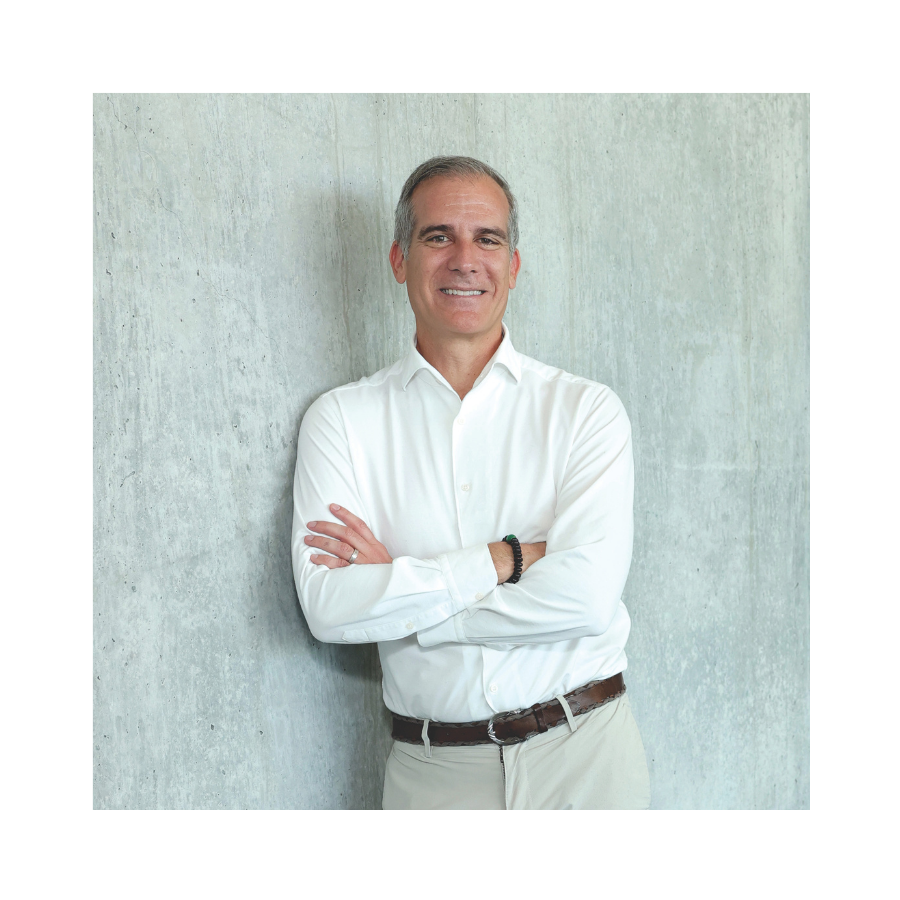

A bracelet of prayer beads peeks out from under Eric Garcetti’s sleeve. The former mayor of Los Angeles got it in Bodh Gaya, India, where Buddha reached enlightenment under the Bodhi tree. Now he wears it whenever he can, he says, sitting down for an interview at the Montreal Climate Summit in April.
There really is something quite equanimous in the way Garcetti talks about the deep political rift in the United States over low-carbon energy. Garcetti currently serves as chief ambassador for global climate diplomacy at C40 Cities, an international network of nearly 100 mayors committed to advancing climate action. He served as the group’s chair from 2019 to 2021, during the last part of his nine-year tenure as L.A.’s top official.
Garcetti is on a mission to remind the world that President Donald Trump doesn’t have the last word on the state of climate action in the United States, nor is he the most reliable authority. If you pay attention only to the current administration, you’re missing the bigger story about where climate adaptation and mitigation are headed in the world’s largest economy, Garcetti says.
We spoke with Garcetti about the power of cities and states to implement the green transition, how climate communications are evolving, and why Washington can’t stop the low-carbon economy.
This interview has been edited and condensed.
MARK MANN: Are you building a parallel order of climate diplomacy?
ERIC GARCETTI: Look, we know that things like a pandemic and disease and certainly climate, these things don’t care where we draw borders between cities or countries. It demands a diplomacy that also doesn’t ignore borders but works across them, and that’s really what we’re doing.
MM: You’re here at the Montreal Climate Summit with Gina McCarthy, chair of the America Is All In coalition and former climate adviser to President Biden, who argues that Trump’s power to stymie climate action is exaggerated. I’ve noticed it in the media, that sometimes Trump’s attacks are much more amply covered than the rebuttals. What’s going on there?
EG: Well, go to your business model: what generates clicks is conflict. But at the end of the day, it doesn’t matter what generates clicks; what matters is what generates electricity in a sustainable way. Wind might be controversial in one project off the coast, but meanwhile, take Texas. It’s a very conservative political state right now, run by Republicans, and they’re decarbonizing the Permian Basin, the largest oil field in America, primarily with wind and solar. Maybe they don’t brag about it because it doesn’t fit their politics, but they’re not stopping.
MM: Do you take a page and talk less about climate?
EG: Yeah, not because of Trump, but because I think “climate” is an abstract word for many people. Climate literally means weather. It doesn’t have a value to it. Climate isn’t environmentalism or green, and those things, while they were good early on, were too segregated. You felt very special if you were a green activist or if you worked on environmental issues, when it requires a billion people to be incorporating sustainable values.
I like talking about jobs, health and safety. And in the face of extreme weather and climate change, we have communities that don’t feel safe because of floods and fires and everything else. The economy is rapidly changing, and so responding to what’s happening requires us to retrain people and to generate jobs through the work that needs to be done.
MM: What’s the best evidence, in your view, that climate action is still winning in the United States? That the momentum is still there?
EG: Sometimes there are setbacks that reduce the acceleration, but there’s nothing that’s reversing the direction. You read headlines and you think, “Oh, people are going backwards.” No. Coal plants are still being shut down, even if the president is trying to save a handful of them over the wishes of the actual power companies that own them. We are seeing the more conservative states – like, 70% of the new [low-carbon power] installation was done in Texas, Ohio and Florida, all run by Republican governors.
California continues that. Los Angeles, the largest municipal utility, is still on path to be at 97% carbon-free power in four years – it’s so exciting to even say that – and 100% by 2035. Transportation investments are continuing. The number-one car sold in California is still an electric car.
It’s hard to find a measure where we are moving backwards. When you look at capital flows, too, there’s never been more deals at a better price than right now. When I talk to investors, they’re like, “Maybe we don’t talk about it as loudly, but in some ways all that shouting coming out of Washington has helped us find even better deals.” Everybody knows it’s the cheapest way to get power. It’s the best way to move forward with transportation. It’s the healthiest thing to do for communities. We struggle to find evidence against it, [despite] what the White House claims.

MM: Do you think energy is shifting to the local level? Is there any sense that the centre of gravity is moving away from federal politics?
EG: No, I don’t think many people ever cared what Washington was doing, even when they might be pro–climate action. I mean, there have been moments, like when Joe Biden passed the Inflation Reduction Act. That was huge. It was the biggest piece of environmental legislation ever passed by any nation. But they also knew that if you could add up all the local and state money spent, it would dwarf [the IRA]. We’re the ones who maintain sewer systems, who do private investment, build houses. We invest and build our transportation networks. In America, most spending on climate-related sectors is done at the sub-national level. I think anybody who has been active has always known that’s where the fight is.
MM: In Canada, cities can be disempowered relative to the provinces. Often there’s a dynamic where politicians at the provincial level gain more power from rural voters than from urban voters. I’m wondering how powerful cities really are?
EG: It’s different from state to state, but in the United States, big cities have tremendous power, whether it’s formal or informal. Even if you’re a drop of blue in a red state, the state leaders know they need to have a Houston work, or Atlanta work or Nashville work. There’s often political conflict, but when it comes to spending money and getting things done, it’s the same voters and the same people who are demanding answers.
I also think that urban–rural divide is disappearing a little bit based on some issues. For instance, data centres are being built in the most rural areas and the most urban areas. And people are like, “Whoa, why are my energy bills going up 20% in a year? What is the impact of having this around me? How are we actually generating that electricity?” Folks who might not have in the past cared about whether it was coal or gas are suddenly questioning, “Do I really want that, just to help an AI system develop?” In urban areas, they’re finding new coalitions between people.
The majority of people really do live now in urban areas in America, overwhelmingly. Depending on how you measure it, up to 80% of Americans live in cities. So that is allowing cities to hit above their weight class, even if they don’t have the formal power. They really have the influence, even sometimes when they’re led by people from a different party.
MM: I don’t know if people are still talking about “abundance” as much, but I’m curious if you think that’s the type of shift that we need?
EG: I’m not a huge fan of the word “abundance,” because what does that mean? It’s another one of these academic-sounding words. But making shit easier to get done: yes.
There are some basics we should never, ever sacrifice. But we’ve put so many boulders in our backpack, it’s so slow to move. For instance, imagine a New York subway system getting built in this day and age. It would take 100 years to build that, and it would cost a trillion dollars.
RELATED POSTS


I’ve become simultaneously more progressive and libertarian as I age. Libertarian, like, get the hell out of the way. Get the basics covered, but let people do stuff because there’s a crisis. And more progressive: make sure it has a conscience. Don’t just let bad design and capital flow in however it wants. But if you let capital flow in in a predictable way, there are smart ways to be both progressive and caring, but also a little bit more libertarian and less regulatory.
MM: Do U.S. mayors who engage in the C40 or in other types of sub-national climate diplomacy face threat or pushback from the federal government?
EG: Yeah, when they’re not focused on something else, like wars in the Middle East or going after our immigrants. It’s somewhere in that agenda. It’s not frequent, and it’s not a friendly partnership, but [Washington doesn’t have] a lot of tools. They can’t tell Los Angeles “You can’t create renewable energy for your energy mix.” They can’t write our building code. They can’t tell us where to invest our transportation dollars.
There are moments when federal funds would be useful, and can help accelerate the greening of our ports, the building of more public transportation, the environmental-justice issues of restoring communities cut up by bad infrastructure decisions, and that’s frustrating at times.
But no, I think that there are bigger targets that they have their attention on. And we actually welcome collaboration with them. If you can get past some of the fixations they have, whether it’s offshore wind or this, that and the other, there are opportunities for America to be strong and have jobs the same way that Prime Minister Carney is talking about. This is the age of more national sovereignty, reshoring jobs. I’d love for us to be talking about in the United States, as Canada is doing, really being one of the green manufacturing hubs that can export to the world. Don’t cede that to China, as marvellous a job as they’ve done. They shouldn’t be creating every future car. We should have Canadians and Americans that build cars, but it’s probably not going to be an internal combustion engine 20 years from now. So we’re going to lose a decade by winding away all those subsidies. And we’re going to be behind the eight ball for a long time.
Mark Mann is the managing editor of Corporate Knights. He lives in Montreal.
The Weekly Roundup
Get all our stories in one place, every Wednesday at noon EST.