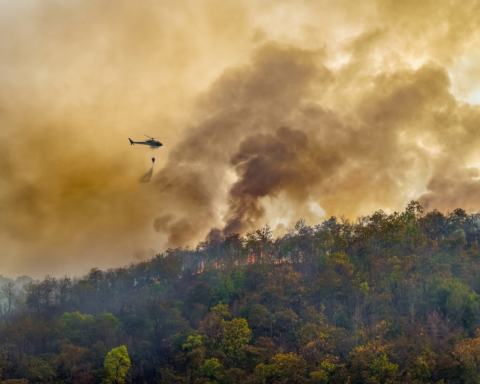
Resilience seems to have overtaken the narrative of climate action these days. It featured as an overarching theme at last week’s New York Climate Week and later this month the EU is set to release its eagerly anticipated climate resilience framework – against a backdrop of at least 35,000 excess deaths after record heatwaves in Europe this summer.
“Collective resilience” was also the key message of Canada’s prime minister Mark Carney in his recent remarks to the European Parliament, in which he welcomed European Commission president Ursula von der Leyen’s surprise move to offer Canada associate membership of the EU.
While debate is rife about what ‘associate membership’ entails exactly – since no country has ever gained it before and the EU legal framework seems patchy, to say the least – a closer alliance between the EU and Canada has the potential to spur greater cooperation on climate issues and the energy transition. Despite recent revisions to the bloc’s European Green Deal, von der Leyen reiterated that “Europe can, must and will stay the course on its climate targets.”
Carney’s changing record
Carney himself is also no stranger to climate frameworks and negotiations. While spearheading the Bank of England during the tumultuous years following the Brexit vote, he pioneered climate stress testing and helped establish the Task Force on Climate-related Financial Disclosures – requiring UK financial services to incorporate climate risk into their governance and decision-making practices. He also became the face of the now-unravelled Glasgow Financial Alliance for Net Zero, during his tenure as the UN special envoy on climate action and finance.
Since taking office as Canada’s prime minister, however, the tide has turned. His track record on climate leadership has been tarnished by policy reversals on carbon taxation and EV mandates. A recent proposal to include fossil-fuel abatement in Canada’s long-awaited sustainable finance taxonomy has also raised eyebrows with sceptics warning of greenwashing risks.
What the transition requires
So where does that leave the climate transition? Following his acclaimed Davos speech earlier this year, Carney is positioning Canada as a more reliable and alternative partner to its US neighbour, including on climate and energy diplomacy.
With the current US administration upholding an economic agenda based on trade tariffs, policy statements that at times comprise climate denialism, and many unresolved tensions linked to the global energy crisis spurred by the US-Israel war in Iran, Carney sees a window of opportunity to act.
In his speech to EU MEPs, he said that “Canada brings energy at huge scale and in every form that the transition requires.” He also mentioned that his country is among the top producers of the 10 most essential critical raw materials for the energy transition.
Closer ties
Carney’s willingness to form closer ties to Europe could benefit the EU bloc in becoming less dependent on the US and China for key resources in the energy transition, and help build strategic autonomy with other like-minded countries. The upcoming EU-Canada summit – taking place a few days before the US midterm elections – could provide further details on what this future relationship can look like.
With the leaders of the world’s two superpowers, China and the US, currently on opposite ends of the climate transition, it remains to be seen how much leverage middle powers like Canada and the EU can build to push forward the transition on their terms.
Rising interest rates and increased defence spending are causing fiscal headaches for many EU governments, while the normalisation of far-right rhetoric in recent years has turned decarbonisation into a quest for re-industrialisation and competitiveness. This has not stopped the green transition but has certainly rephrased it.
Maybe resilience, for lack of a better word, is a new, pragmatic way to ensure climate action and collaboration still take place in an ever more geopolitically fragmented world.
Claudia De Meulemeester is a London-based financial journalist.
This article was originally published by Green Central Banking in their Dispatch newsletter. It has been edited to conform with Corporate Knights style. View the original here.
The Weekly Roundup
Get all our stories in one place, every Wednesday at noon EST.