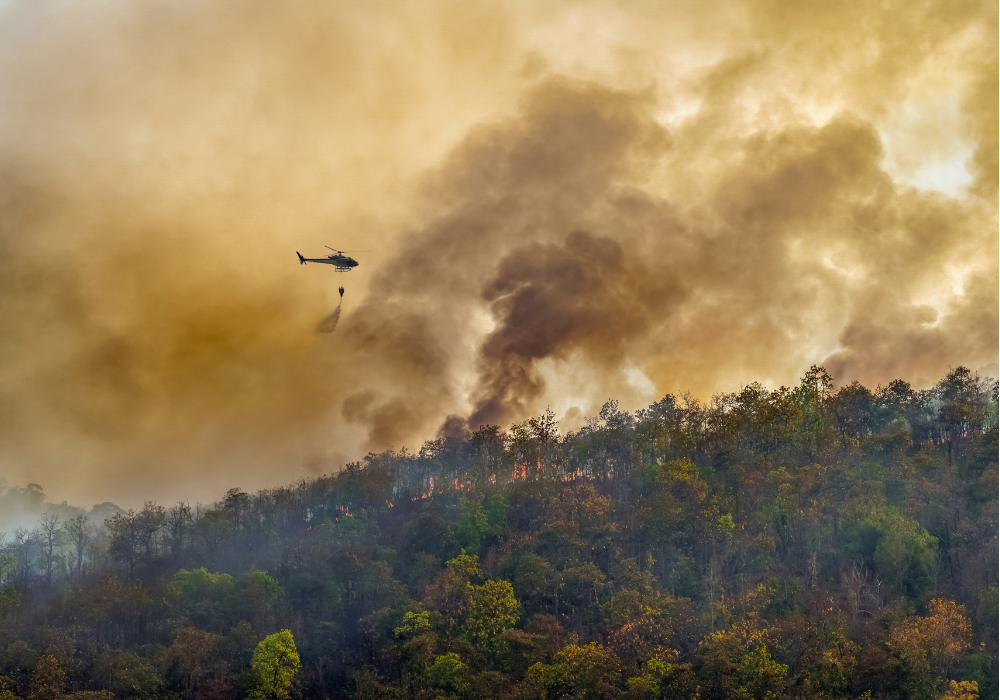
Canada’s forests are shifting from a carbon sink to a carbon source, driven by wildfire disturbance, reveal carbon cycle models that better represent Canadian landscapes than earlier estimates.
“Since 2009, the immediate impacts of disturbance have begun to overwhelm the recovery-driven carbon sink in Canadian forests,” the authors of a recent study published in Global Change Biology write.
The trend might continue as future fire seasons are projected to worsen, they add, and the resulting rise in forest disturbance “would lead to additional emissions, rising wildfire and forestry management costs, and imperil efforts to manage the carbon sink through sustainable land management practices and fire suppression.”
The study aims to fill a knowledge gap left by previous models, providing “the first physically coherent wall-to-wall estimates of all major carbon pools and fluxes for Canada.”
While past studies provide a rough idea of how Canadian forests store or release carbon dioxide, the new research is tailored to Canadian conditions and is a step up in accuracy, the authors say. It uses a newer model – referred to as the Canadian Land Surface Scheme Including Biogeochemical Cycles (CLASSIC) model – with specific geophysical and plant data for all of the country’s forested and unforested land.
CLASSIC also relies on process-based modelling, which uses equations based on historical data and scientific laws – like rules of energy conservation – to simulate real-life processes, rather than estimating future conditions based on current observations. The model can calculate changes in how forest carbon is stored and lost over time.
The authors note that their study does not explicitly model peatland carbon cycles, carbon stocks or peatlands’ role in boreal fire emissions from soil.
To determine the impact of forest disturbance on Canada’s forest carbon stocks, the study simulates carbon cycling across the country from 1750 to 2023 and reconstructs wildfire and harvesting during that time, as well as forest regrowth, respiration and “CO2 fertilization” – meaning increased plant growth linked to higher levels of carbon dioxide. They found that Canada’s forestland on average acted as a net carbon sink all that time.
But forests started to lose more carbon than they were able to take up as the area of disturbed forestland increased in the early 21st century. Though carbon losses from disturbance had in the past been offset by carbon stored through forests naturally regenerating, the models show that disturbances started to overwhelm regeneration capacity starting in 2009, and eventually “Canadian forests crossed the source-sink transition around 2021.”
After comparing the latest 15-year period against the rest of the study’s timeline, the authors conclude that “this trend is unprecedented over the last ~100 years” and “is primarily driven by wildfire disturbance concentrated in central Canadian forests where lower [carbon uptake from plant growth] slows vegetation recovery.”
With projections showing that wildfires are likely to burn over greater land area in the future, the researchers say the forests could become an even greater source of carbon emissions.