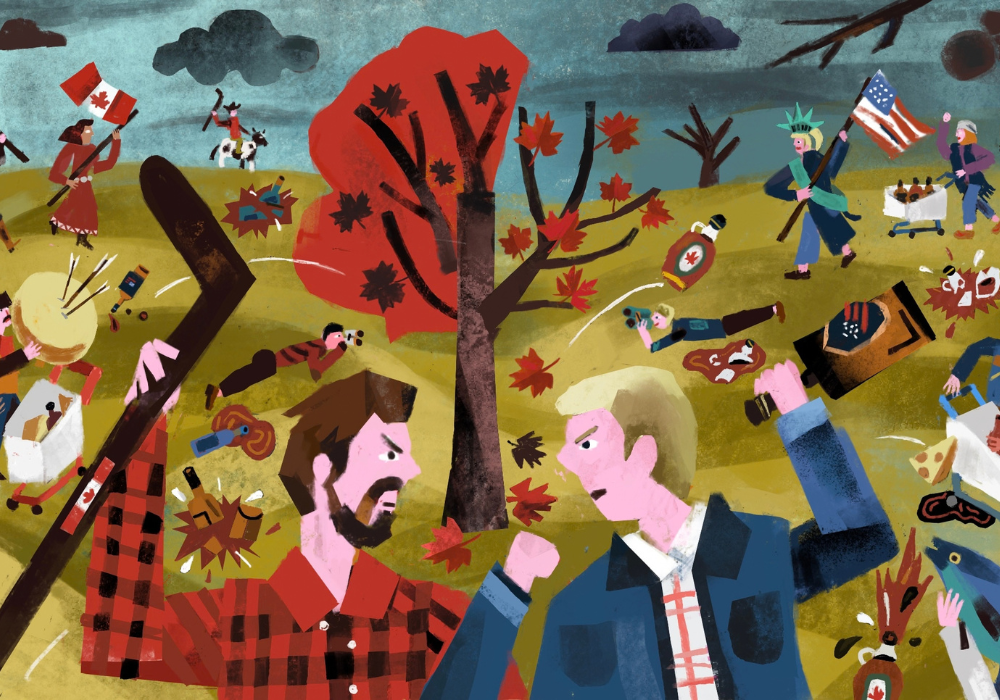
In episode 24 of season six of The Simpsons, “Lemon of Troy,” Springfield’s prize lemon tree is stolen by children from the neighbouring town of Shelbyville. “That lemon tree is part of our town, and as kids, the backbone of our economy,” Bart says, as he raises an invasion force. Homer commandeers Ned Flanders’s RV, and – hidden inside à la Trojan Horse – they get themselves towed to the impound lot where the tree is being held. In short, the lemon tree is rescued and restored, though it is much bedraggled and diminished in the process.
Mark Carney keeps making a similar point about our own neighbourly dispute: the trade war makes losers of us all. Every time he has the chance, the prime minister keeps pointing out that we could instead be getting richer if we just got down to the business of doing business, rather than all this flinging of sand into the economic gears. Some U.S. lawmakers and industry leaders have echoed these sentiments. “We need the politics and the rhetoric to die down, and we need to focus on what the true economics are,” Glenn Stevens Jr., head of the Michigan automative group MichAuto, told The Logic.
But by the logic of dominion exercised by Donald Trump’s Republican Party, there’s a bigger prize to be won through subjugation than cooperation. In his “Trump corollary to the Monroe Doctrine,” the president proclaims “American preeminence in the Western Hemisphere.” Control and expansion in the Americas are the central planks of the U.S. National Security Strategy published in December 2025. The plan is to discourage collaboration with partners other than the United States and to use economic coercion to dismantle regulations that limit U.S. business interests in other countries. Canada’s insistence on trade diversification runs directly counter to the Donroe Doctrine, and it’s one of the principal reasons the talks broke down.
RELATED STORIES



Carney has proven himself adaptable and willing to rise to the challenge. Previous to the current trade war, which arguably propelled him into Canada’s highest office, the former central banker had staked his career on helping launch a “sustainable revolution” in finance. For him, COP26 in Glasgow – where he served as the UN secretary-general’s special envoy on climate action and finance as well as Boris Johnson’s finance adviser – was a full-circle moment 250 years in the making. In the same city where Adam Smith developed the core ideas for The Wealth of Nations, Carney assembled the Glasgow Financial Alliance for Net Zero, which put private investing at the heart of the climate-conscious shift in economics. He likely never imagined that the United States government would become hell-bent on unravelling all that good work. Now his willingness to carry water for the fossil-fuel industry – using the language of decarbonized oil and labouring to secure a new pipeline to serve Asian markets – can generously be described as a pragmatic turn from his previous life as the avatar of climate-aware finance.
Times have clearly changed since 2021. While visiting France this summer, I was discussing the breakdown of Canada–U.S. relations with the mother of a friend. “We think that Canadians will fight back, no?” she asked. Seemingly so. We’ll fight if we have to, at any rate. After the trade deal broke down on August 21, Carney adopted a more belligerent tone. “You’re at war when you get attacked and we were attacked,” he said. Much of the country is indeed squared off for a fight. Apart from the latest dollar-for-dollar counter-tariffs on more than 700 U.S.-origin products, U.S. alcohol has been removed from shelves across the country and polls show that many shoppers are checking labels and boycotting U.S. goods.
That’s all good, but our real focus should be on investing in ourselves. We can’t back down, but if Canada is to weather the storm and come out better than before, it won’t be from brawling. Our mantra for the past year and a half has been “elbows up,” which is a polite, hockey-fied way of saying, “Make it hurt.” These are not fighting words. It’s a call to play sharp and hard, not to throw the gloves down and start swinging. But there’s another connotation of “elbows up” that reflects an even stronger approach: we put our elbows up so that we can lock arms. In economic terms, the United States vastly outguns us – “Canada’s economy is smaller than that of Texas,” Scott Bessent, Trump’s treasury secretary, sneered – but Canadians have huge stores of personal investments that could be profitably steered into local community projects. The trade war will end, but the lesson will remain.
To explore these themes, we embarked on a special issue of Corporate Knights – out today in the Ottawa edition of The Globe and Mail, and built in part with the help of Tapestry Community Capital. In it, we examine what it would mean for Canada’s economy and our transition to a low-carbon energy system if the federal government cleared the way for much more community investing. We see a big opportunity for Canadians to earn strong returns by helping to finance impactful, revenue-generating projects at home. With community investing methods, it’s possible to alleviate pernicious challenges like food insecurity and the housing crisis, build distributed power generation that cuts our overall emissions, create the infrastructure for cheap electric mobility, fund projects we love in our cities, and boost our economic resilience in the face of U.S. aggression. The tools are there, but it’s still too hard for most people to use them. This issue is about how we can put our elbows up together and make community finance for non-profits, cooperatives and charities a no-brainer for ordinary Canadians.
Mark Mann is the managing editor at Corporate Knights. He is based in Montreal.
The Weekly Roundup
Get all our stories in one place, every Wednesday at noon EST.