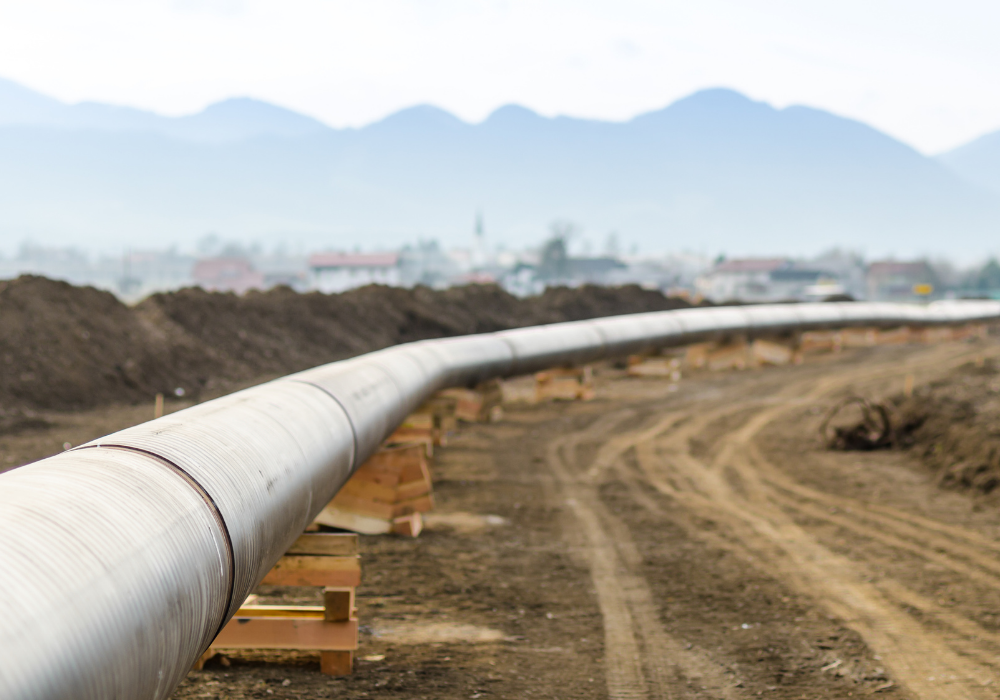
No oil company is willing to pay for the pipeline Ottawa and Alberta intend to build. That is the most telling fact about the West Coast line announced in July by Prime Minister Mark Carney and Alberta Premier Danielle Smith. The two governments would hold it as equal partners, with development led by the federally owned Trans Mountain Corporation along the existing Trans Mountain corridor, and would carry about 90% of the cost.
Governments are preparing to absorb a risk that highly profitable oil companies have declined to take. That is not a technical detail of project financing; it is the clearest signal yet of a fraught economic strategy for Canada’s near future – one that puts resource extraction at the centre of national development.
A strategy, not a project
On July 2, the federal government and British Columbia committed billions in public investment to liquefied natural gas development, mining and other extractive industries, and to expanding the Roberts Bank port terminal south of Vancouver, later identified as the marine terminus for the new Alberta pipeline. Later that day, the West Coast line was revealed. The following week, Alberta and Ontario proposed a second pipeline, also without a private proponent and also likely to require substantial public money.
Whether or not that second line is ever built, the sequence confirms that these are not separate infrastructure decisions. They are part of a broader commitment to an extractive economy: the federal Major Projects Office is now fast-tracking 23 “nation-building” initiatives worth well more than $130 billion across liquefied natural gas, nuclear, mining and transportation.
A bet the industry won’t make
Ottawa has formally proposed listing the pipeline as a “project of national interest.” Alberta’s submission puts the cost at $35.2 billion to $43.7 billion, excluding escalation and financing costs, and assuming regulatory savings. It would be built by a new entity jointly owned by Trans Mountain Corporation, Alberta’s Petroleum Marketing Commission and Pembina Pipeline, a Calgary-based company whose non-binding 10% stake is the only private participation. Taxpayers would carry the rest, and there is still no finalized financing plan.
The pipeline is also only part of the public bill. Add the Roberts Bank terminal at roughly $10 billion and the linked carbon-capture project at $16.5 billion officially, and more than $20 billion by recent estimates, and allow for overruns of the kind Trans Mountain produced, and the public commitment could exceed $100 billion – an estimate from market-oriented critics, not climate advocates.
The project includes an Indigenous equity purchase right, to be drawn from the two governments’ shares, but its size and timing remain unspecified. First Nations along the southern route say they were not consulted before the announcement, and 14 First Nations are challenging the fast-tracking law in court.
Canada has been here before: Ottawa acquired the Trans Mountain system in 2018 after private investors stepped back. The expansion ultimately cost about $34 billion, more than six times the original estimate.
The reluctance of industry is not hard to explain. Bitumen is among the highest-cost sources of oil, highly sensitive to price swings and exposed to declining long-term demand as decarbonization accelerates. The International Energy Agency expects global oil demand to peak by 2030, with supply capacity running well above it. With the West Coast line unlikely to be complete before the early-to-mid 2030s, the project risks becoming a stranded asset.
Companies are behaving accordingly. Through the recent price boom, the four largest oil-sands producers cut investment – to $15.9 billion a year across 2021 to 2024, down from $27.9 billion a year in the 2011 to 2014 boom – while sharply increasing dividends and share buybacks. Capital is being returned to shareholders, not committed to new production. If the industry believed in the economics of expansion, it would be leading the investment.
Who this economy is for
Ottawa and Alberta describe the West Coast line as the way to build a strong, prosperous, sovereign Canada. But the record of the last boom complicates these claims.
A report by the Alberta Federation of Labour and Canadians for Tax Fairness found that between 2021 and 2023, the oil and gas industry earned $135.2 billion in operating profits while paying $43 billion in wages – $3.14 in profit for every dollar paid to workers, up from $0.92 in the previous boom. The sector employs roughly 30,000 fewer people than in 2014. And the owners collecting those profits are largely not Canadian. The report estimates that the big four producers are 73% foreign-owned and 60% U.S.-owned, with an estimated $58 billion in dividends and buybacks flowing to foreign owners between 2021 and 2024.
An industry that produces more with fewer workers, invests less, and sends most of its returns abroad is a weak foundation for shared prosperity – and a strange candidate for one of the largest public commitments of the coming decade.
The rollbacks are part of the plan
You might wonder about the environmental safeguards in place, especially as the urgency of climate change is evident all around us. Projects on this scale face barriers under existing environmental rules. So, those rules are being loosened. Canada and Alberta signed a cooperation agreement to streamline and add flexibility to impact assessment; their implementation agreement commits both governments to regulatory frameworks enabling substantial oil-sands growth. The federal government is now proposing faster approvals, expanded pre-designated development zones, and a narrower scope for environmental assessment.
The retreat extends beyond permitting: over the past year, Ottawa has scrapped or weakened the consumer carbon price, the planned oil and gas emissions cap, the electric vehicle mandate, the clean-electricity regulations and the industrial carbon price. Deregulation and environmental rollbacks are not incidental to this strategy. They are what makes it possible – and they build higher emissions into it by design.
The environmental case offered in return is the multibillion-dollar plan to capture and store 16 million tonnes of carbon dioxide a year from the oil sands by 2045. The so-called Pathways project – designed by an alliance of five major oil-sands players – would itself require substantial public funding. Reducing production emissions is worthwhile and should be required of the industry. But about 80% of a barrel’s life-cycle emissions come from burning the fuel, not from producing, refining and transporting it – which is what carbon capture addresses.
Pathways is to capture six million tonnes a year by 2035, while the pipeline is sized to carry a million barrels a day – 365 million barrels a year, or about 157 million tonnes of carbon dioxide when burned. So the “decarbonized oil” the prime minister has invoked would, even if every commitment in the package is met, be oil whose emissions are lower by less than a 10th. In exchange, the companies get a slower rise in carbon-price stringency.
The path not taken
Capital markets respond not only to subsidies but to perceived direction. When governments commit to fossil expansion while delaying climate policy, they signal that Canada’s economic future remains anchored in extraction – shaping where investment flows, which technologies scale and which regions are seen as growth areas while eroding the policy certainty that clean industries need.
The contrast with other jurisdictions is stark. Across Europe, parts of Asia and especially China, governments are pursuing electrification strategies built on renewable energy, grid expansion, electric mobility and low-carbon industry. These are not environmental side projects; they are 21st-century industrial strategies designed to win in a decarbonizing economy. Ottawa’s recently proposed electrification strategy will be credible only if matched by fiscal and regulatory decisions of comparable weight.
Fiscal capacity is finite. Hundreds of billions of dollars committed over the coming decade to extractive infrastructure, nuclear development and military expenditure will press on everything else – healthcare, education, affordable housing, climate adaptation and the care economy, sectors already facing hiring freezes and service reductions even as capital commitments are made elsewhere.
Political capital is finite, too. Aligning closely with the governments of Danielle Smith and Doug Ford eases agreement on these projects while making a different course harder to take later. Pipelines built in the 2030s will still be seeking returns in the 2060s. That is the definition of lock-in, at a time when Canada is already off-track for its climate targets and when extreme heat, wildfire smoke, floods and drought are already damaging health, infrastructure and public finances.
A better bet
Canada does need an ambitious strategy for a low-carbon future – one that diversifies trade, strengthens economic sovereignty and builds at scale. And the same public investment and political capital could go to renewables, a national electricity grid, storage and efficiency, building retrofits, electrified transportation, a circular economy, climate resilience, the care economy and a just transition for the workers and communities that depend on extraction. All this builds value as the world decarbonizes, employs more people per dollar, and cannot be stranded by a shift in global demand.
Before Canada commits another generation of public money to the industries of the last century, governments should be able to explain why this is a better investment in the country’s future than the alternatives competing for the same support. So far, they have not.
Ricardo Grinspun is professor emeritus of economics at York University and a member of Seniors for Climate Action Now!