

A paid-media partnership with Tapestry Community Capital.
In November 2020, at the height of the early COVID era, Mark Carney travelled to London to deliver the BBC’s Reith Lectures, which he titled “How to Get What We Value.” As at many other points in his career, his message ran on a current of crisis: the global pandemic with all its fallout, but also the crisis of capitalism, which had created markets that were “not just financially but ethically fragile.” Capitalism had succumbed to its most amoral tendencies, in Carney’s telling, “privatizing the profits but socializing the losses.” But it could be fixed. With smart adjustments, we could, as his book Value(s) later promised, “build a better world for all.”
Now Carney is steering the Canadian economy through a new crisis and into a harsher era of geopolitics, one in which the United States seeks to dominate us by undermining our economy. The threat runs deeper than the ebb and flow of tariffs, and hanging over this conflict is the question of sacrifice. Must we, too, regress to capitalism’s worst excesses, or can we still get what we value?
The prime minister is working hard to strengthen one of our shared values: security. Carney is shoring up our economic sovereignty by spurring major investment in nation-building projects and diversifying trade away from the United States. Carney also understands the importance of giving Canadians ownership stakes in the new economy. The Canada Strong Fund, still under development, is designed to let Canadians play a role in financing those big projects, and earn some of the rewards.
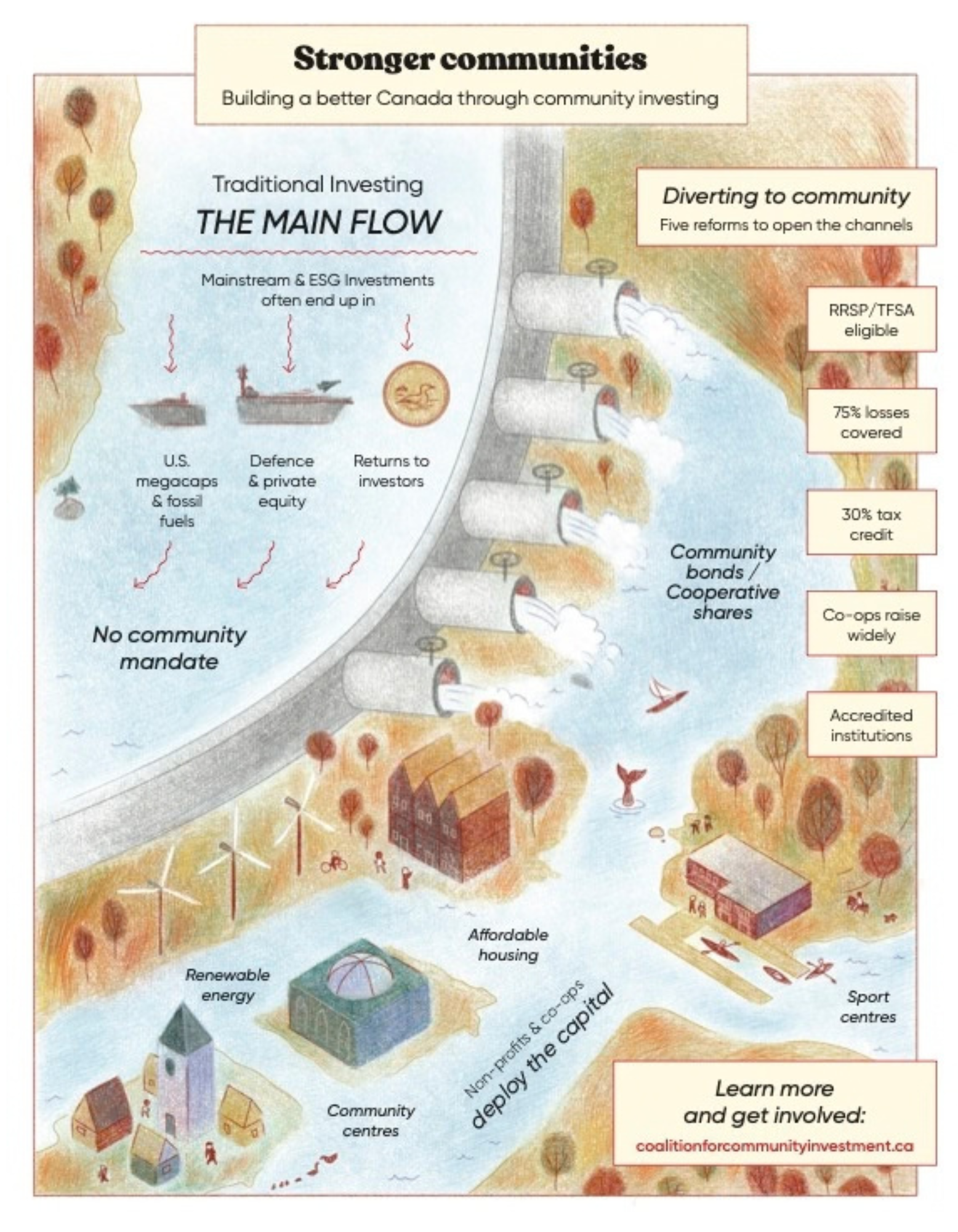
But Canadians need more options to direct their investments back into their own communities and build wealth at home. Statistics Canada calculates total Canadian financial assets at $11.95 trillion, of which about 35%, or $4.18 trillion, are estimated to be in personal investments such as stocks, bonds, mutual funds and exchange-traded funds. But only a small portion of that money is building productive capacity in Canada, with the rest invested outside the country: Canadian investors held $3.04 trillion in U.S. securities at the end of 2024. Much of that capital is concentrated among a small group of corporate giants. The 10 largest companies on the S&P 500 account for nearly 41% of the index’s value.
Some of that capital could be steered toward regional economies and solutions that benefit communities. The instruments are well established: direct investments by ordinary citizens into revenue-generating non-profits, charities and cooperatives. If even just 1% of Canadian investments went into community bonds and cooperative shares, the community-finance market could rise from roughly $150 million today to $42 billion, according to research by Corporate Knights.
The Canadian Coalition for Community Capital, an advocacy network of more than 30 organizations across the country, says the federal government could use tax incentives to encourage this growth. “Everyday Canadians are investing in the communities they call home,” says Suzanne Faiza, the coalition’s coordinator. “They’re helping fund government priorities like affordable housing, renewable energy and other projects they can actually see and experience in their own communities.”
RELATED STORIES:



There are five smart ways that Ottawa could unleash citizen financing for the benefit of Canadian communities:
1. Open up tax-advantaged savings accounts. For their long-term investing goals, Canadians have several ways to gain tax benefits on their investments: registered retirement savings plans (RRSPs), tax-free savings accounts (TFSAs) and first-home savings accounts (FHSAs). But community bonds are generally ineligible or too hard to include in these types of investing accounts. By opening them up, the federal government would enable Canadians to invest more easily and confidently in revenue-generating non-profits.
2. Share some of the risk of local investing. No investment is risk-free, but some investments generate economic, social and environmental returns that extend beyond individual financial returns. By allowing investors to deduct 75% of losses on eligible securities, the federal government would instill more confidence into community investing and produce more of the wider co-benefits.
3. Incentivize community finance. Ottawa already provides targeted tax preferences for investments that align with policy priorities. There are tax credits for investments in clean technology, research and development, mineral exploration, film and TV production, and more. Given their special role in affordable housing, low-carbon energy and local development, community bonds deserve similar treatment: a 30% community-capital tax credit (20% non-refundable + 10% refundable) with a $10,000 per-investor cap.
4. Give co-ops more reach. Canadian cooperatives can raise financing effectively by selling ownership stakes in projects that support local food systems, low-carbon energy and more. However, co-ops aren’t allowed to sell shares outside of their membership bases. By allowing all Canadians to invest in cooperative projects they believe in, Ottawa would give this vital part of the economy a powerful boost.
5. Build the necessary supports. To build credibility for investors, the community finance ecosystem needs a network of accredited institutions and intermediaries that can facilitate bond issuances reliably.
Independent modelling shows that these reforms more than pay for themselves: even in the most conservative scenario, every dollar of federal tax expenditure generates $17 in Canadian gross domestic product and returns more in federal tax revenue than it costs.
“Canadians want their money to stay here,” Faiza says. “They’re checking labels at the grocery store, prioritizing Canadian products in their day-to-day lives. The government has an opportunity now to channel that sentiment into investment, too, building a network of local investment in community infrastructure. That’s real economic strength.”
The Canadian Coalition for Community Capital is asking the federal government to make it easier for everyday people to invest in local Canadian projects. Learn more and get involved at coalitionforcommunitycapital.ca.