

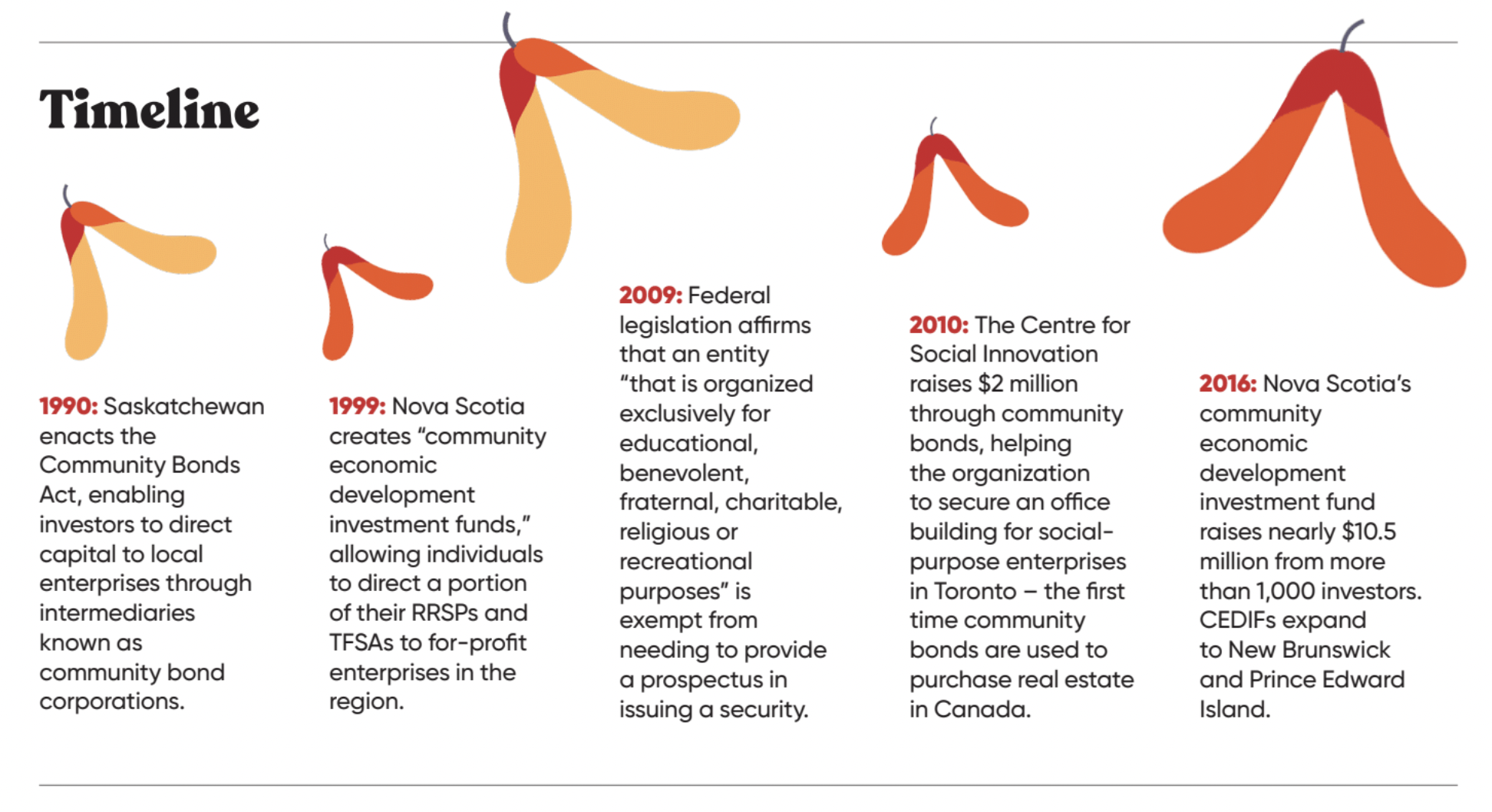
In the 1980s, Canada was in the grips of a severe recession. In Saskatchewan, where the agricultural sector was struggling with low commodity prices, high interest rates and years of drought, the province devised a new tool to fuel investment in rural enterprises: community bonds. Today, these types of securities allow for direct investment by citizens, but this early iteration – formalized in the 1990 Community Bonds Act – instead created a new type of business called a community bond corporation. These locally owned bond issuers could raise money from individuals and make equity investments in local projects, with the provincial government providing a guarantee on the principal. By 1993, more than 5,000 investors had raised nearly $13 million, with money going to projects such as a metal fabrication facility and a farm equipment producer.
Saskatchewan’s community bond innovation would pave the way for much more evolution in the sector, but it didn’t come out of nowhere. Grassroots wealth-building has deep roots in Canada. In the early 20th century, poor miners and fishermen in Nova Scotia banded together in cooperatives to secure improved housing, better prices for their fish and access to credit. Following the Second World War, Dutch immigrants to Canada established a credit union to overcome the barriers they faced in accessing capital. But since the 1990s, this often-informal process of pooling capital has found stronger footing in the form of community bonds, which use direct investment from individuals to address some of the country’s most intractable challenges, including affordable housing and the energy transition.
“Humans have been kind of doing community investment across various societies for a long time,” says Suzanne Faiza, policy manager at Tapestry Community Capital. “A community bond is like a more formalized version of thinking, ‘How do we get people who often aren’t related to one another investing together?’”
Nova Scotia took a different approach to answering that question. In the 1990s, policymakers in Nova Scotia realized that Nova Scotians had no easy way to invest in locally owned and operated enterprises and cooperatives. As a result, just 2% of the equity investments that Nova Scotians made in registered retirement savings plans (RRSPs), for instance, were invested in local businesses. This meant that hundreds of millions of dollars flowed out of the region every year. Community economic development investment funds (CEDIFs), launched in 1999, allowed citizens to invest in local businesses in exchange for an income tax credit. Though CEDIFs were slow to start, they eventually raised millions every year and supported the creation of more than 100 businesses.
In more recent decades, Canadian securities regulations have enabled a new era for community bonds, by creating a prospectus exemption (an exemption that allows entities to sell securities without having to generate a complicated legal document outlining information about their operations and finances) for non-profits and charities. This has allowed these organizations to issue securities without having to undergo lengthy and onerous reporting requirements. Securities laws in every Canadian province and territory now recognize community bonds and facilitate a simplified process for qualifying organizations, allowing them to deal directly with investors who are open to making a lower rate of return in exchange for greater public benefit. So far, the Coalition for Community Capital estimates that Canadians have invested $170 million in community bonds.
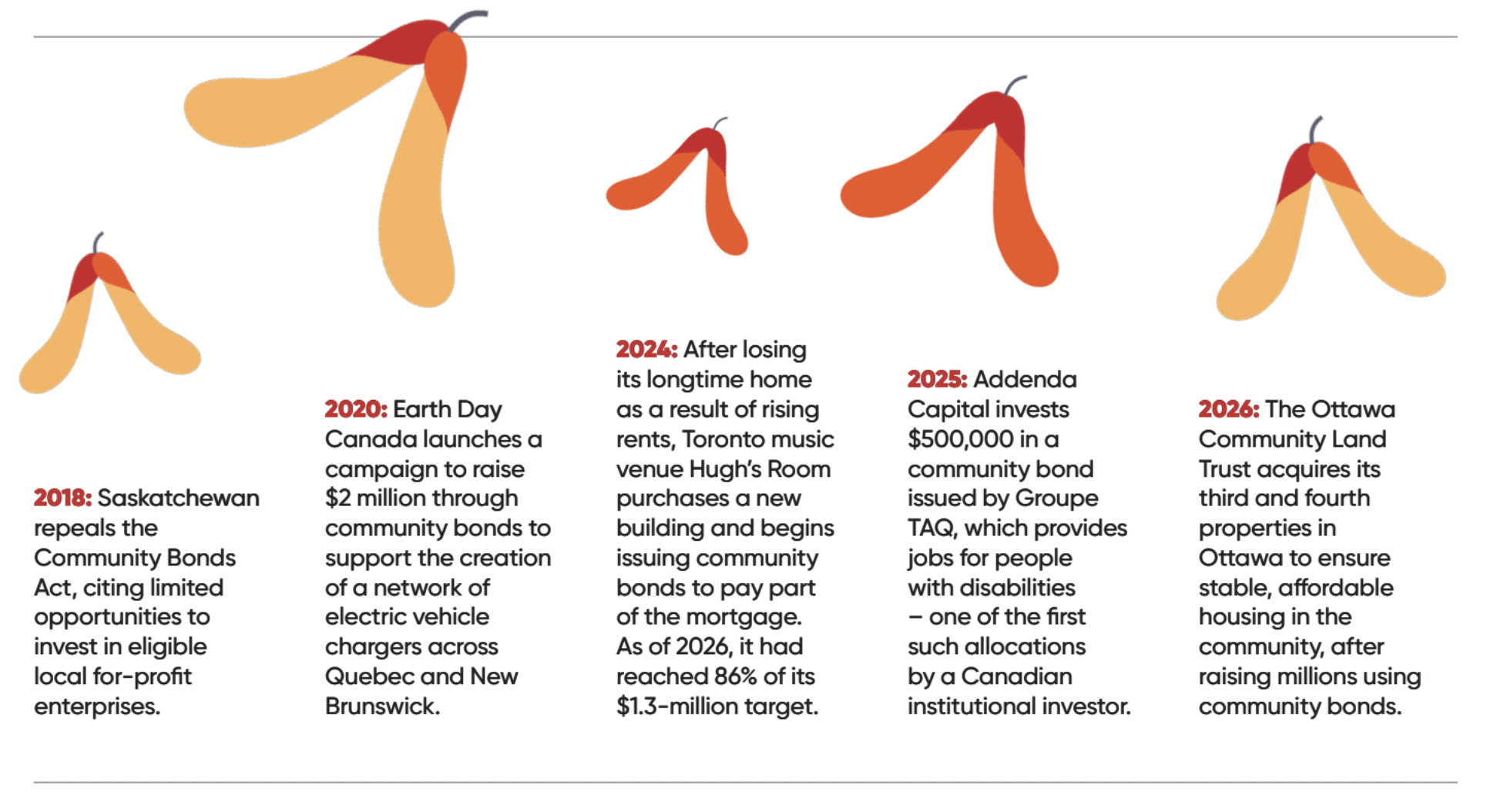
 “It’s very much patient capital that’s invested in something within the community that is going to have this positive impact,” says Tessa Hebb, distinguished research fellow at Carleton University’s Centre for Community Innovation. Since the late 2000s, community bonds have been used to raise capital for everything from affordable housing projects and co-working spaces to renewable-energy projects.
There are some policy changes that would allow for still greater uptake of community bonds, Hebb says. One is establishing a third-party rating agency to assess risk, equivalent to what exists in the regular bond market. Another is increasing eligibility for community bonds in tax-free savings accounts (TFSAs) and RRSPs, which currently require a complicated workaround.
Faiza says opening up TFSAs and RRSPs to community bonds, with a $20,000 cap for unsecured debt, would allow more people to invest in their communities while maintaining the integrity of their accounts. In addition to that change, the Coalition for Community Capital recommends other tax amendments to mobilize more investment, including creating a tax credit for community bonds and making it possible for investors to deduct any losses they incur from community bonds.
As community bonds continue to mature, they contain at their core the same informal impulse that has long guided communities in difficult moments, Faiza says: to support one another in challenging times, and build resilience amid forces beyond one’s control.
Moira Donovan is a Nova Scotia–based journalist who specializes in theenvironment and climate change.
The Weekly Roundup
Get all our stories in one place, every Wednesday at noon EST.