As the planet experiences more intense heat waves, a key piece of the energy transition puzzle is undergoing its own evolution.
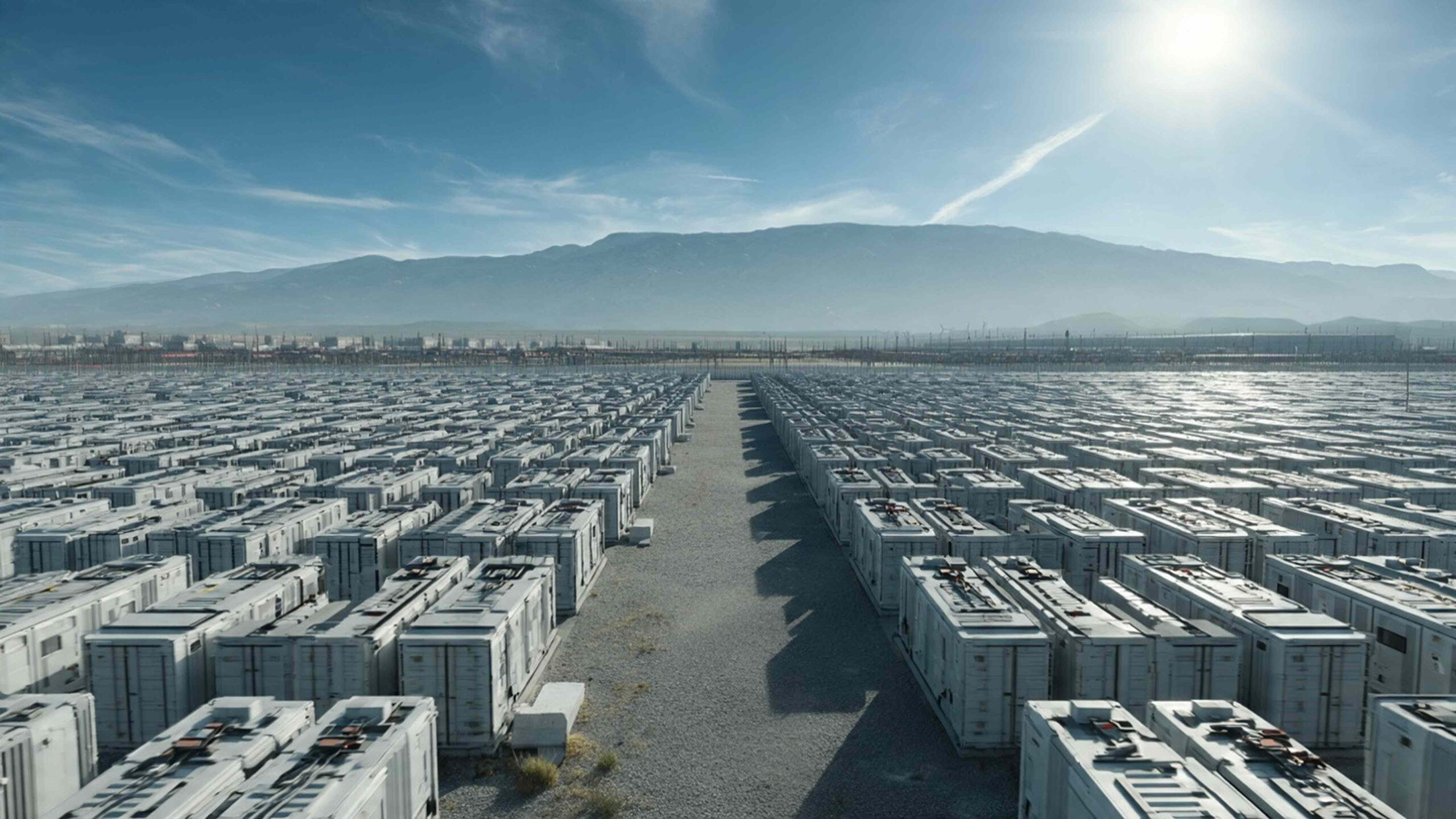
Grid-scale batteries are an important part of the energy system today, providing a mechanism to compensate for fluctuating renewable-energy supply by storing power when there is a lull in energy production.
For decades, the backbone of the electrical grid has been transmission infrastructure. But as more activities shift from fossil fuels to electricity, and demand for power lines from renewable-energy projects surges, the infrastructure is struggling to keep up. Instead of building massive new wires, experts say that batteries can help bridge the gap during peak hours when power is needed. Battery power is cheaper, faster to build, and can be deployed precisely where the demand is coming from, such as near an artificial intelligence data centre or electric vehicle factory.
The last five years have seen grid battery capacity boom as developers push for large utility projects all over the world, in the United States, China, South Africa, Chile, Canada and Australia, among others.
But the prolonged and increasingly extreme heat is also degrading batteries’ lifespans. According to a report by the International Energy Agency, most grid batteries deployed today cluster around two to four hours – a capacity insufficient to last through the night or support the grid during extreme weather conditions when demand reaches its peak.
With modern technology, grid storage is transitioning beyond the four-hour lithium-ion default toward long duration. These are some of the technologies that have moved past their pilot stage and are now being deployed for large-scale, long-duration storage.
Iron-air batteries
Form Energy is a U.S.-based company that has invented an iron-air battery technology capable of storing and discharging electricity for up to 100 hours on multiple consecutive days. This is a significant edge on lithium-ion batteries, which provide energy for shorter time spans, depending on the device in which they are installed.
The battery cycle of iron-air batteries operates like reversible rusting. During the discharge process, the battery inhales oxygen from the air and converts the metallic iron to rust. While charging, an electrical current converts the rust back into iron while the battery breathes out oxygen.
In October 2024, Form Energy began production at its first high-volume manufacturing facility in West Virginia, powering more than 75 gigawatt-hours of projects, according to Fast Company. In October 2025, it deployed its first commercial batteries, and earlier this year it announced plans to build what some called the “largest battery in the world by energy capacity” as part of a project to support powering a Google data centre in Minnesota.
The venture was developed in collaboration with the Xcel Energy utility, which is headquartered in Minneapolis. Xcel Energy will supply the power for this new data centre, while Google will cover the infrastructure and utility costs associated with its own electric service.
Form Energy anticipates delivering and shipping the first iron-battery modules to the data centre by the end of 2028. The company also expects to hit a yearly production capacity of 500 megawatts before the end of 2028.
Compressed-air technology
Compressed air is an ancient technology. Its first practical application emerged in the 1600s, and it went on to revolutionize construction and mining efforts by running pneumatic drills to bore tunnels through the Alps in the 1800s. In the modern age, companies such as Toronto-based Hydrostor have developed a system of compressed-air energy storage, or A-CAES (for “advanced compressed air energy storage”), to support off-peak electricity.
Founded in 2010, Hydrostor stores energy in rock caverns. It says that a single 500-megawatt, eight-hour A-CAES facility can store enough electricity to power a city the size of Boston for eight hours on less than 100 acres of land.
“At its core, A-CAES functions as a giant air battery,” Hydrostor’s chief technology officer, Chris Phebus, wrote in June. “When discharged, the cavern is flooded with water. To charge, compressed air is injected into the cavern, displacing water upward into a surface reservoir. It is 100 percent charged when the cavern is filled with air. To discharge, water flows back into the cavern, pushing the compressed air to the surface to generate electricity. The cavern operates at a fixed pressure band with the weight of the water column acting as a massive underground piston.”
Hydrostor’s facility in Goderich, Ontario, is the world’s first commercially contracted A-CAES project. The company is now scaling through its Willow Rock facility located in Kern County, California. In early 2026, Hydrostor signed a 50-megawatt offtake agreement with California Community Power (CC Power). This partnership enables the Willow Rock facility to supply and store energy for eight hours of continuous, emission-free discharge to six distinct local, non-profit public energy agencies.
The tech is part of a growing field known as long-duration energy storage, which is meant to increase the reliability of grids during peak demand or when renewable-energy generation lulls.
Carbon dioxide
Founded in 2020 in Milan, Italy, Energy Dome is a deep-tech facility adapting long-duration energy storage with its innovative battery technology of storing 2,000 tons of carbon dioxide daily in a dome at its primary hub in Piacenza.
When demand for energy peaks, Energy Dome treats carbon dioxide like a giant, reusable battery. When renewable energy is abundant, the facility uses this electricity to compress carbon dioxide into a high-pressure state. This stores the energy in the pressure of the gas. When the grid requires power, the system releases the pressure, which expands the carbon dioxide, generating electricity on demand. It doesn’t use lithium or other critical materials. The facility’s batteries have a much longer life expectancy than lithium-ion batteries.
In July 2025, Energy Dome announced a partnership with Google, using the facility’s carbon dioxide battery technology to provide carbon-free energy to power the electrical grids serving Google’s operations.
The firm is also developing its first U.S.-based 200-megawatt-hour facility in Columbia County, Wisconsin, in a partnership with Alliant Energy. Construction is slated for 2026 and completion is expected by late 2027. This project will “deliver enough electricity to power approximately 18,000 Wisconsin homes for 10 hours on a single charge,” according to Alliant.
Sodium-ion batteries
Founded in 2011, China’s Contemporary Amperex Technology Co., Limited’s technology consists of cheap, abundant sodium-ion batteries to reduce dependence on lithium.
This battery technology operates through “reversible sodium-ion movement between the cathode and anode,” according to Tycorun, a Chinese battery manufacturer.
In July 2021, CATL unveiled its first-generation sodium-ion battery. It was a test case to demonstrate that sodium-ion chemistry can realistically compete with lithium.
CATL is currently scheduling the delivery of its first sodium-ion energy storage system, which is expected to enter commercial deployment in September 2026.
ESS News says battery shipments are expected to to reach one gigawatt-hour by the end of 2026 across four sectors: “battery swapping, passenger vehicles, commercial vehicles, and energy storage.”
Zinc-air batteries
In the bid to come up with longer duration batteries, a Toronto-based company is making waves: e-Zinc’s electromechanical technology stores energy in zinc metal. Unlike lithium-ion, e-Zinc’s technology incorporates zinc-air chemistry that provides 10- to 100-hour discharge at a cheaper cost than other battery technologies.
The World Economic Forum called it an “affordable, flexible and long duration energy storage solution” in naming it to its global list of 100 Technology Pioneers in 2023. Zinc is an abundant metal, with between 30% and 40% of it coming from recycled scrap metal. “e-Zinc’s solution can replace diesel generators for backup power for commercial and industrial customers or run on remote microgrids or at grid scale to firm up renewable generation,” the World Economic Forum noted.
In 2024, the company raised US$31 million in Series A2 financing and later that year opened a 42,000-square-foot pilot facility in Mississauga, Ontario. It has partnered with the California Energy Commission and Toyota Tsusho Canada to develop two commercial pilots that are expected to validate e-Zinc’s technology in customer-facing settings.
The Weekly Roundup
Get all our stories in one place, every Wednesday at noon EST.