

“Play anywhere” is more than just marketing speak. The Xbox tagline reflects a shifting trend in the video game industry as cloud gaming – or the ability to stream video games over the internet – becomes an increasingly popular way to consume this ubiquitous form of entertainment.
Research shows that the global cloud-gaming user base reached more than 395 million in 2024, with forecasts projecting this number to creep toward 500 million by 2027.
Cloud gaming now represents around 38% of the global online video game market. According to the latest Cloud Gaming Report, 51% of 22,665 players surveyed used cloud gaming daily in 2025, and more than 75% at least weekly.
 The dematerialization of video games is raising other questions around how to quantify carbon footprints, and what to do about it. From arcade cabinets to physical cartridge to digital downloads and now cloud gaming, video games are progressively shedding their physicality and relocating into data centres. And while this process of detaching from hardware does mean fewer plastic cartridges, it still doesn’t do away with the industry’s environmental impact.
Climate technology company Greenly reported last October that the electricity usage for consoles in the United States totalled 3.9 terawatt-hours in 2025, resulting in 1.6 million metric tons of carbon dioxide equivalent. This figure doesn’t include the electricity consumption of televisions, which are often used for gaming. The report further quantifies the emissions created as a result of one hour of cloud-based gaming, totalling 0.44 kilograms of carbon dioxide equivalent.
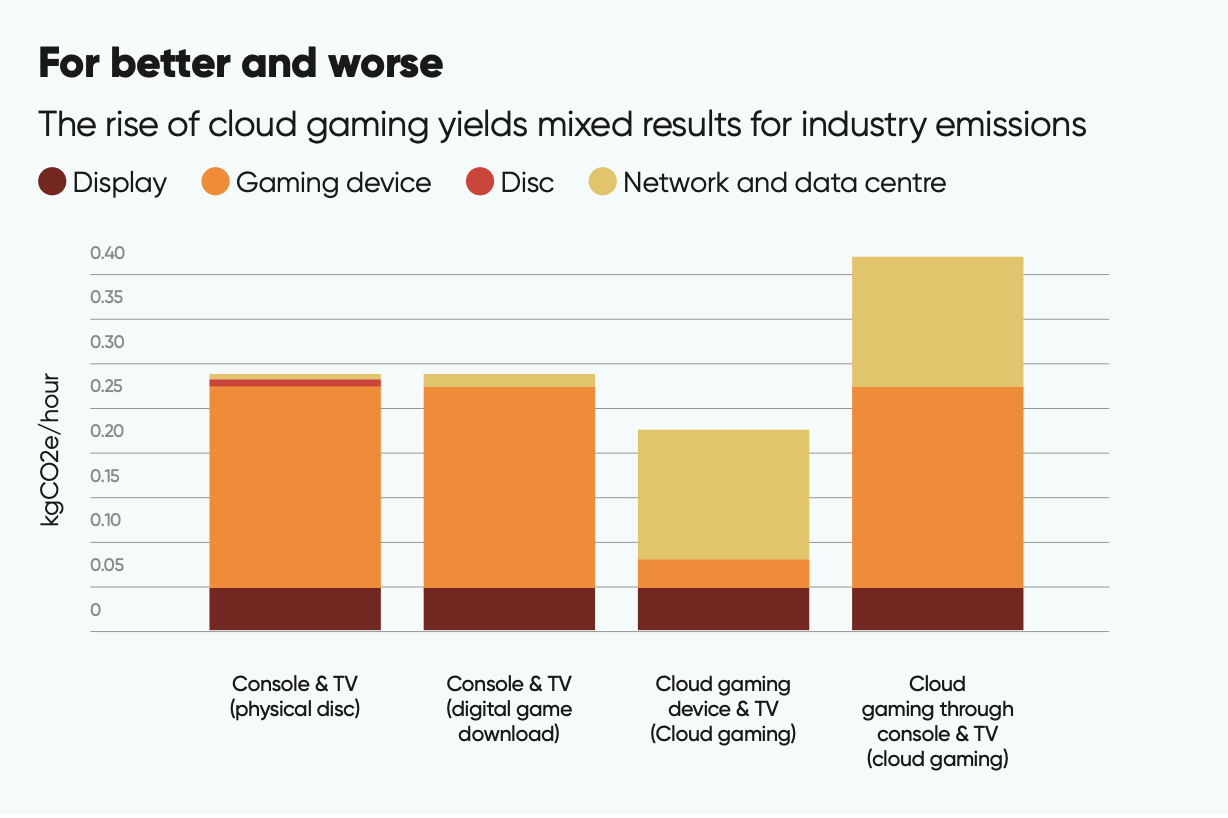
These numbers are in line with previous findings. A 2023 report by Playing for the Planet, an alliance supporting the video game industry to take action on the environment, found that the total carbon impact per hour of gameplay was roughly 50 grams of carbon dioxide equivalent across different forms of play. Among these options, cloud-gaming devices (such as Logitech G Cloud, Nvidia Shield TV, PS TV, etc.) produced the fewest emissions, while cloud gaming on a console or PC (such as desktop computer, Xbox Series X/S, PlayStation 5, etc.) connected to a TV produced the most.
Reducing emissions from video games
A big challenge when determining the carbon footprint of the video game industry is the lack of proper reporting by companies and the need to piece estimated data from many different places. Matt Anderson, decarbonization lead at Playing for the Planet, emphasizes that “the simplest way to reduce emissions is to have renewable electricity.” When considering the life cycle of video games, electricity consumption is key at every step, from development, production, to that act of playing the games.
Findings from an extensive 2019 research project by Joshua Aslan, now senior manager of environment and climate strategy at Sony Interactive Entertainment, corroborates these numbers. The results showed that cloud gaming produced more carbon emissions than downloading games in 2019. However, using a dedicated cloud-gaming device created fewer emissions per hour of gameplay than playing disc-based games on a console.
But these numbers tell only part of the story, says Michael Iantorno, a postdoctoral researcher at the University of Waterloo. The whole life cycle of games is much more difficult to quantify, he says. Players might download the same game across different devices, while physical games might change hands multiple times, allowing many different people to play the same game across decades. “It’s very hard to quantify, because we can’t just do a one-to-one comparison.”
“The lion’s share of [the energy consumption] is happening somewhere else,” says artist Alex Custodio, a researcher at Concordia University. “It’s completely invisible to the user.” Whether it is the game makers using high-end computers to run energy-intensive programs like Unity, or the player who downloads a 100-gigabyte game over high-speed internet, the environmental cost is obfuscated.
A huge infrastructure problem
But the difficulty of clarifying gaming’s impact hasn’t stopped indie game makers in particular, as well as fans and enthusiasts of games, from engaging in a variety of practices and experiments that support green gaming: climate-sensitive mods (or user-created modifications to a game’s content) for existing games, solar-powered gaming devices, and perma-computing focused on long-lasting, repairable and sustainable digital systems, to name a few.
Initiatives like Playing for the Planet bring together small and large studios under an umbrella, providing working groups to develop a climate strategy, tools that help developers measure the carbon footprint of their games from the developmental stages to the use phase. “There’s just so much changing now with digital technology,” Anderson says, “so we really need to think about future scenarios and trajectories to make sure we don’t get caught off guard.”
Still, Custodio is skeptical of initiatives that make vague promises or put the responsibility on players. “Those are important, those need to exist, but they need to exist with a note saying, hey, this is a huge infrastructural problem.” The change cannot be implemented simply on the consumer’s end; it must transform how video game companies operate, from the manufacturing of the hardware to the design of the software they produce throughout the whole life cycle of video games.
Alexandre Paquet is a Toronto-based researcher writing about video games and culture industries.
The Weekly Roundup
Get all our stories in one place, every Wednesday at noon EST.