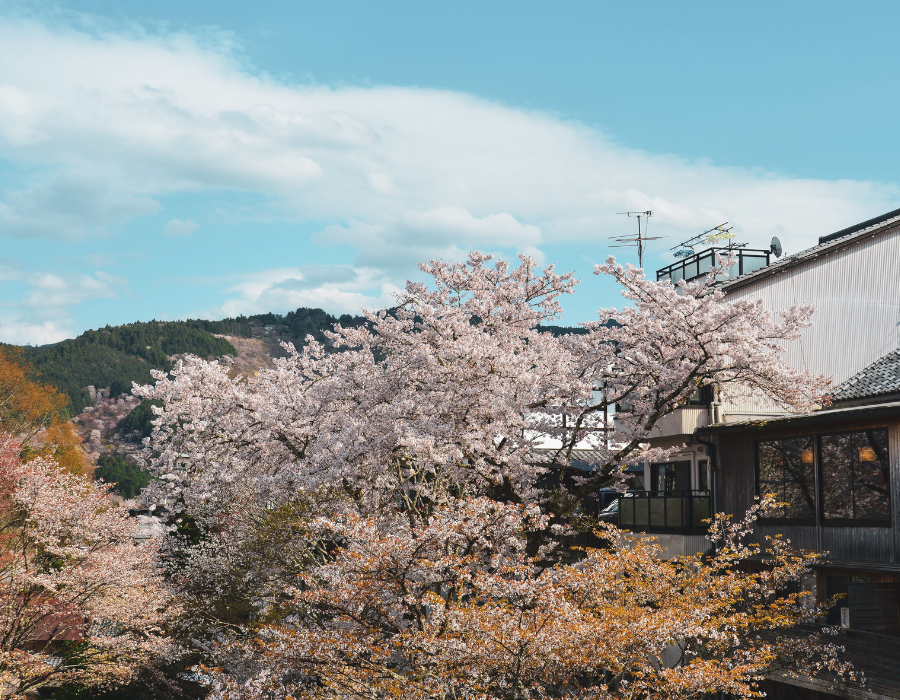
Some call them “sakura chasers”: the intrepid travellers who journey from all corners of the world to revel in the beauty of Japan’s cherry blossom (or sakura) season. Millions make the trek every spring. Given the fleeting nature of the floral spectacle – between five to seven days per region – a certain attention to timing is crucial.
But climate change has turned this transient phenomenon into a moving target. Tokyo’s sakura peak this year was around March 19, which is up to a week earlier than usual. Early arrivals between 2021 and 2023 in Kyoto smashed 1,200-year-old records. The main culprit is rising temperatures, but erratic winters may also threaten a tree’s ability to bloom at all. Research suggests that under a medium emissions scenario, peak bloom may move up another week by 2100.
“To me, the cherry blossom record really captures how extreme these changes are,” Elizabeth Wolkovich, an associate professor at the University of British Columbia who studies plant communities and climate change, told National Geographic.
The study of recurring biological events such as flowering and leaf emergence, known as phenology, has arguably become one of the most powerful tools for understanding climate change. Studies by Wolkovich show that rising temperatures are advancing spring biological events across the globe, with plant phenology shifting by roughly four to six days for every degree Celsius of warming. Her research has also found that experimental studies often underestimate how rapidly plants respond to warming compared with long-term observational records.
For more than 1,200 years, Kyoto’s cherry blossoms have been documented in imperial court diaries, temple records, aristocratic journals and historical chronicles, creating one of the world’s longest continuous phenological datasets. Yasuyuki Aono and Shizuka Saito, two researchers affiliated with Osaka Metropolitan University and Fujicco Co. Ltd., have reconstructed temperatures of medieval Kyoto by “gap-filling” cherry blossom records beginning in 812 CE. Their research suggests that peak bloom dates remained relatively stable around mid-April throughout the medieval period, making the recent string of record-breaking early blooms especially striking against a millennium of historical precedent.
This shift is changing how people experience one of Japan’s most important seasonal traditions. Hanami, the centuries-old practice of gathering under blooming cherry trees, is traditionally timed around the short window of peak cherry blossom, often coordinated through workplace outings, school calendars and travel itineraries. As flowering now arrives earlier and with greater variability, these social rhythms are increasingly strained. Visitors and locals alike rely on increasingly precise forecasts, yet even small temperature fluctuations can shift peak bloom by days, compressing or displacing long-planned gatherings. What emerges is a subtle reordering of seasonal life: a cultural calendar once anchored in predictable natural cycles is now being recalibrated in real time to a climate that is less stable, making hanami not only a ritual of appreciation, but also one of adaptation.
If current warming trends continue, the timing of cherry blossoms may keep shifting beyond familiar seasonal boundaries, leaving a tradition once anchored in predictability to unfold within an increasingly uncertain climate future.
Natalie Alcoba is a Buenos Aires-based journalist and senior editor at Corporate Knights. Alexandre Paquet is a Toronto-based researcher writing about video games and culture industries.
The Weekly Roundup
Get all our stories in one place, every Wednesday at noon EST.