By now it’s clear that Mark Carney’s government wants to chart a new course for climate-change progress in Canada. Of the Trudeau government’s approach, Prime Minister Carney has said, “The climate plan we inherited from the previous government was well-intentioned and well-suited for the times in which it was designed . . . but as times have changed, we must change our plan to get there.”
The contours of that new plan have been slow in coming, but after the government’s first year and a half in office, some details are now evident.
Here are five explicit Carney climate-related commitments:
1. “A carbon market that actually works”:
This has been a core part of the Carney government’s memorandum of understanding with Alberta, and it remains a work in progress. Industrial carbon pricing can reduce substantial emissions at minimal cost. However, as multiple analyses from the Canadian Climate Institute have shown, the changes made to Alberta’s industrial carbon market are simply not sufficient to put the system on firm footing nationally. In fact, the price of carbon credits in Alberta has actually declined since the MOU was signed. Industrial carbon pricing needed fixing when Carney took office, and it still needs fixing now.
2. “75% electric vehicle adoption rate” and 90% by 2040:
This is among the more specific and important of the prime minister’s statements. In the press conference launching his new strategy to transform Canada’s auto sector, he said the government would strengthen vehicle emissions standards to achieve “the equivalent emissions reductions of a 75% EV adoption rate,” with a 2040 goal of 90%. Unfortunately, in proceeding to repeal the existing EV policy and delaying the implementation of the new one, the government has made its job more difficult, and what has been revealed thus far of the new federal standard does not appear sufficiently effective.
3. Turning Canada into a “clean and conventional” energy superpower:
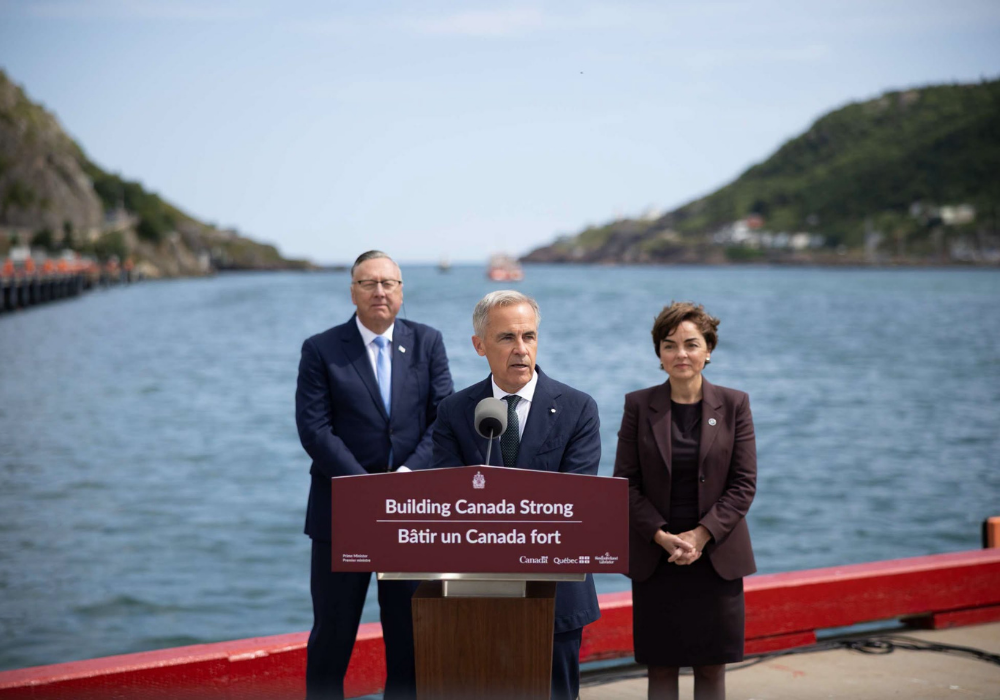
This phrase has appeared across government communications products. The prime minister’s “Forward Guidance” video even set a goal to “build clean energy on a scale that would astound even Sir Adam Beck,” a reference to the Ontario politician and early advocate of hydropower on the Niagara River. But while the conventional part of this equation is clear – and backed by billions of dollars in public money – the clean part is less so. The recent clean-energy announcement between the federal government, Quebec, and Newfoundland and Labrador is important progress, but more of the same is needed right across the country to deliver on the objective.
4. “Made-in-Canada sustainable investment guidelines”:
This was one of the core climate commitments in Budget 2025: a pledge from the Carney government to support the development of made-in-Canada sustainable investment guidelines which will be published in 2027, and to explore the development of a sustainable bond framework to be aligned. The federal government tapped the Canadian Climate Institute and Business Future Pathways to develop the guidelines collaboratively. In July, we published our first draft report, proposing a framework for action.
5. “Achieve net-zero emissions by 2050”:
This commitment from the prime minister is one that was baked into the text of the final MOU agreement with Alberta and reiterated elsewhere. Ultimately, if it is to have any credibility, it needs to be backed up by sufficient policy action to get Canada on track. At the moment, we are not.
Add it all up and you get a list of policy promises that have the potential to improve people’s lives, electrify the economy and reduce national emissions. As much of the country continues to feel the impacts of yet another dangerous wildfire season driven by climate change, the urgency to act is clear.
Since Carney’s election, the climate focus has been on where his government stood with respect to Trudeau-era policies. With Parliament set to return, this will now shift to whether the Carney government is living up to its own explicit goals.
Rick Smith is president of the Canadian Climate Institute.
The Weekly Roundup
Get all our stories in one place, every Wednesday at noon EST.