Canada’s urban canopy is set to branch out.
Earlier this year, the federal government partnered with the Federation of Canadian Municipalities (FCM) to announce an investment of $67.8 million in urban forestry projects across the country. The money will support 165 tree-planting projects, including approximately $4.9 million for street trees to reduce heat risk in Vancouver neighbourhoods and $2.2 million to reforest the Cooksville Creek watershed in the City of Mississauga.
“A single investment in trees also delivers cleaner air, biodiversity, carbon storage and public health benefits that conventional infrastructure typically doesn’t,” says Berry Vrbanovic, mayor of Kitchener, Ontario, and council chair of the Green Municipal Fund, an FCM program that earmarked funding for the project. “Municipalities increasingly see urban forests as essential community assets, and this initiative is building the plans and capacity to support that shift.”
The announcement is not the first time that the federal government has invested in urban trees. The $67.8-million commitment is part of a larger $291-million investment through the Green Municipal Fund’s Growing Canada’s Community Canopies initiative, which aims to support the planting of at least 1.2 million trees by 2031.
The September announcement came as Environment and Climate Change Canada released its 2026 Canada’s Changing Climate Report, which finds that average temperatures across Canada have risen by 2°C. The report predicts that temperatures will continue to rise throughout this century, putting increasing pressure on cities to keep buildings cool while continuing to reduce fossil-fuel use.
When researchers at the University of Ottawa combined aerial imagery of the city’s urban tree canopy with electricity consumption data for 1,968 houses, they found that trees within 12.5 metres were associated with a 2.9% reduction in electricity consumption (primarily cooling systems) during the period the trees are in leaf.
This echoes around the world as cities are rethinking how they plant and use trees not for aesthetic appeal, but as infrastructure to be invested in.
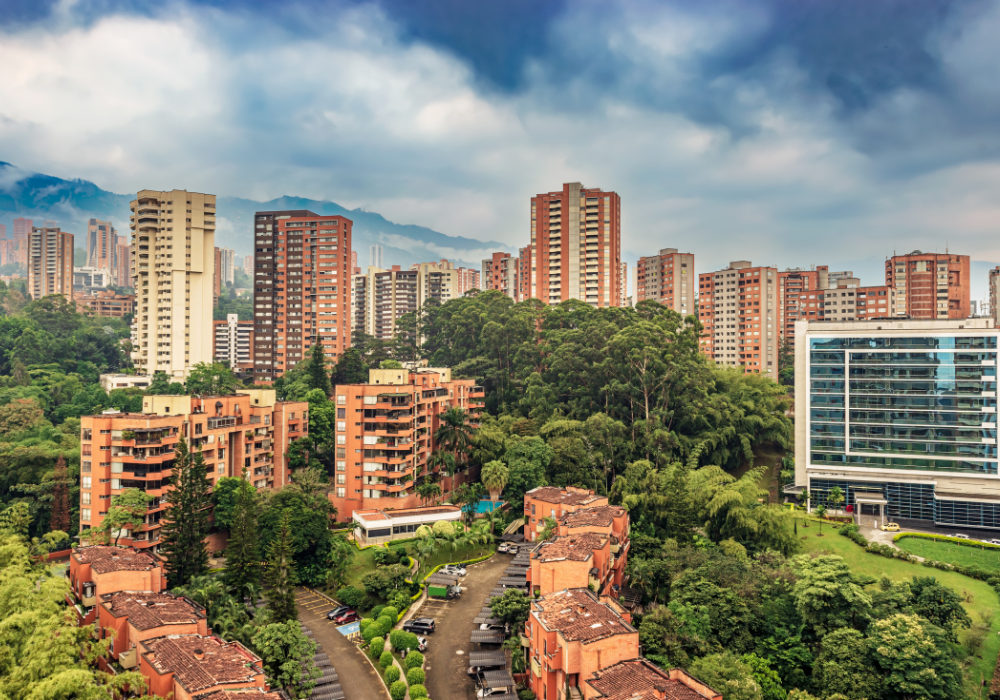
Medellín, Colombia
After 50 years of rapid urbanization in Medellín, the heat-island effect was intense. Since 2016, the city has developed a network of 56 green infrastructure projects covering more than 1.3 million square metres across the city. With an initial city investment of US$16.3 million, the corridors have paid dividends by reducing exposure to hot temperature events by 2°C, with an expected further decrease of 4°C to 5°C in the next two decades.
In 2025, Medellín was among 283 cities recognized by Tree Cities of the World, a program supported by the Arbor Day Foundation and the United Nations Food and Agriculture Organization. To qualify, cities must assign public responsibility for trees, document annual investment in planting and care, and celebrate trees publicly.
Sydney, Australia
The City of Sydney has approximately 34,500 street trees and 14,000 park trees, along with an estimated 40,000 private trees. In its 2021 Greening Sydney Strategy, the city earmarked $377 million (US$262 million) to invest in parks, green roofs and walls, streetscape gardening and improved urban forests across the whole local government area, including the planting of at least 700 trees a year.
“We see trees and green spaces as essential infrastructure, as effective and extensive canopy cover can help reduce temperatures on the ground by up to 10 degrees,” writes Clover Moore, Sydney’s mayor.
Stockholm, Sweden
The City of Stockholm has invested heavily in trees. In its 2025 budget, the city allocated 10 million krona (approximately US$1 million) for tree planting. To keep the trees healthy, the city has developed a specialized planting-bed system to help trees survive in dense urban environments, where compacted soil and paved surfaces often restrict vegetation growth. The “Stockholm model” combines structural stone with biochar (organic compost) to give roots room to grow, retain water and nutrients, and allow rainwater to infiltrate the soil rather than flow directly into drains. The trees live longer, cool overheated streets and manage stormwater, making them a functional part of the city’s climate-adaptation infrastructure.
New York City, United States
New York City’s tree canopy covers 23.4% of the city and includes more than seven million trees along streets, in parks, in front of businesses and on private property. The MillionTreesNYC initiative, launched in 2007, was a turning point for NYC’s urban forest. By 2017, the city had successfully planted one million trees, which provide ecosystem services such as air-pollution removal, stormwater absorption, carbon storage and temperature regulation.
In fact, analysis by the U.S. Forest Service, NYC shows trees are estimated to reduce annual residential energy costs by US$17.1 million per year.
However, while progress is being made, tree canopy in historically disadvantaged neighbourhoods, including parts of the eastern section of NYC’s Queens borough, can be less than 10%. “We must treat growing our urban forest as a shared civic project that reflects our commitment to a healthier, more resilient, and more equitable city for all,” Mayor Zohran Mamdani writes.
Singapore
Singapore has earned a global reputation as the “City in Nature.” It plans to plant 170,000 trees in industrial areas by 2030, adding to the city’s already seven million trees. Of those, the National Parks Board manages around six million; the remainder are managed by town councils, private landowners and non-profit groups.
The government encourages all residents to care for the environment and has initiated the Plant-A-Tree Programme. Individuals and groups are invited to plant trees and donate S$300 (US$234) to support the care of a tree. The program forms part of Singapore’s OneMillionTrees movement, which aims to plant an additional one million trees by 2030.
Jennifer Cole is a Vancouver journalist writing about the people and ideas restoring ecosystems and building a more sustainable future.
The Weekly Roundup
Get all our stories in one place, every Wednesday at noon EST.