
Tianjin has long been a pivot in commercial and cultural expansion for China. More than 600 years old, the northern port city funnelled rice and grains to the south, and then people and commodities, before establishing itself as an international gateway to the West.
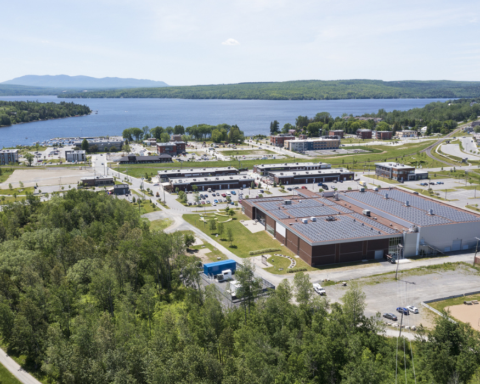
As an industrial powerhouse, it has more recently turned into an example of Chinese green transformation, boasting the world’s first smart and zero-carbon port that is 100% electricity driven and green-energy backed. Onsite industrial-scale wind turbines and solar panels ensure renewable-energy self-sufficiency in the 10th-busiest port in the world, handling more than 20 million shipping containers annually.
It’s perhaps no wonder, then, that China chose to host last year’s summit of the Shanghai Cooperation Organization in Tianjin, on the banks of the Bohai Sea, in yet one more show of growing influence from Beijing. With twice the number of world leaders in attendance since the summit launch in 2001, from Russian President Vladimir Putin to Indian head of state Narendra Modi, Xi Jinping called for an end to the “Cold War mentality” that was triggering “turbulence and transformation” and called for “equal and orderly multipolarization” of the world that could pave the way to a “more just and equitable global governance system.”
The group pledged increased cooperation in energy, infrastructure, green industry, AI and innovation. These are the economic pillars of the present and the future that is being built. And they are the architecture for a new kind of cold war, one over our ecological future, propelled by a growing geopolitical rivalry between the giants of the 21st century.
Great power rivalry
In an article last year in Foreign Policy magazine, the influential historian and futurist Nils Gilman argued that the advent of the “ecological cold war” is upon us, driven by a struggle “over the metabolic basis of modern industrial society.”
“Call it a Green Entente vs an Axis of Petrostates,” he wrote on LinkedIn.
In the wider transition to a low-carbon economy, China needs no introduction. Its influence in the green transition – through supply chain routes and cheap hardware – is plain to see. It has installed more solar and wind than the rest of the world combined, the United Nations has said. Its capacity to drive down the cost of clean technologies has been a boon for reining in the growth of carbon emissions, giving vast swaths of the planet the tools to shift to renewables.
It has also played at least some role in the U.S. decision to retreat from climate policies, with a Trump administration that has made a U-turn to a fossil fuel agenda and adopted protectionist measures in an “America first” attempt to decouple from Chinese economic might. At the same time, the United States has signalled a sharp interest in ridding itself of dependency on China for critical minerals, which are not just key to green tech but intrinsic to military hardware. This year, Trump launched “Project Vault,” which includes loans for domestic mining and a bid to stockpile reserves.
Europe has responded to growing national backlash to climate policies by cooling them down and doubling down on its own protectionist measures. In the midst of all this, emerging economies that could help accelerate the energy transition are running up against roadblocks.

A piece of the green pie
While some observers take issue with Cold War framing, others are mapping out the ripple effects of these geopolitical tensions when it comes to the race to slow down planetary warming. “We are in the midst of a green cold war,” agrees economist Jorge Arbache, a professor at the University of Brasília. “The implications are that China, which is already leading, will probably lead even more because China will keep investing in green production.”
For Arbache, the heart of the struggle has to do with the amount of money that is at stake. Suffice to say, it’s a lot. One 2025 estimate from the Boston Consulting Group pegs the opportunities embedded in four key sectors – critical minerals, green tech manufacturing, green industrial material and green services – as US$11 trillion by 2040. “We are talking about an extremely big business agenda, and of course there is a competition in terms of who will eat what size of the cake,” Arbache says.
Although many developed countries are well positioned to participate in that agenda, it is also true that they do not necessarily have the key elements, such as critical minerals, available clean energy, carbon markets, abundant water and biodiversity. “Geography is back,” Arbache says. That means that developing economies that do have those assets could find themselves better positioned than before. “It gives those economies a bargaining power that they did not have very recently,” he says.
Chaos vs. foresight
But the name of the game, lately at least, has been chaos, driven by its number-one agent, U.S. President Donald Trump. “If I could sum it up, it’s better to govern chaos, because order is too costly,” observes Sabino Vaca Narvaja, a political scientist and former Argentine ambassador to China. “A fragmented society is easier to manipulate.”
China, of course, is steeped in contradiction, pouring money into coal projects, and facing accusations of human rights violations. It also has a different logic to its movements, Vaca Narvaja notes, one that bets on the long term. And so far, it has paid off.
The Chinese incursion into the green market was not about business at the outset, Arbache notes; it was about domestic security. Beijing registered, decades ago, the vulnerability it could face when it came to power supply. A desire to become energy self-sufficient shifted it into green-tech development, which has positioned it as a leader in renewables development. It now has a stranglehold on a huge chunk of the critical-minerals market, controlling 50% of global production and 87% of processing and refining.
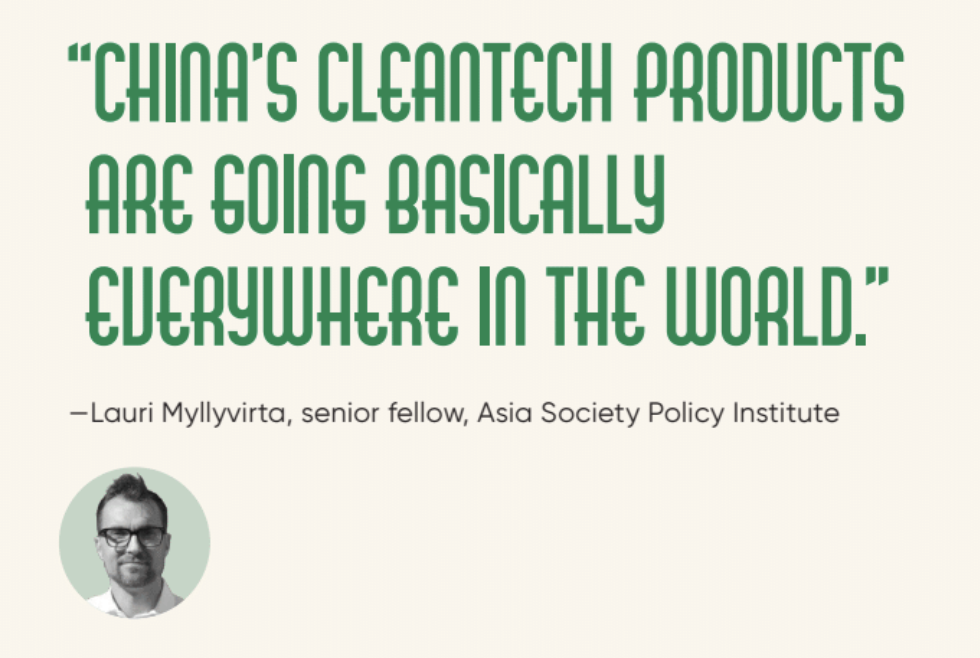
China’s formula also relies on the rest of the world, Vaca Narvaja notes. It needs the world to buy its products. And it is. “China’s cleantech products are going basically everywhere in the world,” said Lauri Myllyvirta, non-resident senior fellow at the Asia Society Policy Institute’s China Climate Hub, in a conversation held last year on China’s climate path amid trade tensions.
RELATED STORIES

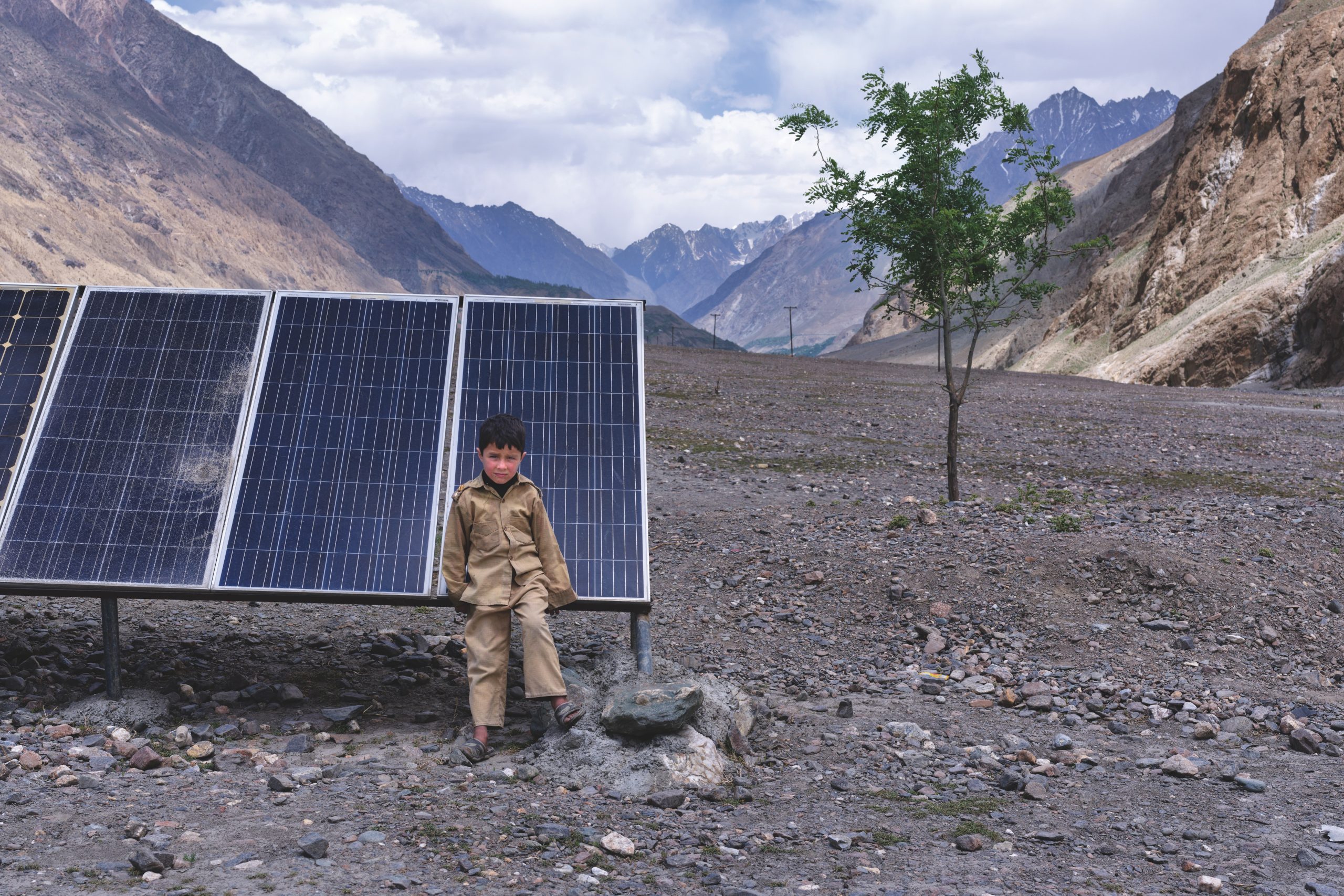
For all major cleantech products except batteries, “the Global South, broadly understood, has overtaken the old developed world as the larger destination,” Myllyvirta said. There are countries with impressive uptake in solar, such as Pakistan, South Africa and Middle Eastern countries, but it’s the broad-based nature of the boom that’s sending the biggest signal. “From one side, there is the cost competitiveness of Chinese supply, and from the other side, there is a massive diversity of drivers,” he said.
Electrification is everywhere. Cities are turning to electric buses. Drivers are turning to electric vehicles. Governments and individuals alike are turning to solar power in the Middle East and Africa. Clean-energy sectors continued to drive growth in China in 2025, doubling in value from 2022 to US$2.1 trillion – which is equal to the economies of Brazil or Canada, according to an analysis from the think tank Carbon Brief.
At the same time, a glut in solar panel production is leading to uncertainty. Beijing set its 2026 growth target between 4.5% and 5%, the lowest level in 35 years, noting a “grave and complex” landscape.
“I don’t think we will be talking about renewable energy the way we are if it wasn’t for what China has been able to accomplish in the last decade,” says Jai Asundi, executive director of the Center for Study of Science, Technology and Policy, in Bangalore, India. “Taking a technology that has been developed somewhere else, and driving the price down. A classic capitalistic efficiency market. That is, if you are more efficient in the way you use a resource, then the capital flows to you.”
Emerging economies demand protagonism
The flip side of that efficient flow of capital, of course, is that it can make it difficult for other economies to compete. Take a place like India, where attempts to jump-start domestic green-energy device production have stalled. “Energy prices are very high in India. So to produce something is already very costly. And some of these technologies are very energy intensive,” Asundi says.
India, which represents 17% of the world’s population, is a prescient case study for wide swaths of the world that are trying to shrink a yawning inequality gap by raising gross domestic product, without contributing to global warming. The developed world built its industrialized wealth at the expense of the environment. That is no longer an option.
“What we are struggling with is this notion of how we work as an ecosystem,” Asundi says. “How do we work as a global society as opposed to a country-driven society? Because after all, climate change is not a country phenomenon; it is a global phenomenon.”
Chen Yu, senior policy officer at the non-profit Global Witness, agrees. “U.S.–China competition may continue, and the global energy landscape seems to be becoming more regionalized and multipolar, but this does not necessarily mean inevitable confrontation,” she says. “The key question is whether competition preserves space for cooperation and allows for fairer rules and resource distribution, rather than creating exclusive blocs.”
Whatever the mix, what matters, she stresses, is that the process of reducing emissions is not delayed.
The rise of ‘powershoring’
Unfortunately, the current moves and countermoves of nations trying to bolster national economies, and respond to electorate demands, is proving detrimental. Arbache says there are alliances available now using today’s technology that could speed up decarbonization, but they are being squandered. The Brazilian economist, who is also the former vice president of the Development Bank of Latin America and the Caribbean, coined the term “powershoring” to describe the strategic relocation of energy-intensive industries to countries that have clean, abundant and secure energy. To produce one tonne of aluminum using coal-fired electricity results in 20 to 22 tonnes of carbon dioxide, Arbache says. But if you produce that same aluminum in Iceland, which runs on nearly 100% renewable power, the carbon output drops to 2 to 3.5 tonnes.
Countries like Brazil, Uruguay and Paraguay also offer abundant green grids for manufacturing. But they are not attracting as many powershoring projects as anticipated from places like Europe, Arbache says. “Although they need new allies and friends to solve their problems, they are still very skeptical because of this very notion of protectionism,” he says. “In the end, they are harming their own economies and they are also harming our economies.”
Canada’s balancing act
Canada, with three-quarters of its exports going to the United States, is also navigating tricky terrain. The shifting sands of Trump tariffs has led the government to overhaul how it approaches trade and put it in hot pursuit of new partners – or increasing the strength of existing ones.
Prime Minister Mark Carney said as much in his headline-grabbing speech at Davos this year, where he warned middle powers that if “we’re not at the table, we’re on the menu.” The phrase carried added weight because it came on the heels of an announcement to expand trade with China, and, crucially, allow at first up to 24,500 Chinese EVs annually into the Canadian market. Carney has since signed agreements with India to export uranium for its fleet of nuclear reactors, critical minerals, and oil and gas. The government also announced a split from the United States over auto policy, revitalizing incentives for EV production and purchase, and the intention of customizing new tailpipe emissions rules, rather than defaulting to the U.S. ones.
The divergence from U.S. policy is significant, says Rick Smith, president of the Canadian Climate Institute. “All we get from the Trump administration is this drumbeat that fossil fuels are the future. It’s very easy to let that overwhelm us as Canadians – to assume that that’s correct, and it’s not,” he says. “The actual economic opportunity is in decarbonization.”
While there are inherent challenges to decarbonization for an oil- and gas-producing country that other nations do not have, Smith says Canada is in a privileged position to move in on the booming battery market. “We’ve got all the elements of a very significant battery supply chain in Canada. And very few countries can say that,” he says. “In a grand contest between China and the United States, should we just be happy that China’s winning on the decarbonization front? No. We should also be getting our elbows up and trying to compete.”
Natalie Alcoba is a Buenos Aires-based journalist and senior editor of Corporate Knights.
The Weekly Roundup
Get all our stories in one place, every Wednesday at noon EST.