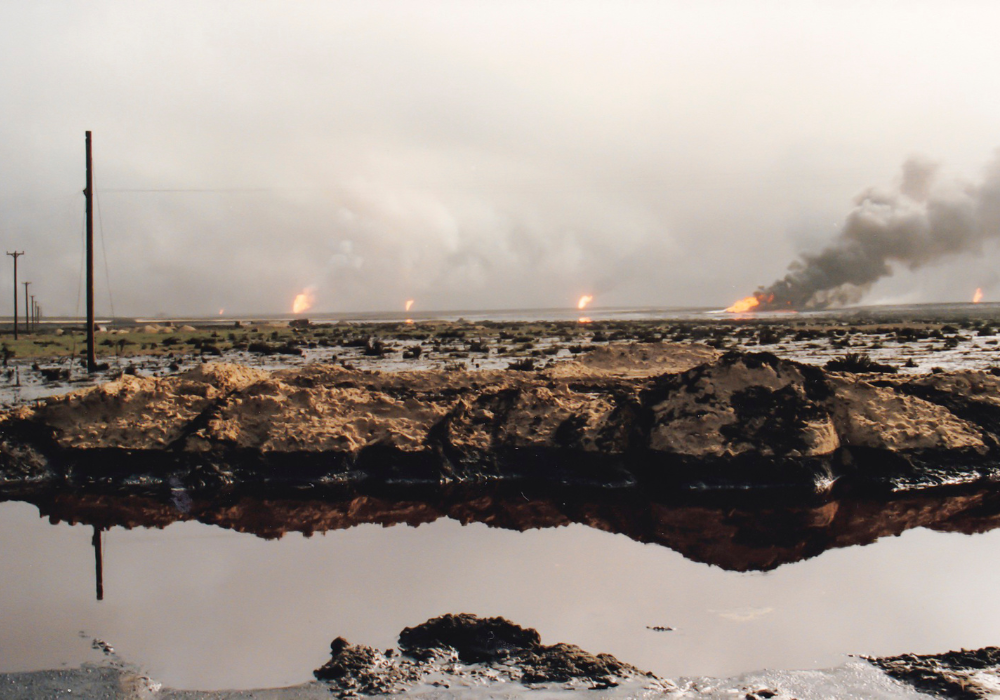
My father saw the devastation of the Second World War firsthand and often said, “There are no winners in war.” It sounded like moralism when I was young. Today it reads like systems analysis. In a world of tight carbon budgets and finite critical minerals, the war economy and the energy transition are not parallel projects. They are rival claimants on the same resources, and only one of them can ultimately keep us safe.
We already know the headline facts. The wars in Ukraine and Iran are producing emissions on the order of a mid-sized industrial economy. The scramble for energy and resources helped set the stage, and the destruction of pipelines, depots and power stations has become a recurring spectacle. Analysts have tallied the greenhouse gases, the poisoned soils, the bombed substations and the forests turned to smoke. Less discussed is what this means for the energy transition itself: every tank, missile and drone is built from metals and fuels we also need for wind turbines, batteries and resilient grids.
Every tonne of copper that ends up in shrapnel rather than in wires, every kilogram of lithium that ends up in loitering munitions rather than stationary storage, slows the transition and deepens climate risk for everyone, including the supposed winners. When we choose war, we are not just adding to the climate problem; we are cannibalizing the solution.
Here we face a fork in the road. One path is to treat transition minerals as the new oil: strategic assets to be hoarded, weaponized and fought over. That path is already visible in export controls, trade extortion and a growing list of violent incidents and community protests around mines in the GlobalSouth. The other path is to treat them as a global lifeline for common security, with shared stockpiles, transparent reporting, producer countries as real partners and apolitical norm that the first call on these minerals is decarbonization, not escalation.
Modern warfare also confirms, in the harshest possible way, the old principle that shows up in all the great religious traditions: what you do unto others, you do unto yourself. In a tightly coupled Earth system, the effects of our actions propagate through food webs, supply chains and the atmosphere. When a refinery or gas pipeline explodes, the carbon doesn’t check passports on the way up. When artillery fires shell after shell into fields, the contaminants do not ask permission before entering rivers and crops. Thermobaric weapons suck oxygen from the air and generate firestorms; forests and towns burn, releasing greenhouse gases and black carbon that darken ice and accelerate melting thousands of kilometres away. High-precision missiles and drones can target power plants and transmission lines with uncanny accuracy; the replacement steel and concrete, when they eventually arrive, carry their own enormous carbon price tag. In Ukraine, war-related emissions are now estimated to exceed the emissions from all of the country’s civilian sectors.
And yet, from a certain narrow corner, war looks like a success story. Defence budgets climb; order books for missiles, shells and air defence systems fill; share prices rise. Headlines announce record revenues for the world’s largest arms makers. If your horizon is the next quarter and your constituency is shareholders, war is indeed “good for business.”
Should governments that proudly report power-sector decarbonization be allowed to keep military emissions off the books?
But that business model is parasitic on the larger economy and on the biosphere. War destroys infrastructure, scares off investment, shreds trade links and forces governments to divert money from health, education and decarbonization into replenishing stockpiles and repairing damage. It also burns through critical minerals that the low-carbon economy will need for generations.
Militarization is itself a threat to our security and that leads to some uncomfortable but necessary questions for business and finance. Should climate-aligned investors treat defence exposure as compatible with net-zero strategies, given what we now know about war’s emissions and mineral demands? Should governments that proudly report power-sector decarbonization be allowed to keep military emissions off the books? Should critical-mineral off take agreements be judged only on price and supply security, or also on whether they prioritize uses that reduce net global risk?
My father’s line about there being no winners in war was, in its way, a statement of planetary accounting. In the 21st century, with the atmosphere full and the mineral supply tight, any war anywhere threatens states and markets everywhere, and the thin atmospheric envelope that makes any kind of economy possible at all.
Ralph Torrie is director of research at Corporate Knights.
The Weekly Roundup
Get all our stories in one place, every Wednesday at noon EST.