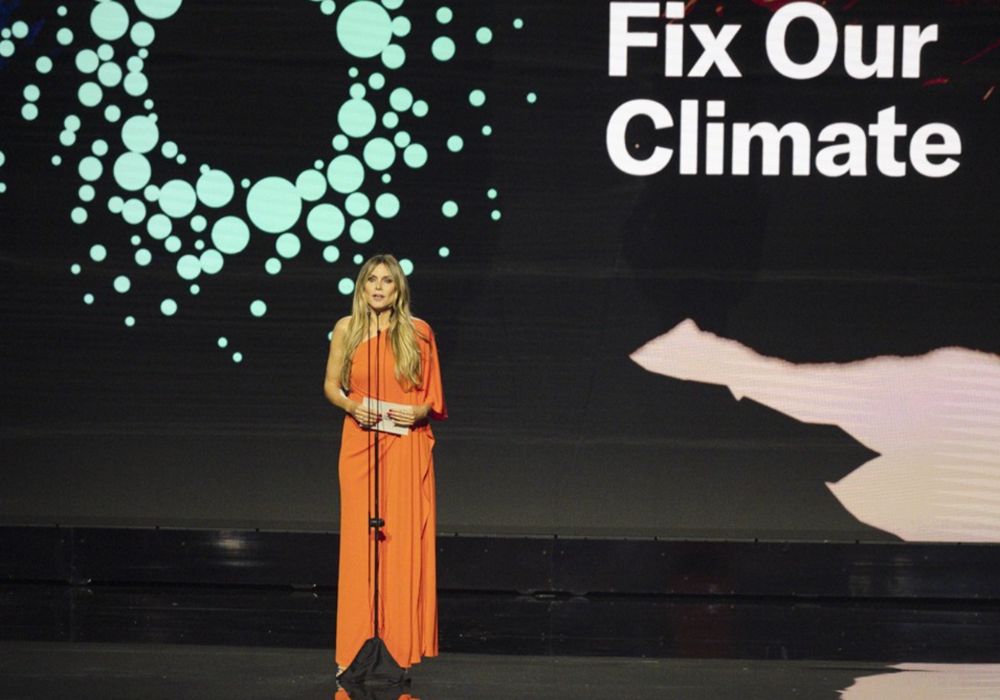
The makers of heat recovery systems don’t tend to generate much media frenzy, but when they’re introduced by the likes of America’s Got Talent judge Heidi Klum, Canadian supermodel Winnie Harlow and William, Prince of Wales, the paparazzi start to take notice. That’s the magic formula behind this month’s Earthshot Prize awards ceremony in Cape Town, South Africa, a glitzy event that shamelessly combined Hollywood pizzazz and British royalty with innovative waste-heat systems, wildlife conservation and circular-economy waste solutions.
Developed by Prince William and biologist and broadcaster David Attenborough four years ago as a way to build excitement (and investor attention) around planet-saving ideas, the Earthshot Prize gives five environmental innovators £1 million each to grow their vision and impact. The A-list celebs, the televised “green carpet” preshow and the Shark Tank–level cash prizes may be straight out of Hollywood, but the event’s true objective is all business. Not just the five winners, but all 15 finalists become Earthshot “fellows” – eligible to draw on ongoing advisory services and a global funding platform designed to accelerate further growth.
As the prince, wearing white biodegradable sneakers, told the audience in Cape Town, it was a trip to Namibia in 2018 to study the illegal wildlife trade that helped him recognize “the power of how innovative, positive solutions to environmental problems could drive transformative change for humans and nature.”
This year’s winners were a mix of scrappy grassroots groups, start-ups and multinational deal-makers. In the “Clean Our Air” category, the winner was the youth-led advocacy group Green Africa Youth Organization (GAYO), based in Accra, Ghana. In communities where inadequate waste-management systems mean that most garbage is simply burned – including mountains of car tires and electronic waste – GAYO is promoting the no-waste movement. Through education and innovation, and savvy lobbying, GAYO has set up youth-run sorting centres where trash is separated and reused, reducing pollution while creating more than 700 jobs. GAYO is also involved in sustainable agriculture, disaster risk reduction and renewable energy. With a team of 150 employees in four countries, founder Desmond Alugnoa says that “the aim is to create a sustainable circular economy across Africa.” In addition to its 150 employees, GAYO has trained more than 5,000 people to upcycle waste and make a living by selling products such as compost and charcoal briquettes.
The Altyn Dala Conservation Initiative in Kazakhstan set out to preserve the “Golden Steppe,” the grassy plains of central Asia. Overgrazing, agriculture, a shifting climate, poaching and disease have affected many species in this crucial migration corridor, but none more than the saiga antelope, whose numbers dipped from the millions to as few as 20,000 in 2003. By restoring and protecting five million hectares and using ranger teams and aerial patrols to combat poaching, Altyn Dala has helped the saiga population bounce back to 2.8 million. Its work has also resulted in the formation of new national parks and a burgeoning ecotourism industry. The group plans to put its prize money toward doing the same for kulan (wild asses), ertagy (wild Przewalski’s horses) and steppe eagles.
Some Earthshot Prize winners are more global in scope, including the multinational organization that helped secure the “30×30” target, calling for the effective protection and management of 30% of the world’s land and water by 2030, signed by delegates of the 2022 UN biodiversity conference in Montreal. Co-chaired by Costa Rica and France, the High Ambition Coalition for Nature and People (HAC for N&P) gives governments the tools they need to protect more spaces, write their commitments into law and overcome financial and technical barriers to action. HAC for N&P says its efforts have helped 50 member countries enact or strengthen conservation laws. The organization puts special emphasis on protecting ocean waters, since member countries are further ahead on designating conservation lands than on protecting marine ecosystems – which helped HAC for N&P secure Earthshot’s “Revive Our Oceans” award.
RELATED:
Don‘t let climate grief and despair defeat climate solutions
How AI is helping NotCo cook up a plant-based takeover of Big Food
Ram Amar’s ‘crazy’ plan to store a gigaton of carbon at the bottom of the Black Sea
The winner of the “Build a Waste-Free World” prize was Nairobi-based Keep IT Cool (KIC), whose sustainable refrigeration system helps underserved smallholder fishers in Kenya and Uganda reduce spoilage and increase their revenues. KIC works with fishing cooperatives on Lake Victoria and the desert Lake Turkana, where fishers can take two days to collect a catch big enough to transport to market. At fish landing points, KIC now provides solar-powered icemakers and cold-storage units that have cut spoilage and food waste by 98%.
The “Fix Our Climate” finalist was Advanced Thermovoltaic Systems (ATS) of Fort Collins, Colorado, which has developed a simple, safe process to help heavy industries turn waste heat into electricity. Founder Kelly Adams says that current turbine-based recovery systems capture only 40% of waste heat; his company’s container-sized units use modern materials technology to generate electricity from even low levels of heat. What’s more, they use no moving parts, require little maintenance and can be run from an iPhone. ATS hopes to be operational in more than 100 plant sites by 2030, saving 3.5 million tonnes of carbon dioxide.