In January 2025, stocks for quantum computing companies across the board tumbled when Nvidia CEO Jensen Huang predicted it would be another 30 years before we saw a “very useful” quantum computer. One of those companies, IonQ, saw its largest single-day drop with shares plunging 40%.
Now, less than two years later, IonQ has announced a new partnership to deploy Nvidia’s first-ever quantum computer.
With this move, the world’s most valuable company joins the likes of Google, AWS and IBM in deploying new quantum technology. This comes amid an expanding backdrop of new data centres being constructed to meet artificial intelligence’s staggering appetite for computing power. As Corporate Knights has previously reported, data centres require spectacular quantities of water and energy. By its own estimates, OpenAI alone – one of Nvidia’s largest clients – expects to consume as much energy as the country of India and, according to other analyses, emit twice as much carbon as the world’s largest oil companies.
 While the advent of quantum computing is unlikely to slow this colossal build-out in the short term, it does open up some interesting possibilities for addressing these challenges.
Quantum computers are experimental machines that can perform fiendishly difficult computing tasks that would be otherwise impossible for even the most powerful supercomputers. In what is perhaps the highest-profile example to date, Hartmut Neven, the lead of Google’s Quantum Artificial Intelligence Lab, announced in December 2024 that Google’s newest quantum computing chip, Willow, had completed a standard benchmark operation that would take one of the world’s fastest supercomputers 10 septillion (10 followed by 25 zeroes) years. The computation took Willow five minutes.
Find the tennis ball
 In traditional computing, every task – from sending emails to playing Spotify songs – can be boiled down to a string of binary bits, a series of electrical or optical pulses representing a 1 or 0. The more complex the function, the longer the series. Bits can either be a 1 or a 0 but not both. In a quantum computer, a qubit – the quantum equivalent of a classical computing bit – can be both, because of a quantum property known as superposition.
Then there is entanglement, wherein the state of one subatomic particle determines the state of another, even if separated by great distances. If two coins were entangled with one another, and you flipped one of them, the result of flipping one (heads) would determine the result of flipping the other (tails), regardless of whether you were in the next room or on the surface of the moon.
A quantum computer manipulates subatomic particles in such a way that it takes advantage of these properties, leading to exponential efficiencies in computing power. In a 2022 piece for The New Yorker, Neven explained one quantum algorithm as follows: “I like to think about it as a huge closet with a million drawers.” One of the drawers contains a tennis ball. A human rooting around in the closet will, on average, find the ball after opening half a million drawers. “[A quantum computer] could do it in just 1,000 steps,” Neven said.
Energy efficiency not a given
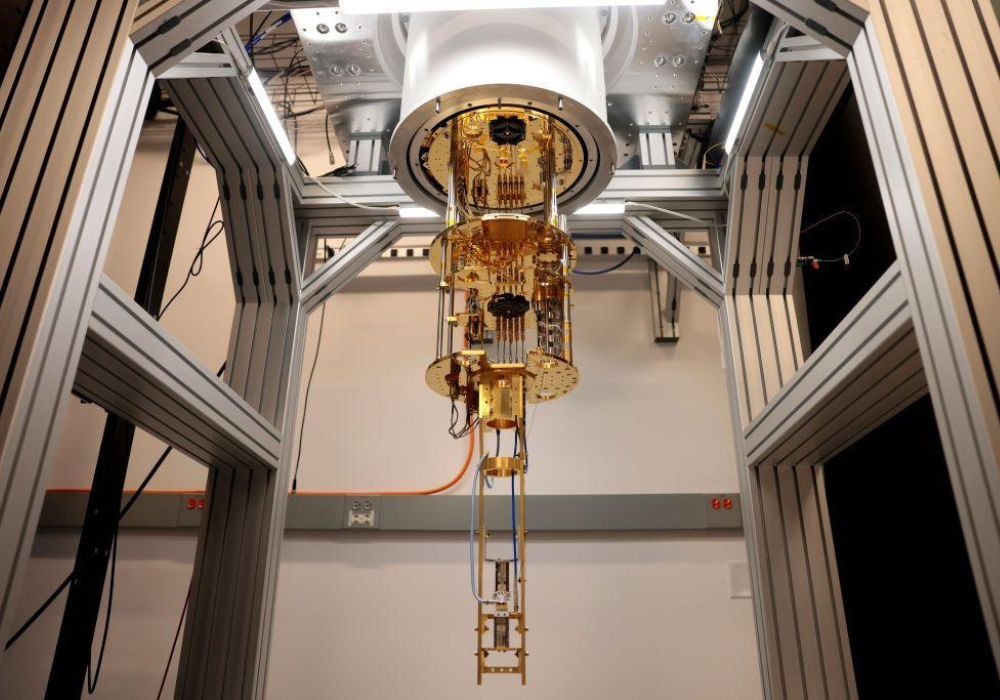
Quantum efficiency has implications for energy use as well. Julian Fletcher, chair of the BCS Quantum Computing specialist group, attempted to develop a formula to compare a supercomputer’s energy use against a quantum computer and concluded that the latter would realize significant energy savings, at least in theory. In practice, however, it may be a different story. Google’s Willow, for example, is housed in a densely wired chamber that looks like a futuristic chandelier, which cools superconducting alloys in the chip to near-absolute zero. The ultra-low temperatures are necessary because even minor interference can dispel the quantum properties and introduce errors. Fletcher estimates that the additional “overhead” for error correction might make the energy demands for larger quantum computers working on more difficult equations up to 35 times higher than a classical computer.
RELATED STORIES

Error correction remains the largest engineering hurdle to large-scale quantum computers. Fletcher acknowledges there is tremendous difficulty estimating what a one-to-one energy comparison might look like in the future. Others, like the authors of one McKinsey report, say that given their architecture, future large-scale quantum computers are unlikely to come close to the resource demands of the most powerful supercomputers – which, as Science reported, require as much energy as 15,000 homes and must be cooled by pumps powerful enough to fill an Olympic-sized swimming pool in minutes. Those efficiencies will become especially consequential if quantum computers remove the limits on computing power presented by physical infrastructure. “Theoretically, a fully fault-tolerant quantum chip could one day rival the output of billions of classical GPUs on certain highly specialized problems,” the McKinsey authors wrote, “such as simulating molecular quantum systems, which classical machines struggle to scale efficiently.”
The Google researchers note that the computations these machines are able to perform today are difficult but, so far, not very useful. Experts like Neven suggest that when that changes, it may lead to breakthroughs in material design that could have unique environmental impacts: the discovery and creation of new molecules that can more effectively hold a charge in an electric car’s battery, for example, or that will revolutionize carbon-capture technology, or withstand the heat and pressure required to create fusion energy here on Earth.
“Many of these future game-changing applications won’t be feasible on classical computers,” Neven wrote. “They’re waiting to be unlocked with quantum computing.”
Tristan Bronca is a magazine writer and editor based in Newmarket, Ontario.
The Weekly Roundup
Get all our stories in one place, every Wednesday at noon EST.