

The Canadian Climate Institute has published a detailed script for the Mark Carney government to spearhead wide-scale upgrades of Canada’s electricity system. The report published Wednesday argues that for the prime minister’s massive trade and building push to succeed, the country must move quickly to preserve a key competitive advantage: abundant clean, low-cost power.
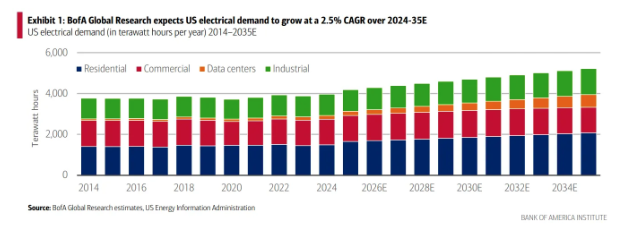
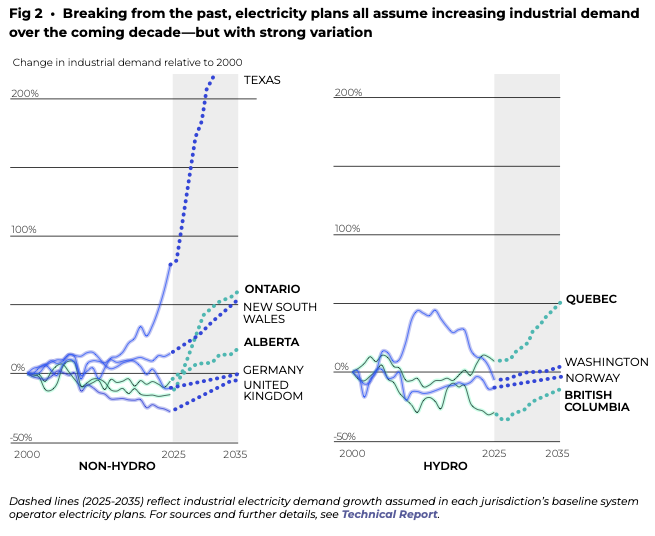
Canada has some of the lowest industrial power prices among high-income economies, and 85% of the grid is non-emitting, with nuclear and hydro playing an important part of the mix. But as artificial intelligence and electrification drive up demand faster than expected, Canada’s edge for attracting big industry is at risk of eroding, the authors write. After a decade of flat growth, Bank of America Institute now forecasts 2.5% compound annual growth until 2035. Investment will flow to regions with the best grids, not just the most resources, but Canadian jurisdictions are systematically underplanning for industrial demand, they argue.
The report, titled Power Play: How to Supercharge Canada’s Clean Electricity Advantage, contends that for Carney’s economic strategy to work, the country must overcome an ethos of risk-avoidance at the planning level. Utilities and regulators are wary of overbuilding infrastructure and passing the bill to ratepayers. But the bigger risk now is underbuilding, the Climate Institute suggests, especially as faster-moving regions take advantage of low-cost renewable technologies to improve their offer for energy-hungry industries.
The new research presents side-by-side comparisons of Canada’s four largest electricity systems with other jurisdictions around the world. Alberta and Texas are treated together as “market-led systems,” while Ontario and the United Kingdom are compared as “coordinated market systems.” Four other jurisdictions – British Columbia, Quebec, Washington and Norway – are grouped as “hydro-led systems,” whose reservoir storage gives them an inherent advantage with clean, dispatchable power. Quebec’s tie-in with California’s well-functioning carbon market is an added bonus for investors.
Implementing growth
Increasing grid flexibility across all regions is one of the foremost recommendations of the report. That means more “firm” power from low-emissions sources like batteries, as well as more interties with neighbouring grids so that available clean energy is more likely to be shared and less likely to be wasted. The report also points to better long-term planning, more predictable procurement for renewables, modernized rate design, and stable climate policy as critical to sharpening Canada’s offer. It argues that funding interregional transmission lines should be a national policy imperative.
Increasing Indigenous ownership is another strategic priority, to uphold self-determination and bring in capital. “Indigenous ownership could further unlock $12 billion in generation and $5 billion in transmission equity,” the report states, citing the First Nations Major Projects Coalition.
The Climate Institute’s central argument about protecting Canada’s clean electricity advantage echoes a report published in February by SHARE, or the Shareholder Association for Research and Education. “Grid constraints, slow infrastructure build-out, and mounting policy and regulatory barriers are colliding with skyrocketing demand from electric vehicle manufacturing, battery materials, critical minerals, AI and data centres, and green industrial production,” the authors write. Increasing the flow of clean electricity “adds material asset value and enables market access” for industries like tech, AI and mining, SHARE’s Power at Risk report states.
Mark Mann is the managing editor at Corporate Knights.
The Weekly Roundup
Get all our stories in one place, every Wednesday at noon EST.