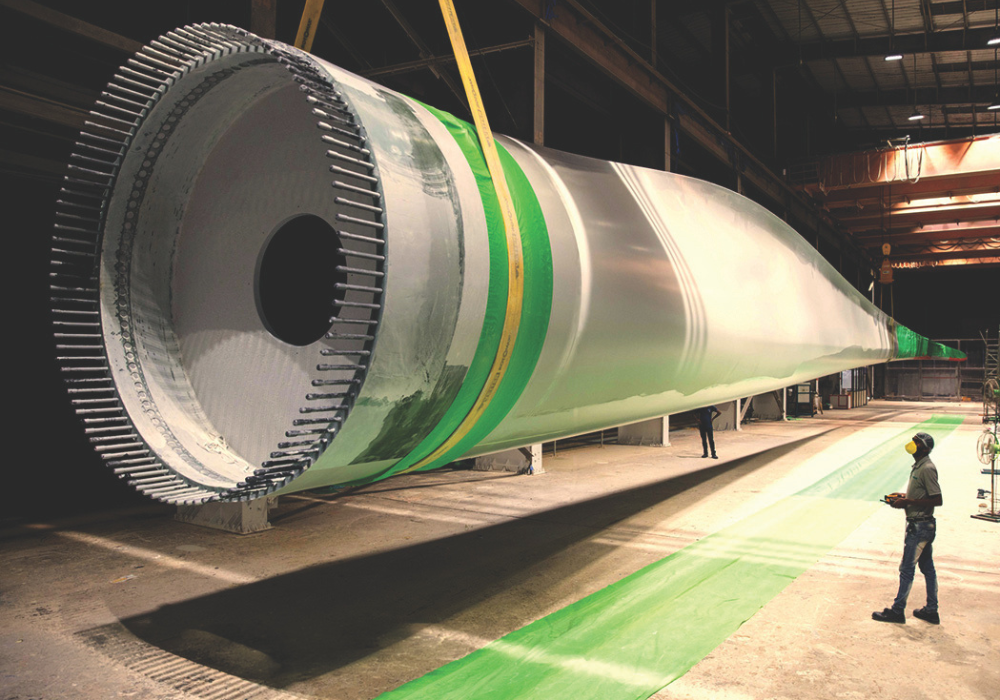
Among the many challenges for climate policy worldwide, decarbonizing the steel industry is surely one of the thorniest. One company offering a way forward is India’s Suzlon. Over the past year, the wind turbine maker has signed a string of deals to supply renewable electricity to steel producers, giving the carbon-intensive industry a faster, cheaper way to cut some of its emissions.
Suzlon Group is a renewable-energy provider headquartered in Pune, India, with wind projects in approximately 17 countries. In January, Suzlon announced that it had secured a 248.85-megawatt wind power order from the global steel giant ArcelorMittal Group. The deal is part of a larger US$900-million investment in clean energy across a series of projects across Maharashtra, Rajasthan and Gujarat. Together, they combine 250 megawatts of wind power, 736 megawatts of solar power, and 800 megawatt-hours of battery storage and are set to double ArcelorMittal’s renewable-energy capacity in India to two gigawatts by 2028. Collectively, they are expected to cut roughly 1.59 million tonnes of carbon dioxide per year.
Steel production makes up about 12% of India’s carbon dioxide emissions. For every tonne of steel made domestically, around 2.55 tonnes of carbon dioxide are released, roughly 38% higher than the global industry average of 1.85 tonnes. India’s steel industry is responsible for around 240 million tonnes of carbon dioxide emissions annually, a figure expected to double by 2030.
Adding renewables makes a difference, but it doesn’t fundamentally alter the equation for the steel industry. Suzlon’s wind projects cut electricity-related emissions, also known as Scope 2, which come from the power that steel facilities buy from the grid. They don’t replace the actual blast furnaces that account for the bulk of steel’s direct, on-site emissions, or Scope 1. That gap sits at the heart of debates over what qualifies as “green steel.”
To cut emissions further, steelmakers can incorporate carbon capture technology and use low- or zero-carbon fuels alongside recycled steel, but ultimately, they need an alternative to blast furnaces. Electric arc furnaces powered by renewable energy provide an answer, but they rely on recycling scrap for a primary source of iron, and building them demands huge upfront investment, so they’ve been slow to scale. Today, a little over a quarter of global steel production comes from electric arc furnaces.
The lack of a shared definition of “green steel” allows companies to make environmental claims without substantial emission reductions. With no widely accepted framework, green steel is vulnerable to misleading marketing.
Governments are starting to write their own definitions into law. India was among the first, adopting an official definition in December 2024. The European Union is working on its own standards for low-emissions steel under upcoming green product rules. In the United States, federal programs now steer public purchasing toward low-carbon steel, and proposed legislation would support new steel plants aligned with the criteria set by ResponsibleSteel, an international sustainability standard for the industry.
According to Ysanne Choksey of Agora Energiewende, a German think tank, regulatory frameworks serve as critical benchmarks for assessing whether steel producers are genuinely meeting climate standards. What the industry needs are rules that direct investments into low-carbon technologies. Weak standards risk enabling greenwashing, allowing companies to label products as “green” without making the capital investments necessary to decarbonize their operations.
Akshaya Krishnan is a journalist in North York, Ontario.
With files by Alexandre Paquet.
The Weekly Roundup
Get all our stories in one place, every Wednesday at noon EST.