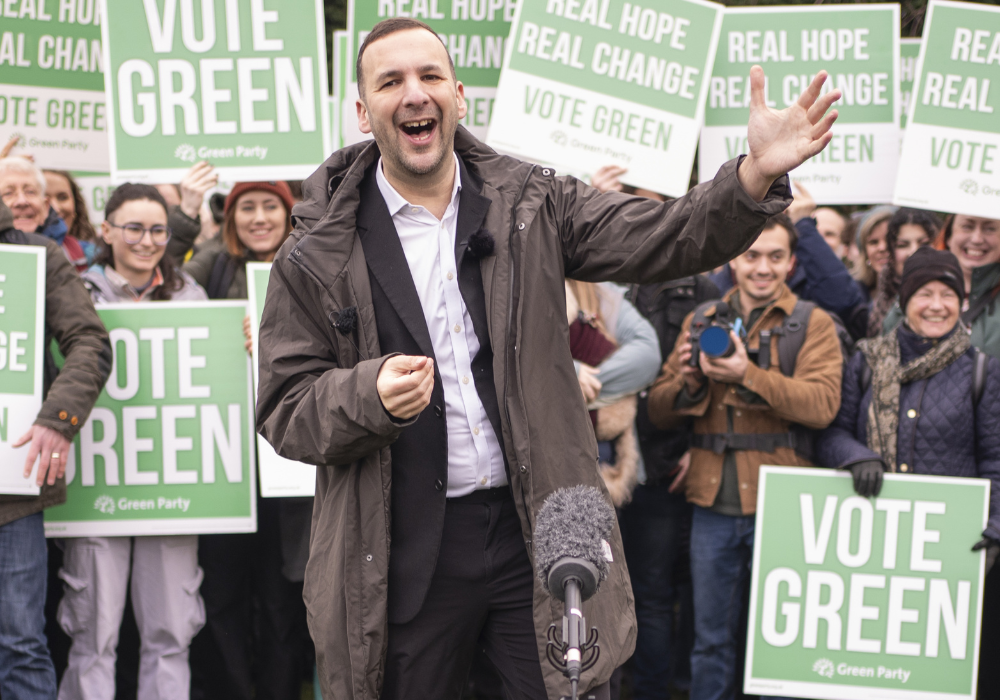
The Green Party of England and Wales is experiencing a historic wave of support under its charismatic new leader, Zack Polanski.
The party’s momentum has been building since the United Kingdom’s July 2024 general election, when voters elected four Green Party members of Parliament out of a total of 650, quadrupling the party’s number of representatives in the House of Commons while removing a handful of seats from the Labour and Conservative parties.
Nearly two years later, the Greens are now averaging around 13.5% support nationally, with a notable gain in recent months, according to an aggregated Guardian tracker. In February, Green Party candidate and plumber Hannah Spencer won a by-election in Manchester’s Gorton and Denton constituency, an area that had been previously held by Labour for the past 90 years, bringing the party’s total number of MPs to five.
What’s powering the surge? Experts say increasing political fragmentation is a key factor, with more voters looking for alternatives to Labour and the Conservatives, which have held the most seats in recent elections. Growing disillusionment with the governing Labour Party is another factor. Britain’s centre-left party is tanking with voters, many of whom feel it has failed to address the cost-of-living crisis or deliver on its promises. According to YouGov’s polling, Prime Minister Keir Starmer’s personal favourability sat at 18% in January 2026.
There’s a big space to the left of the Labour Party that’s been there for a few years. Polanski is tapping into that opportunity.
— Mitya Pearson, University of Warwick
While Starmer’s support stagnates, the Green Party’s Polanski, who is 43, is on an upward trajectory. He was elected party leader in fall 2025, beating two of the party’s MPs with a left-wing eco-populist platform and a direct communication style. Polanski has said the party needs to “connect with that anger and turn it to hope, turn it to possible solutions.” And his message and style have been resonating with an increasing number of voters who feel abandoned by the Labour Party. Since fall 2025, Green Party membership has almost tripled, from 68,500 to more than 200,000.
“I finally feel seen by a politician and someone who is willing to not only defend but make my family’s lives better,” says Tinashe Warikandwa, a London resident who describes herself as a member of the queer community and the daughter of an immigrant and a disabled mother. She is one of the thousands of Brits who recently became Green Party members. “My great interest in Zack is his push to tax the rich,” Warikandwa says. “There is such a discomfort in the U.K., with the cost of everything and not much funding going into our communities. I like his angle of saying there’s more of us than the 1%, so he’s trying to bring us all together. He’s young and fresh and unfiltered.”
Polanski’s message connects the dots between cost-of-living pressures, economic inequality and the climate crisis. He has also taken on issues that Labour and other parties have been reluctant to engage with, including the rights of Palestinian people to self-determination and trans rights.
“There’s a big space to the left of the Labour Party that’s been there for a few years. Polanski is tapping into that opportunity,” says Mitya Pearson, assistant professor in the Politics of Climate Change MA program at the University of Warwick. “Although [the Greens] have always really emphasized the environment and climate change, they’ve been keen to point out that they’re not a single-issue party. So while climate change is part of [their platform], it’s not absolutely front and centre.”
The rise of the Green Party and forward push on climate policies in the United Kingdom stands in contrast to what’s happening in Germany, Austria and other European countries, where far-right parties have been trying to dismantle support for climate policies by blaming them for cost-of-living challenges. Environmentalists and think tanks are raising alarm bells about what they’re calling a “greenlash” against the European Green Deal and other climate policies.
Pearson believes that European voters are still supportive of progressive climate policies but that support for these issues has been superseded by affordability concerns. In both Europe and the United Kingdom, voters are sending the message that affordability and the climate are interconnected and must be addressed as such.
Will Polanski and the Green Party be able to continue to build support in the United Kingdom by connecting those dots? Calls are growing for Starmer to resign, and Pearson says some expect the Labour Party to begin leaning more to the left to rebuild its base. If that happens, there may be more competition for the space the Greens have been moving into. Which could mean more debate about progressive issues, and more choice for voters.
The Weekly Roundup
Get all our stories in one place, every Wednesday at noon EST.