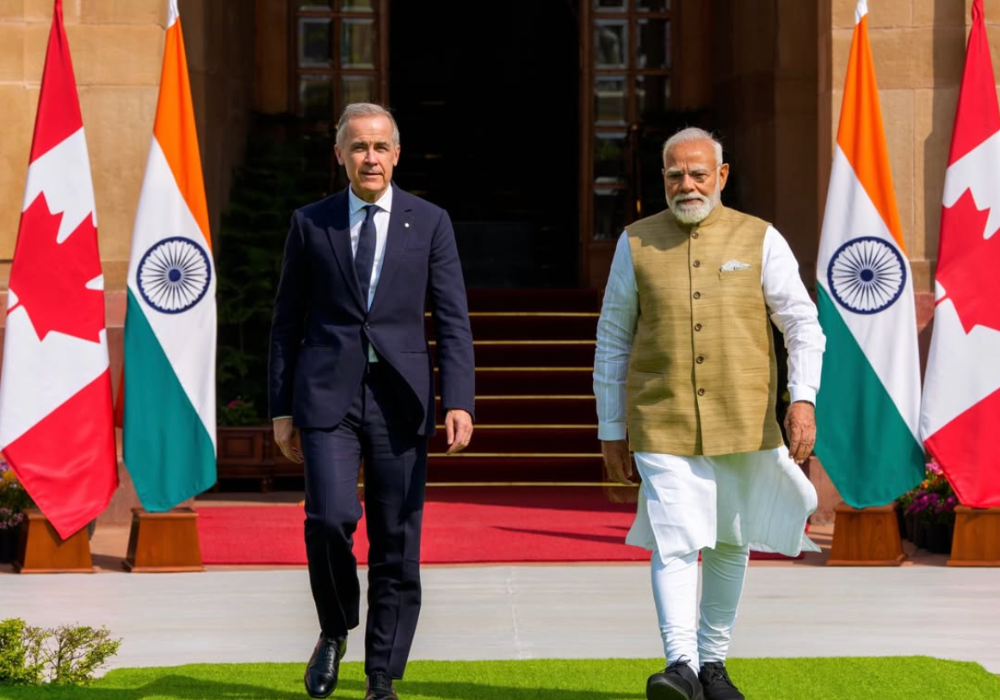
A $2.6-billion uranium export deal, expanded trade in oil and gas, and a plan to double the two-way trading relationship to $70 billion per year by 2030 were centrepieces of a “new partnership” unveiled by prime ministers Mark Carney of Canada and Narendra Modi of India after a meeting in New Delhi Monday.
“With this new partnership, we will not stop until the goals of Atmanirbhar Bharat and Canada Strong are reached,” Carney said, citing the Hindi term for “self-reliant India.”
The agreement will see Saskatoon-based Camemco deliver nearly 22 million pounds of uranium fuel between 2027 and 2035, CBC reports. India currently has 25 nuclear reactors in operation, eight under construction, and plans to boost its nuclear capacity from 8.7 to 100 gigawatts by 2047, the national broadcaster adds.
A wide-ranging joint statement issued by Carney’s office also puts liquefied natural gas (LNG), liquefied petroleum gas (LPG), crude oil and refined petroleum products at the centre of the expanded trade relationship.
Carney “framed this new course as not just a return to how things were but rather an ambitious revisioning of what the two Commonwealth countries can do together in an uncertain era marked by instability,” CBC writes. Just prior to his meeting with Modi, Carney said he hoped to secure a wider free trade agreement with India by the end of the year, possibly in time for a signing at this year’s G20 summit at a Trump property in Miami. The two leaders affirmed that timing after their one-on-one.
“With India positioned to be the largest contributor to incremental global energy demand growth over the next two decades, beyond its current position as the world’s third-largest oil consumer and fourth-largest LNG importer, both sides acknowledged the significant potential to further expand bilateral energy trade,” the joint statement declares. “This includes increased oil and LNG imports by India from Canada, as well as the supply of refined petroleum products from India to Canada. In this context, Canada reaffirmed its plans to expand heavy oil export infrastructure and supplies of LNG to the Indo-Pacific market through Canada’s stated goal of producing 50 million tonnes of LNG per year by 2030 and up to 100 million tonnes by 2040.”
The statement calls for broader cooperation “across clean energy and climate-related value chains, including renewable energy, hydrogen and its derivatives, biofuels, sustainable aviation fuel, battery storage, and electricity systems modernization, recognizing the central role of these sectors in advancing shared climate objectives and energy transition goals.” It says the two leaders also “underscored solutions for carbon capture, utilisation and storage (CCUS) as a key area of cooperation, offering a significant opportunity for the sustainable production of energy and critical minerals.”
And it celebrates a “comprehensive institutional framework to advance bilateral collaboration across solar, wind, bioenergy, small hydro, energy storage, and capacity-building” while recognizing India’s “leadership and capacity in large-scale solar and grid-level energy storage technologies along with scalable models in rooftop solar and other forms of distributed renewable energy solutions.”
CBC has a list of smaller deals that were announced or re-announced this week, including a 1.2-million-tonne coal export contract for British Columbia–based Elk Valley Resources, valued in the hundreds of millions of dollars. Canada will also join the 112-member International Solar Alliance, first conceived by India in 2015 and launched by India and France in 2017.
News coverage of the announcement has focused extensively on the warming of relations after the former Justin Trudeau government concluded and the Modi government denied that India had conducted foreign interference in Canada. “Touting an approach he calls ‘values-based realism,’” The Globe and Mail writes, Carney “has largely sidestepped questions over meddling by New Delhi in Canada, including the allegations it was behind the 2023 murder of a Canadian Sikh activist. Last year, a public inquiry report flagged India as the ‘second most active country engaging in electoral foreign interference in Canada’ after China.”
“But, with Carney at the helm, the relationship has become friendlier with much more diplomatic dialogue – with even more to come after the prime minister invited Modi to visit Canada sometime soon,” CBC reports.
Uranium sale has ‘implications’
Just ahead of Carney’s visit, India’s high commissioner to Canada, Dinesh Patnaik, said the country would be open to buying Canadian nuclear technology or taking an ownership stake in the country’s uranium mines. “We are willing to take whatever,” he told CBC. “Nuclear is a huge field in which we want to work together.”
The Canadian Press says Saskatchewan is the only province that exports uranium. And in New Delhi Monday, Premier Scott Moe declared it a “great day” for his province. “Saskatchewan’s always a big winner when it comes to export deals,” he said. “Saskatchewan will certainly benefit from the agreement signed today, but all Canadians benefit as well. I think that’s important for us to remember.”
In a Globe and Mail opinion piece in December, Gordon Edwards, president of the Canadian Coalition for Nuclear Responsibility, and Erika Simpson, president of the Canadian Peace Research Association, raised the prospect that the uranium deal – then valued at $3.94 billion – would make it easier for India to divert some of its existing nuclear fuel stockpile for military use.
“India is not a routine customer,” they wrote. “It is a nuclear-armed state that has never signed the Nuclear Non-Proliferation Treaty (NPT), the agreement meant to anchor global efforts against the spread of nuclear weapons. In selling it uranium, Canada appears willing to extend to India the kinds of benefits normally reserved for states that accept international inspections on all nuclear facilities and abide by NPT treaty obligations.”
With “one of the world’s largest stockpiles of civilian plutonium, separated from spent reactor fuel,” India could already produce as many as 2,686 nuclear weapons if it chose to redesignate the material for military use, Edwards and Simpson say. “Doing so would require only a political decision. The risk is not hypothetical. It sits just outside the boundaries of our public policy discussion.”
Mitchell Beer is publisher of The Energy Mix, a non-profit community news site and e-digest on climate change, energy and the shift off carbon. This article first appeared on The Energy Mix. It has been edited to conform with Corporate Knights style. Read the original article here.
The Weekly Roundup
Get all our stories in one place, every Wednesday at noon EST.