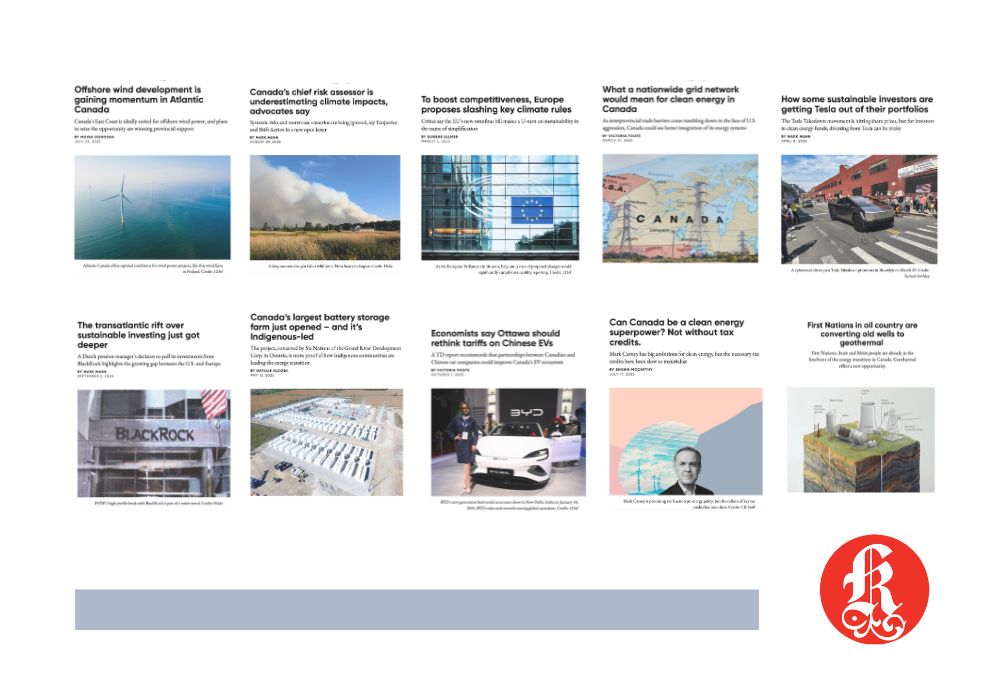
Not surprisingly, the stories that drew the most attention from our readers closely tracked the biggest shifts in the global green economy in 2025. This was a year that reshuffled the deck for sustainability, from policy reversals and new climate rules to breakthroughs in clean technology and corporate accountability. Take a look at these top articles from our website to see how this unfolded.
1. Canada‘s largest battery storage farm just opened – and it’s Indigenous-led
By Natalie Alcoba, May 13
The headline behind the headline here is that many such projects are coming to fruition all the time now: community-level contributions to a low-carbon future, unfolding around the world at an exhilarating rate. Indigenous ownership is a sign that a project is well-designed.
2. How trade threats could lead to a better grid network in Canada
By Victoria Foote, March 12
This story by the British Columbia–based journalist Victoria Foote examines the possibility of dismantling interprovincial trade barriers, which dominated the Canadian political discourse after U.S. President Donald Trump launched his trade war shortly after taking office. Better electricity interconnections between the provinces would be a boon for clean energy and help defend Canada’s economic sovereignty.
3. What happened to Canada’s cleantech tax credits?
By Shawn McCarthy, July 11
Canada has the tools to deploy cleantech at a much greater speed and scale, but it’s been slow to use them. This article by our lead energy journalist, Shawn McCarthy, explains how the federal government botched the rollout of its plan for refundable credits for cleantech. Hundreds of billions in low‑carbon investment could be unlocked by this program, once the bottlenecks are fixed.
4. To boost competitiveness, EU proposes slashing key climate rules
By Eugene Ellmen, March 3
Our word of the year for 2025 is “backlash,” a concept that has provided the primary narrative for the dissolution of so much of the optimism and ambition of the 2021 to 2023 period. The weakening of Europe’s climate-disclosure regulations represented a major plot development in this story. Despite opposition from sustainability advocates, the main elements of this simplification plan have now cleared the EU legislative process, putting most of the companies originally targeted by the rules now out of their scope.
5. First Nations in oil country are converting old wells to geothermal
By Matteo Cimellaro, April 9
Without a doubt, geothermal will be among the biggest stories of 2026. The technology has been winning backers and evading the politicization of other sources of renewable energy throughout 2025, and 2026 will bring many more examples of this kind of story.
6. Canada’s chief actuary underestimates climate risks, advocates say
By Mark Mann, August 29
This campaign by Ecojustice and Shift Action for Pension Wealth and Planet Health raises the alarm that Canada’s Office of the Chief Actuary is neglecting the systemic risks of climate change. Responding appropriately to climate threats is a challenge for everybody, but the chief risk officer is held to the highest standard.
7. Offshore wind is gaining momentum in Atlantic Canada
By Moira Donovan, July 23
How Nova Scotia balances the hurdles and opportunities of major offshore wind development is one of the stories we’ll be following closely in 2026. The province is betting that green hydrogen production will be a core use case for these projects, but that poses its own major challenges, as hydrogen is extremely difficult to transport.
8. How some sustainable investors are divesting from Tesla
By Mark Mann, April 8
As ESG-themed investment funds multiply and mature, green investors are acquiring more ways to tailor their holdings to their ideals. When Elon Musk joined forces with Trump’s authoritarian agenda, sustainable investors who wanted to divest from Tesla struggled to find options. This article by managing editor Mark Mann examined some of the intricacies of ESG-themed index investing.
9. The transatlantic divide over sustainable investing just got wider
By Mark Mann, Sept 5
The rift between U.S. and European investors has widened to a chasm this past year, with many in the EU now treating sustainability and climate as core elements of risk management rather than just marketing. Pension funds, in particular, have emerged as a key pressure point for climate advocates, given their long‑term investment horizons and exposure to climate‑related risks.
10. Economists say Ottawa should rethink tariffs on Chinese EVs
By Victoria Foote, October 1
This will continue to be one of the hottest topics for Canadian sustainability advocates: should Ottawa open the door to low-cost Chinese electric vehicles, or should we continue shielding Western automakers from China’s heavily subsidized industry? Climate advocates should also be wary that if major Eastern markets stumble on their EV rollout in 2026, as Western markets did in 2025, the global electrification narrative would be seriously weakened.
These five op-eds sparked the most conversation this year:
1. The facts of climate progress are the antidote to pessimism
By Rick Smith, February 21
Rick Smith is the president of the Canadian Climate Institute, and he contributes a monthly column to Corporate Knights called Climate Progress. Smith trains a level eye on new developments in climate policy and the green economy, and our readers tend to pay close attention to what he’s saying. The broad theme this year is that when you look beyond the United States, there’s plenty to celebrate, and even on the state and municipal levels, things are looking up for sustainability implementation.
2. Radical reforms are needed to make MBAs a force for good
By Danny Parys, Oct 14
Capitalism itself is increasingly under fire, as widening wealth inequality, growing concentration of capital and deepening unaffordability push societies closer to open class conflict. Yet rarely do these critiques focus on the role of business education. This commentary by Danny Parys in Montreal struck a nerve.
3. Three big shifts that can transform and modernize Canada’s economy
By Ralph Torrie and Mitchell Beer, April 10
Here, Corporate Knights research director Ralph Torrie and Mitchell Beer, the editor-in-chief and publisher of The Energy Mix, have collaborated to produce an overview of Torrie’s Climate Dollars project, which provides a province-by-province transition plan to a net-zero economy by 2050.
4. Trump’s tariffs threaten Canada’s food security. It’s time to go local.
By Justin Abbiss, March 11
A lot is happening in agricultural innovation and food distribution, and we’re keen to follow not only the energy transition but also the shift toward a more regenerative, sustainable food system.
5. Just because Trump wants to kill DEI doesn’t mean CEOs should
By Shilpa Tiwari, January 20
The backlash against diversity, equity and inclusion in business looked bleak at the start of the year, as high‑profile U.S. companies dismantled DEI teams under political pressure from Donald Trump and other anti‑equity agitators. Yet, as Shilpa Tiwari argues in this essay, DEI isn’t a political accessory but a core business survival strategy – and CEOs who retreat in the name of “neutrality” risk aligning themselves with a status quo built on exclusion.