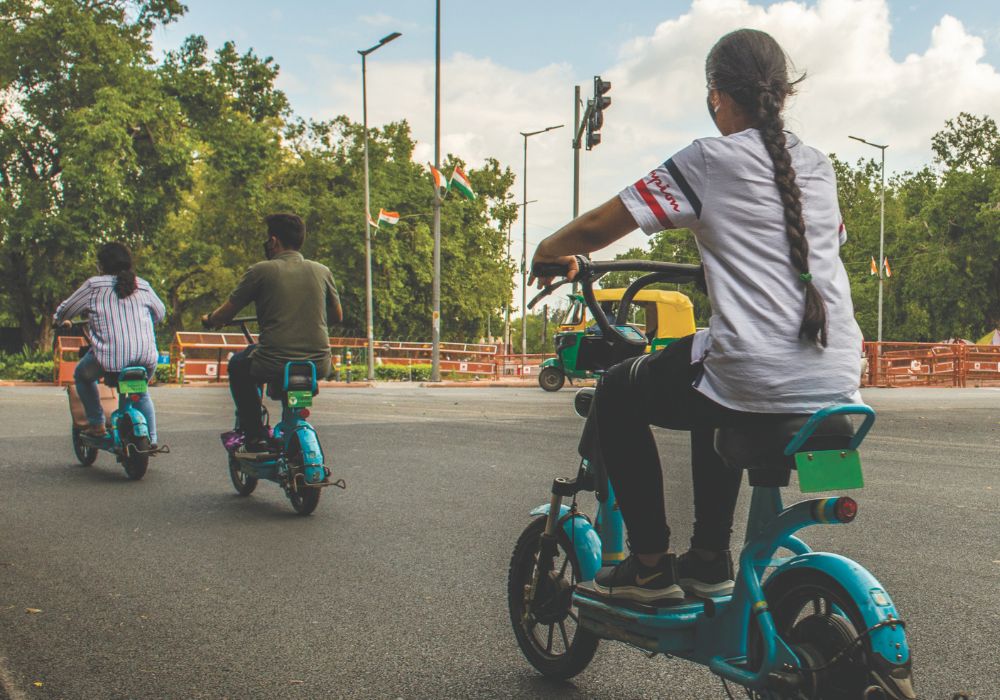
Though North Americans are used to a world built for four-wheeled automobiles, India runs on fewer wheels. About 80% of two- and three-wheel vehicles sold globally are in China, India and Southeast Asia, according to the International Energy Agency. In India, which represents nearly one-fifth of the world’s population, they are the main way to get around. About 270 million two-wheelers and more than 10 million three-wheelers make for nimble transport in crowded urban centres, where they are commonly used for daily commutes and by taxi and delivery services. As India’s pivot from fossil fuels to clean energy accelerates, these vehicles are helping drive the switch.
In a January analysis, the London-based think tank Ember compared the energy makeup of China and India at similar personal income levels and uncovered a massive difference. At $11,000, India’s current level and China’s 2012 level when purchasing-power parity is accounted for, India generates only 40% as much coal power as China did. Solar makes up 9% of its energy, compared to “negligible” amounts for 2012 China. India is the world’s most populous country, with almost 1.45 billion people, and China is second, with 1.4 billion.
But solar isn’t the only reason India is on a different trajectory: Ember is one of several global energy watchers drawing attention to the role of zero-emission bikes and tuk-tuks — three-wheeled motorized rickshaws — in the country’s accelerating green shift.
India remains the world’s second-largest net oil importer, half of which is used for vehicles. But Ember suggests that use has nearly peaked, compared to China at the same economic stage. “Road transport oil demand per capita is significantly lower, thanks first to smaller, lighter vehicles and now to the rise of electric vehicles,” write Kingsmill Bond and Sumant Sinha. Altogether, India is using cheap electric technology to “industrialise without the long fossil detour taken by China and the West.” With the country eyeing zero emissions by 2070, further electrifying road vehicles through policies designed to boost ease of use and adoption will play a critical role.
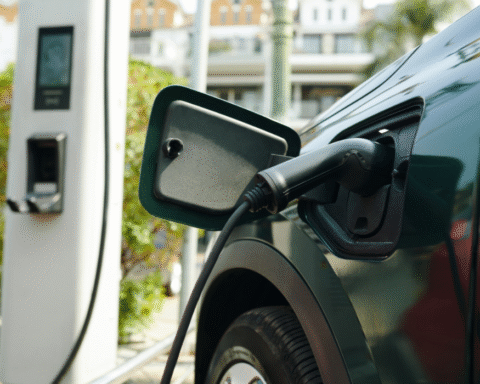
India can’t follow the same net-zero pathways that Western nations have embraced by encouraging EV adoption – only 7.5% of Indians own four-wheel passenger cars. By 2030, the Indian government’s policy think tank NITI Aayog and the Colorado-headquartered Rocky Mountain Institute have projected that 80% of two- and three-wheeled vehicles sold in India could be electric, compared to 30% of private automobiles. The IEA calls electric two- and three-wheelers “the most affordable and accessible entry point into electric mobility.” Not only do they not require significant charging infrastructure, but many of these smaller EVs can easily charge using standard sockets.
Navigating roadblocks
But there are speed bumps. Public charging and battery-swap infrastructure lags in India, especially outside of major cities like Delhi. With only about 25,000 public charging stations and 2,600 battery-swapping kiosks nationwide as of last April, rapid development is needed to reach zero-emission-vehicle goals.
Last year, Cardiff University professor Peter Wells told Polytechnique Insights that India was “lagging behind its ambitions.” Sales figures tell only part of the story. For instance, though nearly 60% of new two-wheelers sold are electric, their overall share was still only 5% in 2024. (Electric three-wheelers are more prevalent, at 50%.) EV performance in India is also still new enough to leave unsettled questions that could affect widespread adoption. “Long charging times, high ownership costs, and limited range can increase the risks for business owners investing in this new technology,” Wells said.
RELATED STORIES

In an International Council on Clean Transportation report on electric two-wheelers, Zifei Yang writes that buyers “are generally highly price-sensitive and upfront cost is often the main factor in purchase decisions,” since two- and three-wheeled EVs still cost more than gasoline models. But, Yang adds, the five-year total cost of EV ownership is less in India than for their fossil-fuel-powered cousins thanks to “battery capacity-based subsidies provided by the central and some state governments” and lower sales tax on EVs.
Competition is lowering prices, and if manufacturer announcements play out, domestic production capacity will increase by 70%. If India keeps on track with its goals, these small electrified vehicles will help it leave peak oil in the rearview mirror.
Rob Csernyik is a freelance journalist specializing in business and investigative reporting, as well as long-form features.
The Weekly Roundup
Get all our stories in one place, every Wednesday at noon EST.