
It’s 7:30 a.m. in Nairobi’s Wakulima Market as a pickup truck noses up to crates of sukuma, tomatoes and passion fruit still cool from the night air. Farmers from 80 to 200 kilometres out arrive on trust and tight timing. Weighing takes minutes. Money pings through mobile channels before the dust settles. By mid-morning, those crates have atomized across the city – into school kitchens, kiosk counters and hotel storerooms. From a distance it could be classified as “informal.” Up close, it looks like muscle memory: a system that learned to survive by becoming short, distributed and locally governed.
Africa’s markets have been pressure-testing what the rest of the world mostly theorizes about: resilience through proximity. The vocabulary is “short food supply chains,” but the practice is older than policy and smarter than jargon: farmer to local aggregator or market to consumer or institution, with 1,000-kilometre detours and very few gatekeepers. A 2025 synthesis of 69 studies across 25 African countries comes to the same conclusion: short chains don’t just move food; they move power, especially when paired with simple digital tools. This isn’t about romanticizing open-air markets; it’s about bargaining power. The shorter the path, the less room for someone far away to set the terms.
“Cash in 24 hours changes everything,” a Kiambu farmer told me, leaning on his pickup as porters shouldered crates toward the scales. “You can buy inputs, pay workers, and you don’t panic-sell.” A platform operator in Nairobi put it even plainer: “We didn’t replace the market – we ride on it.” The digital skin: WhatsApp orders, simple inventory apps, business-to-business produce platforms and mobile money. These tools don’t erase the local chain. They speed it up and make it legible, compressing time between harvest and payment so volatility has less surface area to bite.
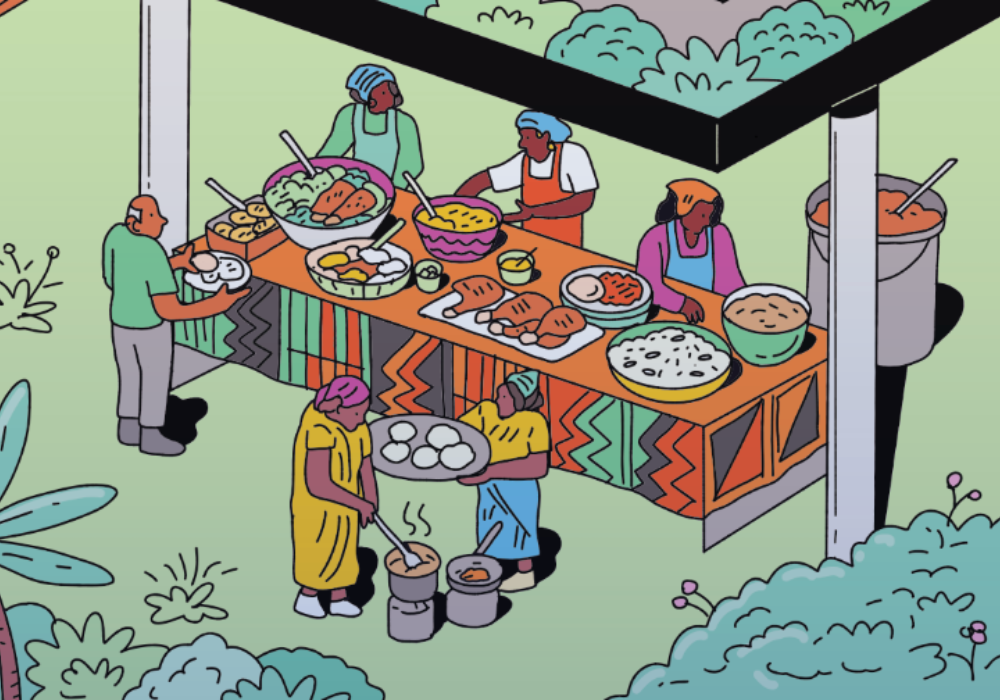
Follow the logic south to northern Tanzania and the system looks different but moves with the same cadence. In Arusha and Moshi, women-led stalls and microprocessors grind maize, smoke fish, blend spices and portion dairy for neighbourhood buyers and institutional kitchens. These aren’t side hustles clipped onto a formal chain; they are the chain that feeds cities. When a truck is late or a road washes out, “five handcarts fill the gap,” a market association leader said. “We don’t wait for permission.” Contingency plans aren’t found in a consultant’s diagram; it’s the woman who keeps a neighbour’s number and a spare cart in case the usual supplier’s son is sick.
Cash in 24 hours changes everything. You can buy inputs, pay workers, and you don’t panic-sell.
— Kiambu farmer
If you want to see why these short chains don’t just endure shocks but metabolize them, watch what happens when everyday demand becomes predictable. Across the region, government-led, home-grown school feeding has turned local purchasing into a weekday ritual rather than a promise: sub-Saharan Africa has added about 20 million children to national programs since 2022, with countries like Benin channelling public orders directly to nearby producers. A school places an order every weekday; upstream, farmers plant to that rhythm, transporters plan routes, microprocessors justify the small capital outlays that make the whole machine hum. A shaded sorting area here, a clean-water tap there, a used chiller bought on instalments. “That daily order turned our stall into a business,” a vendor told me in Moshi. “We hired two more women and finally bought a fridge that doesn’t die on Fridays.”
The objection, predictably, is scale. Where are the volumes? Hidden in plain sight. Day after day, these markets move hundreds of tonnes – some of it visible through platform dashboards, most of it still travelling by phone call and habit. Scale is not a monolith rolling down a highway; it’s accretion: another school on contract, another hotel switching to local suppliers, another ward installing clean water, another women’s group adding a fridge, another pickup joining the dawn queue.
The world keeps searching for resilience in the language of grand designs and silver bullets. Africa’s city-region food systems have been building it in smaller, nearer, more democratic units. Keep the path short. Pay fast. Share the margin with the people who do the work. Give the system a reliable customer. And then, when the shipment doesn’t come, watch the market open anyway.
Shilpa Tiwari is the founder of NoWomen No Spice and Isenzo Group.
The Weekly Roundup
Get all our stories in one place, every Wednesday at noon EST.