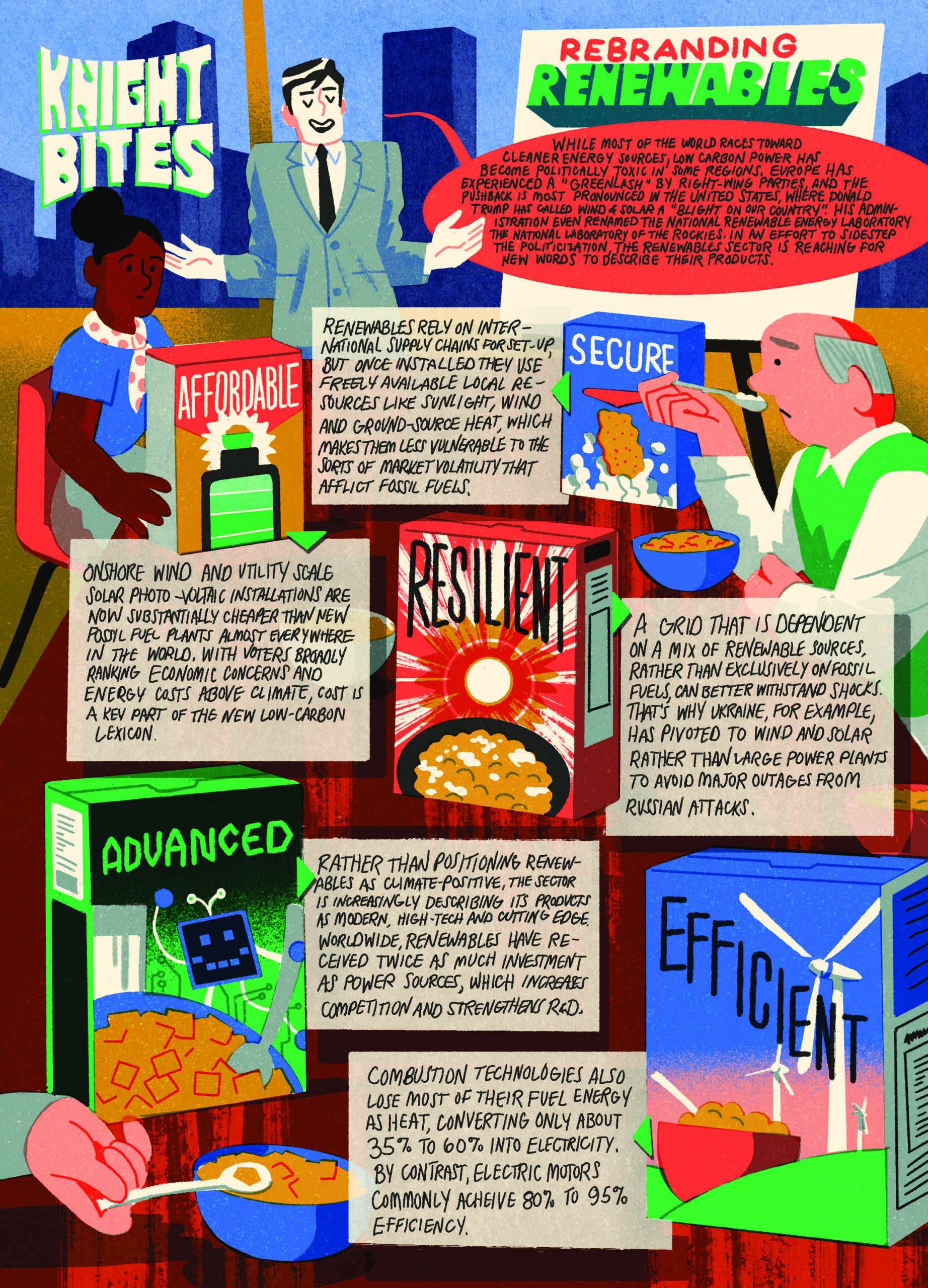
While most of the world races toward cleaner energy sources, low-carbon power has become politically toxic in some regions. Europe has experienced a “greenlash” by right-wing parties, and the pushback is most pronounced than in the United States, where Donald Trump has called wind and solar a “blight on our country.” His administration even renamed the National Renewable Energy Laboratory the National Laboratory of the Rockies. In an effort to sidestep the politicization, the renewables sector is reaching for new words to describe their products.
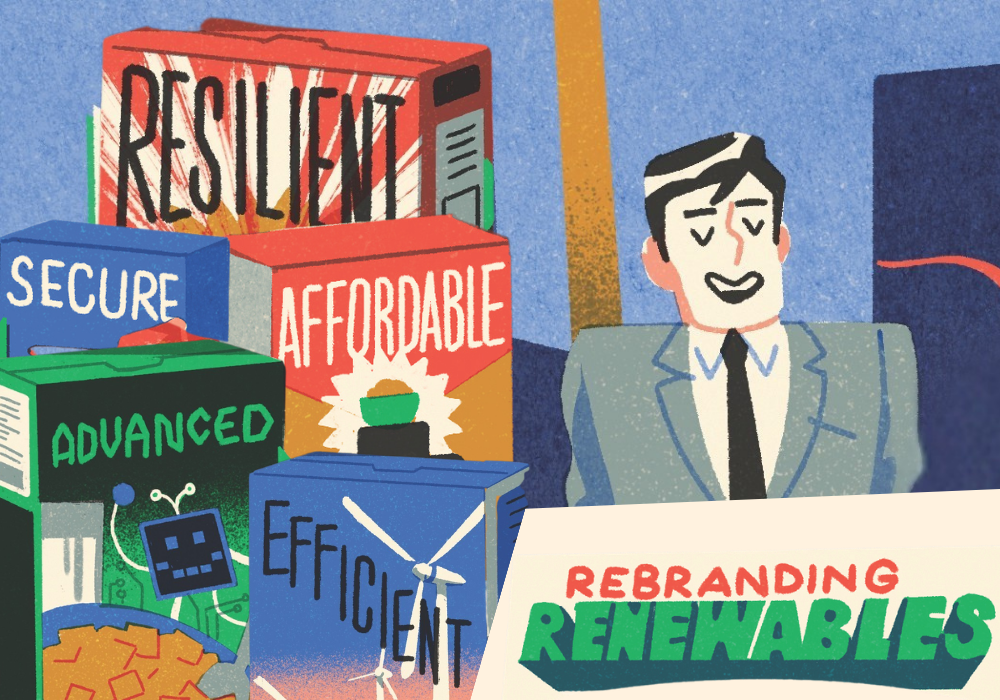
Affordable.
Onshore wind and utility‑scale solar photovoltaic installations are now substantially cheaper than new fossil fuel plants almost everywhere in the world. With voters broadly ranking economic concerns and energy costs above climate, cost is a key part of the new low-carbon lexicon.
Secure.
Renewables rely on international supply chains for set-up, but once installed they use freely available local resources like sunlight, wind and ground-source heat, which makes them less vulnerable to the sorts of market volatility that afflict fossil fuels.
Resilient.
A grid that is dependent on a mix of renewable sources, rather than exclusively on fossil fuels, can better withstand shocks. That’s why Ukraine, for example, has pivoted to wind and solar rather than large power plants to avoid major outages from Russian attacks.
Advanced.
Rather than positioning renewables as climate-positive, the sector is increasingly describing its products as modern, high-tech and cutting edge. Worldwide, renewables have received twice as much investment as other power sources, which increases competition and strengthens.
Efficient.
Combustion technologies also lose most of their fuel energy as heat, converting only about 35% to 60% into electricity. By contrast, electric motors commonly achieve 80% to 95% efficiency.
Illustrations by Drew Shannon