In the late 2010s, when Tommi Eronen and Markku Ylönen were working on their graduate degrees at the Tampere University of Technology, in Finland, they began to toy around with the idea of how to make their community 100% heat self-sufficient. The regional power grid delivered plenty of wind power, but the problem, as with renewables everywhere, was how to store the excess energy so it could be used when needed.
Eronen’s first instinct: a massive water tank linked to solar thermal panels that could store heat, to be used in a district energy system. “Would that be economically and technically viable?” they wondered. The answer, as it turned out, was no. What they needed, instead, was a medium in which to store the high level of heat – as much as 650°C – generated by the electrical current flowing out of photovoltaic panels. That substance would have to be inert, non-combustible, not prone to melting or boiling, and cheap.
The answer, Eronen says, was essentially hiding in plain view: sand. It is abundant, as he says, “everywhere.”
That light bulb moment provided the spark for what would become Polar Night Energy, now a 25-person firm that develops sand batteries to serve communities with renewable energy and district heating systems. Polar has developed two commercial sand batteries in Finland, and the company’s first international project is in Latvia, where it is partnering with Lahti Energia to build a new two-megawatt thermal plant for a local district heating utility, with 250 megawatt-hours of storage capacity, making it the world’s largest such facility when it is finished. Eronen, who is the CEO, says Polar plans to expand into northern European markets like Germany and Switzerland.
Soaring growth for storage
This particular innovation is the latest chapter in the evolution of the renewable-energy storage sector, which has become an indispensable element of the energy transition, particularly now that solar PV has become the least expensive form of electricity generation. Many utilities are deploying large-scale lithium battery installations as they incorporate more renewable sources, but other forms of storage – from traditional pumped hydro to more emergent technologies such as flywheels and aluminum batteries – are part of the mix.
According to a 2024 International Energy Agency report on the role of batteries in the energy transition process, “strong growth occurred [in 2023] for utility-scale battery projects, behind-the-meter batteries, mini-grids and solar home systems for electricity access, adding a total of 42 GW of battery storage capacity globally.” The IEA estimated that global energy storage capacity will have to increase by 1,500 gigawatts by 2030 to facilitate the amount of growth in new solar PV and wind required to achieve the Paris Agreement target of net-zero emissions by 2050.
With rapid projected increases in both electricity consumption and utility-scale solar farms, the role of large-scale storage will only grow in importance, Eronen says. “It means that we have to have very good batteries to take this excess energy at times when we have too much, and then obviously deliver it when we have too little.”
Sand stands out
If you want to understand Eronen and Ylönen’s insights about the role of sand, think about the experience of walking on a beach on a very hot day: the surface of the sand can be uncomfortably warm, but if you dig your feet in only a few centimetres, the temperature drops – evidence, Eronen says, of sand’s capacity to both absorb heat energy and provide natural insulation that prevents that energy from dissipating.
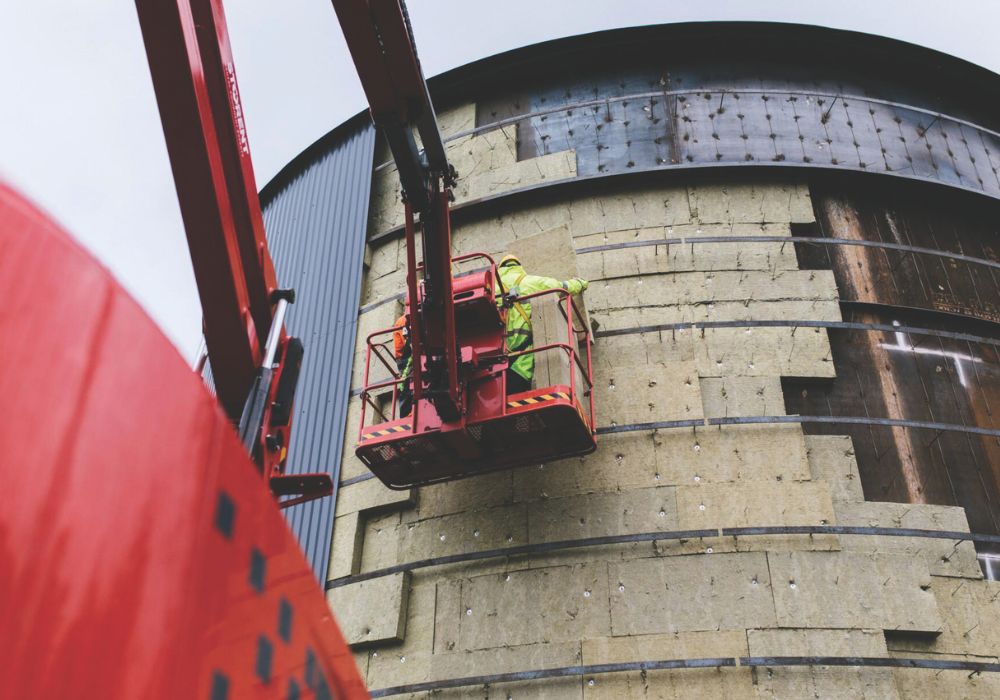
 After graduating and setting up Polar, the two inventors set up a very small-scale sand battery in the backyard of Eronen’s grandparents’ cottage. The proof of concept worked, and, last year, they launched a €4.2-million pilot plant in the city of Valkeakoski, about 150 kilometres north of Helsinki, in partnership with Valkeakosken Energia, a district energy firm, and a state agency.
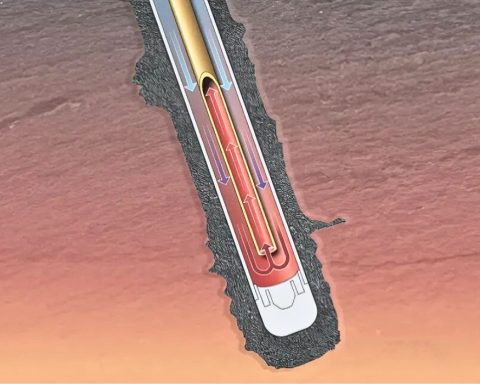
Polar describes its sand battery as a power-to-heat-to-power (P2H2P) technology. Excess renewable electricity flows into the cylindrical sand battery and passes through a series of resistors, which throttle the current and become extremely hot. The resistors heat the sand, and that thermal energy, in turn, can be drawn out as needed through a network of pipes. The super-heated air in the pipes powers a boiler that produces steam to generate electricity.
“We have patented a heat-transfer system that is taking the heat into the sand and away from it when we want to use it,” Eronen says. “We have lots of steel pipes going through the sand. The air and the sand don’t mix, ever.” He adds that large-scale cylinders – imagine something the size of an industrial oil storage tank – are the optimal shape for Polar’s technology and application (i.e., district heating), and the amount of storage they can provide increases in direct proportion to their size.
RELATED STORIES
The company’s technology, and its expansion strategy, received its first big boost a few years ago when a segment on the BBC’s website attracted half a billion views. Eronen says that as they’ve moved to commercial-scale projects, the company has begun bidding for contracts offered in “grid-balancing markets,” typically by transmission operators who need to add storage capacity as more renewable sources come on line.
The major advantage over other technologies is that Polar’s sand batteries can retain heat for up to 100 hours, whereas most other systems, like utility-grade lithium, provide only a few hours of storage between charges. The upshot: “They can charge with the lowest prices possible on the spot market,” Eronen says, “and also be very flexible when they offer that capacity to the grid-balancing markets.”
Perhaps the most appealing aspect of Polar’s invention has to do with its own environmental footprint. Unlike large-scale lithium batteries, for instance, Polar’s product consists of nothing more than sand, steel pipes and a steel silo. As Eronen says, “The life-cycle assessment will say that the emissions from sand batteries are one of the lowest, or even the lowest, of all battery technologies.”
A low-emission storage medium for the renewable-energy revolution seems like the right pairing to deliver the missing link in the energy transition.
John Lorinc is a journalist and author specializing in urban issues, business and culture.
The Weekly Roundup
Get all our stories in one place, every Wednesday at noon EST.