

For the past decade, study after study has shown that young people are desperately fearful of the climate crisis, and disappointed with governments’ lagging responses. But where should they go, and what should they study, if they want to help reduce the impacts of climate change?
That’s the question Corporate Knights tries to answer with its 2026 Better World MBA ranking, our 17th annual ranking of the world’s most sustainable MBA programs. Our survey methodology often evolves from year to year as new data becomes available, and this year we’ve made two changes to help prospective students make smarter choices. We’ve doubled down on graduate-impact metrics to boost the scores of schools that can show that this training has helped their alumni get better jobs with more input into clean decision-making. We’ve also added bonus marks for schools that can prove they’re not just teaching sustainability but actively testing their students’ learnings.
“The ranking evolves as [schools’] practices evolve,” says Althea Reyes, senior research analyst at Corporate Knights, who oversaw this year’s project. The survey tracks schools’ central MBA programs, not climate-oriented specialty offerings.
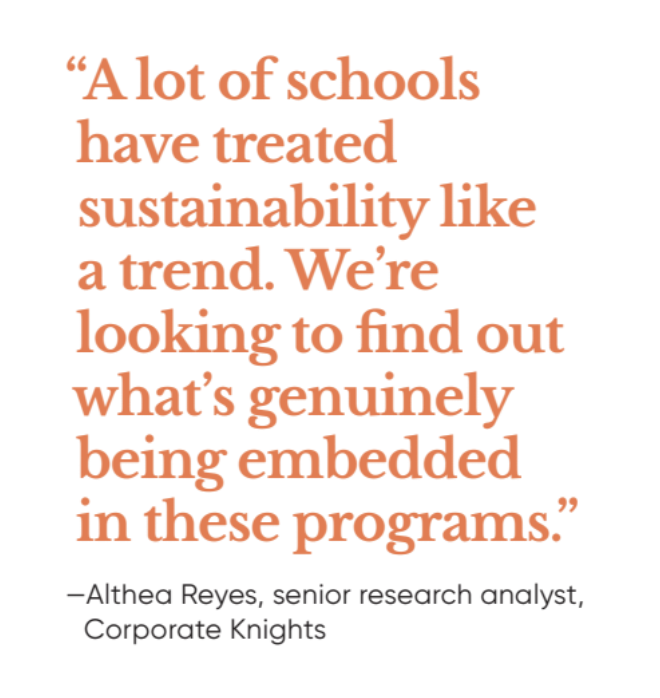
In recent years, the researchers have noticed some slippage in the sustainability portion of these programs, as newer developments – such as the rise of artificial intelligence – shift their focus away from the growing climate threat. “A lot of schools have treated sustainability like a trend,” Reyes says. “We’re looking to find out what’s genuinely being embedded in these programs. Are the schools truly offering sustainable business education, regardless of the latest headwinds?”
 The new rules have helped new schools hit the top of the list. This year’s No. 1 MBA program hails from Maastricht University’s School of Business and Economics, located in Maastricht in the southern Netherlands. (It placed third on last year’s ranking.) Celebrating its 50th anniversary this year, Maastricht offers a part-time, two-year MBA program delivered in person (in English) for adult students with at least five years of business experience (the average is 15 years).
Starting with introductory courses such as “Sustainability Science, Policy, and Society” and “Innovation for Sustainable Development,” Maastricht embeds sustainability principles throughout its curriculum, says dean Mariëlle Heijltjes. “We take a holistic approach to sustainability,” Heijltjes says. “You integrate it into your career; it’s part of your learning goals.”
In the second spot this year, up from seventh in 2025, is South Africa’s University of Cape Town Graduate School of Business. UCT says its curriculum “emphasizes that sustainability is not merely a compliance issue or public relations exercise. Rather, it is a strategic imperative that drives corporate social responsibility, innovation and long-term value creation.” At Cape Town, “students don’t just crunch numbers; they explore the consequences of business decisions on communities and the planet.”
Last year’s No. 1-ranked school, Griffith Business School in Brisbane, Australia, placed third this year, sharing the spot with the Grossman School of Business at the University of Vermont. Despite its relative decline on this list, Griffith University – not just the business school – continues to be “values-led.” It has built sustainability into its 2025 to 2030 strategic plan and aims to achieve net-zero by 2029. In June, the London-based Times Higher Education ranked Griffith second in the world in its Sustainability Impact Rankings, behind only the United Kingdom’s University of Manchester.
In sixth place this year is the top Canadian institution, the University of Victoria’s Peter B. Gustavson School of Business (moving up from ninth spot in 2025). Canadian schools as a whole fared well on this year’s list, with Toronto’s York University sliding into 17th place, alongside Toronto Metropolitan University (19), HEC Montréal (20), Vancouver’s University of British Columbia (23), the University of Guelph (25) and McGill University (34).
Cheryl Mitchell, academic director for Victoria’s flagship MBA in Sustainable Innovation, oversees a program aimed at mid-career professionals who attend classes over 16 weekends. A former healthcare consultant who studied how things like crises and climate change affect health systems, Mitchell created a class for UVic on collaboration and design thinking. In 2020, she joined the faculty and created an MBA program based on the same principles.
“Everything we do in our lives is run by organizations and institutions,” Mitchell notes. She calls her students, who come from engineering and agriculture, government work and not-for-profits, green energy and Alberta’s oil patch, “realist idealists” who “recognize that organizations can be in the service of making better communities and a better world.” The program aims for classes of 40 people, but the last two cohorts – and this fall’s – all have 50 students.
To break old patterns, Victoria’s program uses team-building, mentors, play-based spaces and learning closely from and with First Nations. “We find a place where different perspectives get in a room to solve wicked problems together,” Mitchell says. “Often you don’t understand a problem until you start solving it.”
They test for it, too. “We’ve been doing sustainable testing from the beginning. And we have the highest standard of rigorous faculty evaluation.” All students take “Foundations of Sustainability” in their first block of courses, and they’re tested specifically on their sustainability knowledge at the end of that three-month period. After that, Gustavson evaluates its students mainly through an approach called “assurance of learning.” In lieu of tests, students are graded on their demonstrated mastery of the material, their performance in case competitions, and their ability to create value for partner organizations during their second-year research projects.
Impact? UVic offers that too. One grad who had worked for a B.C. Crown corporation quit his job soon after graduation and now leads sustainability for a large consulting firm. Another student who worked with a First Nations group to reduce food waste now works full-time building that project. A student who entered the program working for a healthcare firm now has her own consulting company. A junior employee of a mining firm who studied ways to transform trucking in the mining sector is now leading that work for his employer. And a student from a multinational financial firm, after completing the course, became her company’s director of sustainability.
According to Reyes, the goal of publishing these rankings is to see “what the companies of the near future will look like, and where the new leaders will come from.” From this angle at least – far from politicians and headlines – the future shines.
The top 40 MBAs for 2026
| 2026 rank | 2025 rank | School | Country | Curriculum (80%) | Alumni impact (20%) | Final weighted score |
|---|---|---|---|---|---|---|
| 1 | 3 | Maastricht University: School of Business and Economics | Netherlands | 94% | 37% | 95.2% |
| 2 | 7 | University of Cape Town Graduate School of Business | South Africa | 83% | 62% | 89.1% |
| ~3 | 2 | University of Vermont: Grossman School of Business | United States | 84% | 50% | 85.8% |
| ~3 | 1 | Griffith Business School | Australia | 88% | 28% | 84.0% |
| 5 | 5 | American University: Kogod School of Business | United States | 78% | 62% | 83.6% |
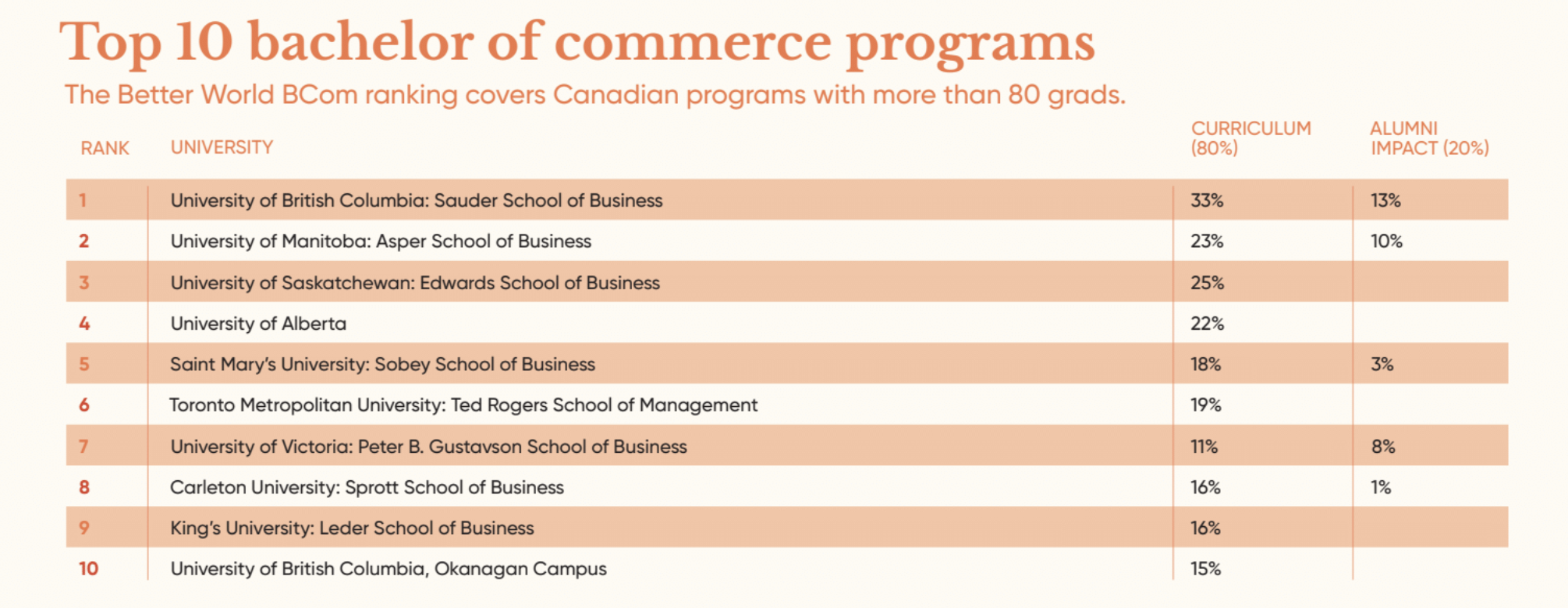
| 6 | 9 | University of Victoria: Peter B. Gustavson School of Business | Canada | 76% | 62% | 82.6% |
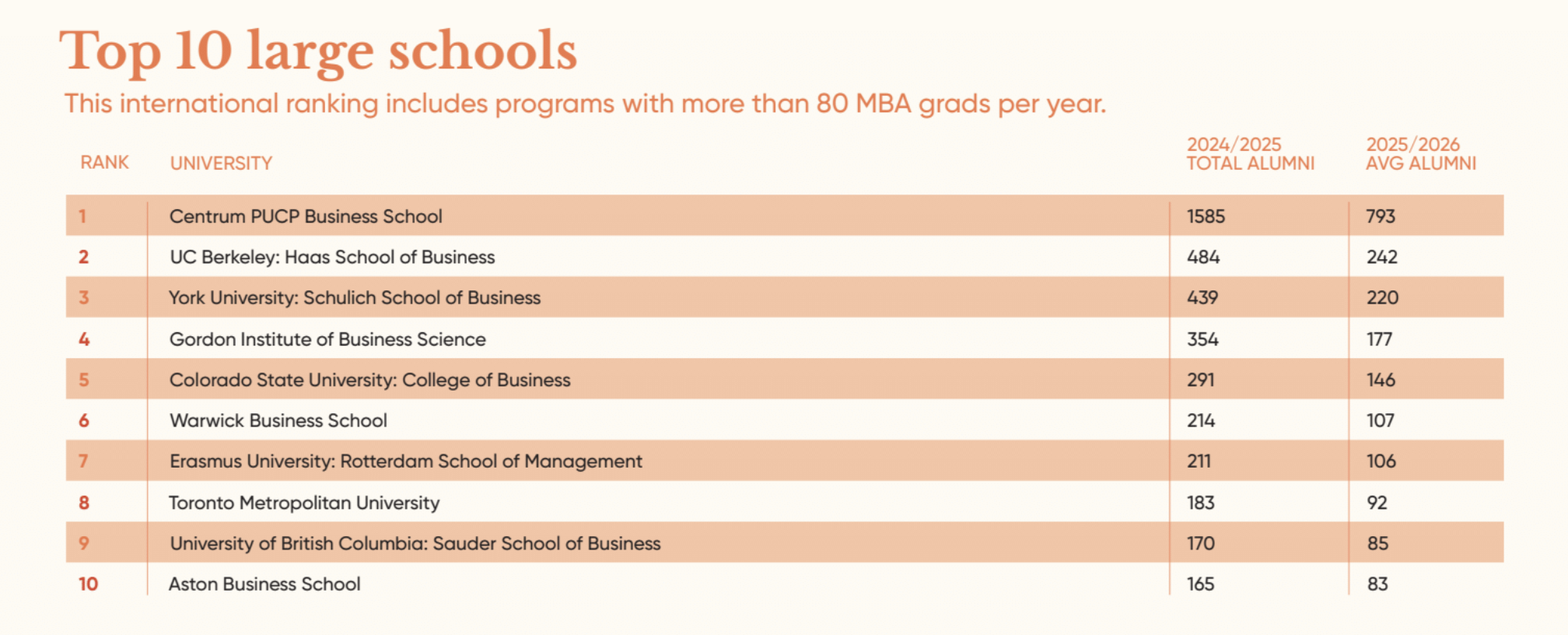
| 7 | 8 | Centrum PUCP Business School | Peru | 72% | 1% | 78.1% |
| 8 | 4 | Bard College | United States | 65% | 62% | 69.9% |
| 9 | 10 | University of Exeter Business School | United Kingdom | 55% | 23% | 64.9% |
| 10 | 6 | Duquesne University: Palumbo-Donahue School of Business | United States | 52% | 70% | 60.5% |
| 11 | 22 | Eada Business School Barcelona | Spain | 59% | 14% | 59.8% |
| 12 | 21 | ESMT Berlin | Germany | 57% | 27% | 57.6% |
| 13 | 17 | Henley Business School | United Kingdom | 55% | 22% | 54.8% |
| 14 | 39 | Loughborough Business School | United Kingdom | 52% | 19% | 52.0% |
| 15 | 19 | Glasgow Caledonian University: Glasgow School for Business and Society | United Kingdom | 50% | 18% | 51.5% |
| 16 | New | Manchester Metropolitan University | United Kingdom | 52% | 9% | 50.6% |
| 17 | 12 | York University: Schulich School of Business | Canada | 52% | 11% | 50.2% |
| 18 | 25 | Rotterdam School of Management, Erasmus University | Netherlands | 47% | 39% | 49.6% |
| 19 | 18 | Toronto Metropolitan University | Canada | 43% | 29% | 44.3% |
| 20 | 41 | HEC Montréal | Canada | 33% | 6% | 41.7% |
| 21 | 24 | Colorado State University: College of Business | United States | 38% | 29% | 41.3% |
| 22 | 20 | University of Winchester Business School | United Kingdom | 44% | 41.1% | |
| 23 | 14 | University of British Columbia: Sauder School of Business | Canada | 41% | 16% | 40.5% |
| 24 | 15 | La Trobe Business School | Australia | 36% | 49% | 40.4% |
| 25 | Opted out | University of Guelph: Gordon S. Lang School of Business and Economics | Canada | 37% | 37% | 39.5% |
| 26 | 11 | Warwick Business School | United Kingdom | 40% | 11% | 39.1% |
| 27 | 23 | Gordon Institute of Business Science | South Africa | 34% | 6% | 38.6% |
| 28 | 13 | UC Berkeley: Haas School of Business | United States | 39% | 15% | 38.6% |
| 29 | 16 | Nottingham University Business School | United Kingdom | 39% | 8% | 37.7% |
| 30 | 59 | Newcastle University Business School | United Kingdom | 40% | 3% | 37.6% |
| 31 | 31 | Frankfurt School of Finance and Management | Germany | 32% | 44% | 36.4% |
| 32 | 29 | TIAS School for Business and Society | Netherlands | 35% | 24% | 36.3% |
| 33 | 42 | University of Bath School of Management | United Kingdom | 38% | 7% | 36.2% |
| 34 | 27 | McGill University: Desautels Faculty of Management | Canada | 36% | 11% | 35.7% |
| 35 | 36 | Keele University: Keele Business School | United Kingdom | 36% | 35.5% | |
| 36 | 30 | Solvay Brussels School of Economics & Management | Belgium | 35% | 18% | 35.4% |
| 37 | 28 | Durham University Business School | United Kingdom | 32% | 14% | 32.6% |
| 38 | New | University of Lincoln | United Kingdom | 33% | 5% | 32.0% |
| 39 | 34 | WHU – Otto Beisheim School of Management | Germany | 32% | 12% | 31.6% |
| 40 | No response | Australian Graduate School of Management at UNSW Business School | Australia | 33% | 31.3% |
Methodology
The 2026 Corporate Knights BetterWorld MBA top 40 ranking examines the performances of 179 business schools. Business schools accredited by either one of three recognized accreditations or PRME Champions can opt in. Schools are evaluated on the sustainability content of their core courses and their alumni impact, the number of recent graduates employed with impact organizations. Data for sustainability content is gathered from publicly disclosed information.Schools can request revisions to the analysis, disclose alumni impact data, and may provide information on their participation in a recognized standardized sustainability assessment, such as TASK by Sulitest, which is worth a 10% bonus.
The Weekly Roundup
Get all our stories in one place, every Wednesday at noon EST.