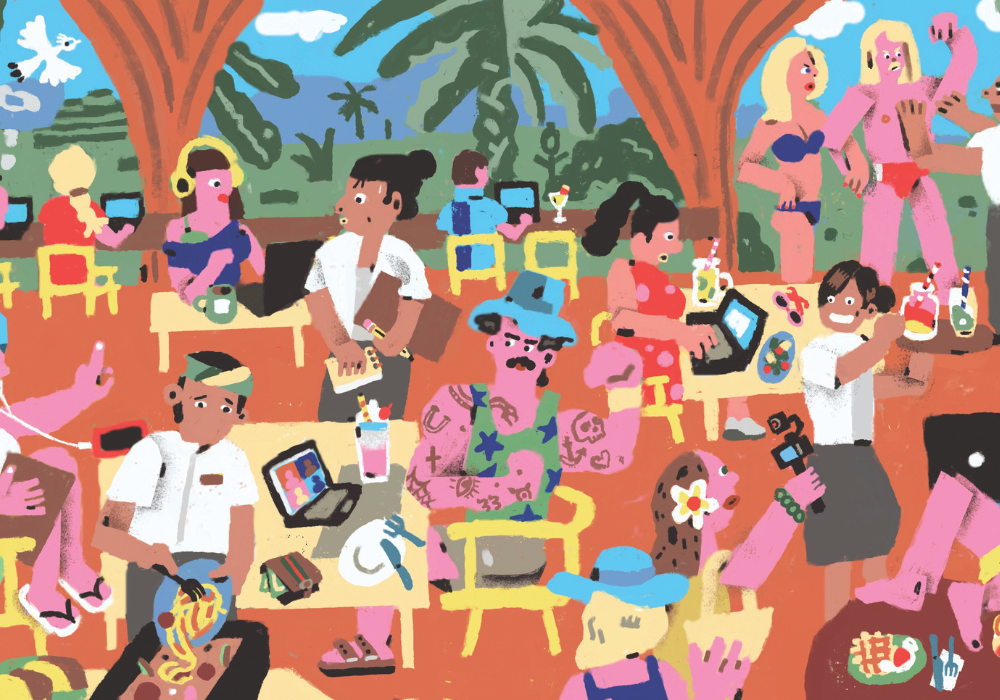
The first time I visited Bali, Indonesia, as a remote worker, I was distracted by the newness of the experience, the novelty of sipping fresh coconuts in coworking spaces and strolling the beach on breaks. My two-week stay was followed by a two-month stint in which I saw the island in a different light.
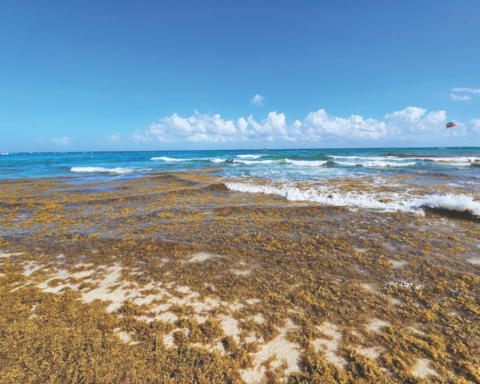
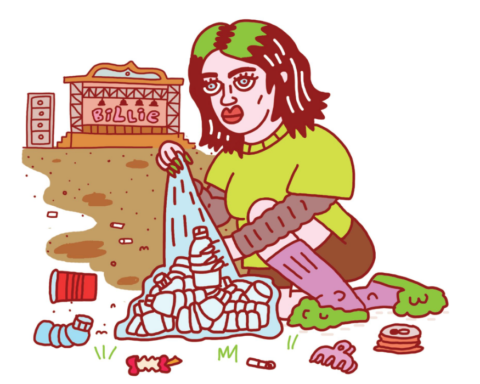
On my cab ride to Canggu, a tourist town of about 9,000 residents, I noticed changes to the built environment from my previous stay: new villas rising over rice fields and freshly opened businesses priced for the several thousand nomads there at any given time, but out of reach of locals who might earn a few hundred dollars a month. As I settled into Bali, my perspective continued to shift. The exhaust-heavy traffic jams, beaches and sewers choked in plastic litter, and flaming garbage piles visible from my $16-a-night hotel window made me wonder if nomads like me had descended on a place that couldn’t contain us.
This same tension prevails in digital-nomad enclaves around the world, where remote workers and untethered entrepreneurs congregate, from Mexico City and Barcelona to Da Nang and Chiang Mai. Since the onset of the remote-work revolution spurred by the COVID-19 pandemic, LinkedIn and Instagram are full of posts portraying digital nomadism as freedom in paradise, but there are environmental and social costs that come with this trend.
Remote work has been supercharged by cost-of-living crises at home and open-door policies from countries that want to lure higher-income earners to their shores. By some estimates, there are up to 40 million people living and working this way: spreading their wings, and their waste. How much waste, exactly, is a mystery, given the relative newness of digital nomadism, the challenge in distinguishing effects of nomads versus tourists at large, and, more critically, that few remote workers stick around to see long-term effects.
A force for good?
Digital-nomad lifestyles tend to emphasize the present moment rather than the long term, not unlike how nations focus on the immediate economic benefits over the generational environmental impacts. Having worked abroad from a dozen countries, I know this first-hand. But this also is true of the countries that court us, and that focus more on the economic effects than environmental ones. Right now, about 50 countries offer digital-nomad visas for stays of a year or more, and even short-term visitors are prized for their impact on sales taxes, hospitality and other economic areas. In some communities, nomad spending becomes, as The Economist called their presence in Latin America, “a force for good.” The magazine reported that in Medellín, Colombia, digital nomads spend nearly $1,000 more per month than locals. In Bali, which has partnered with Airbnb to encourage digital nomadism, about 80% of its economic activity comes from tourists. Mexico City calculated the nomad contribution to tourist spending more precisely at 15% in 2021, or more than $532 million.
Daniel Schlagwein, a professor at Chulalongkorn University and the University of Sydney, is a digital nomad based in Bangkok and has worked on digital-nomad strategies with the Thai government. He says the government views digital nomads more positively than other types of visitors, like “zero baht tourists,” who pass through on tour groups but don’t make a noticeable economic contribution. For local authorities, digital nomads are coveted because they leave money in communities and fade into the background, clacking away on laptops at Airbnbs or coworking spaces.
In a Journal of Business Ethics paper Schlagwein co-wrote on digital nomads and emancipation, the environment didn’t come up frequently, although some nomads surveyed displayed what the authors called “self-reflective guilt” about it. One said that he and a group of nomads spent two years assisting with “a waste separation strategy for the villages and a decentralized waste management facility,” using their tech skills to give back to the community project. But another, based in the Bali community of Ubud, was less positive. “The number one thing that we could do for this economy and this island is to get off [and] leave,” a nomad called Sandra told the researchers. “I don’t want to leave, but we’re taxing the environment.”
Effects on communities can be wide-ranging, from environmental waste to straining infrastructure and resources like groundwater. Pastoral landscapes and seascapes become lodging designed for Western tastes and budgets. Living costs for locals rise, elbowing them out of home communities and creating social tensions with their new, temporary, neighbours.
Digital nomadism isn’t a formal movement, maybe in part because its practitioners tend to be disconnected from the community around them. To paraphrase a 2022 book review, digital nomads quit the sort of life where one collectively organizes or gets involved in politics in exchange for personal freedom. It can be isolating by design, as impermanence, language and cultural barriers converge. Digital nomads also often run in circles with each other, blithely unaware of the mundane realities of their present communities – like where the trash goes.
Articles exploring the ethics of digital nomadism – from The Washington Post to personal blogs – set the bar low: not overstaying visas, supporting local businesses and obeying local laws.
Emerging research suggests digital nomads want to be sustainable, too, but face hurdles. “While digital nomads show environmental awareness and adopt selective sustainable practices, their efforts remain fragmented and constrained by systemic factors such as long-haul travel reliance, market logics, local socioeconomic pressures and regulatory gaps,” researchers from Macau write.
I met digital nomads who would go on “visa runs” where they would fly to another destination and sometimes return the same day. Aviation creates around 2.4% of global carbon emissions and is expected to grow in the coming decades. Given that digital nomadism is predicated on air travel, larger adoption would add to this impact.
In my travels, I also noticed that a lot of digital nomads I met adopted wasteful forms of entrepreneurship – crypto and drop shipping and businesses that involve a lot of energy-sapping AI. Some of these nomads were doubling their waste footprint: creating it via digital nomadism and then again through their jobs, leaving the place behind and the rest unseen.
But on both fronts, Schlagwein doesn’t see how it’s any worse than North American careerists. Traditional corporate jobs can involve a lot of travel.
 Digital nomadism could even prove less polluting than some of these gigs. And potentially wasteful tech is being deployed across the corporate sector, by much worse resource drainers than single nomads. OpenAI says 92% of Fortune 500 companies, some of the world’s largest, are using its data-centre-reliant products like ChatGPT. Schlagwein adds that unlike some workers who move frequently, there is a post-material approach to consumption common to digital nomads, which leads to their buying less furniture and consumer goods, that should be considered in their environmental footprints.
Quitting one’s commute is always a positive step for reducing emissions. A study from researchers in Bangladesh identified digital nomadism as environmentally friendly because remote work “[helps] to lower office-related energy consumption and reduce the need for commuting.” For instance, the average car generates 4.6 metric tons of carbon dioxide per year, though a couple of long-haul flights can make up the deficit quickly.
Schlagwein notes that digital nomads also tend to be “time-limited” to their international mobility days “that are more backpacker-style, primarily travelling and secondarily working.” Eventually, as nomads tire of constantly changing lifestyles, find a preferred location, take on a partner or have kids, they become more sedentary (like Schlagwein staying in Bangkok) or simply return home (like me). Either way, they eventually cut down on travel.
Escaping the vacuum
Now that I’m back in Canada, I’m actively monitoring my footprint more than I did in my digital-nomad days. It’s easier when you’re in one place, particularly with relatively advanced recycling and waste management. Rather than think in the moment, as I did as a nomad, I now think more in terms of the grand scheme of my life. While my digital-nomad era might have been a blight on my carbon footprint, my lifetime impact can be mitigated.
In his view, and no doubt for a lot of nomads, a critical trade-off is the ability of digital nomads “to live a life of their choosing, versus the environmental impact.” People do this with consumer choices like fast fashion or fundamental life decisions like choosing to have kids. We live in a world where we should all be measuring decisions against the environmental impact, though it doesn’t mean the answer is abstinence.
As digital nomads learn to define their ethical frameworks, it’s necessary that each of us engage with the challenge of our footprint and choose a lifestyle that is consistent with avoiding climate catastrophe. This includes letting “self-reflective guilt” help shape our consumption habits on the road. Nomads can no longer act like we exist in a vacuum outside of the communities that so generously host us, and that deal with the effects of our travels long after we’re gone.
Rob Csernyik is a freelance journalist specializing in business and investigative reporting.