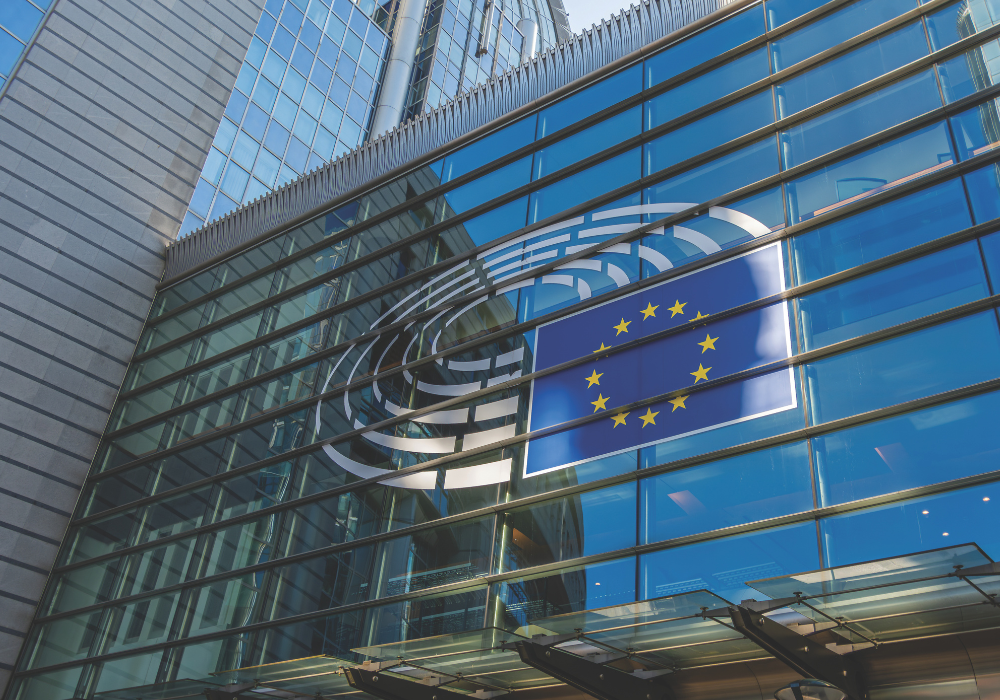
In February, President Emmanuel Macron of France told The Economist and six other European newspapers that the continent is facing a “geo-political and geo-economic state of emergency.” This was ahead of a summit where European leaders would discuss competitiveness, a policy topic that’s been at the top of the European Union agenda for several years. But its surge up the priority list has come at the expense of Europe’s ambitious climate policies.
In early 2025, European lawmakers drastically minimized the scope and scale of corporate sustainability disclosure requirements – cutting by up to 90% the share of companies that are required to report. Then, in December, European Parliament members delayed a law that would help reduce deforestation and forest degradation around the world. That same month, another law that was set to ban production of new combustion-engine cars in Europe by 2035 was watered down. In every case, global competitiveness was among the main reasons cited for the scale-back.
But oscillating between climate leadership and regulatory retreat could also mean that Europe loses its place as a climate pioneer and an industrial power. “If Europe continues with this deregulation drive,” says Andreas Rasche, a professor at Copenhagen Business School, “the climate rules for European businesses will be written elsewhere in the world.”
Simplification vs. deregulation
Opponents of the European Union’s ambitious policies say they have overly complicated reporting structures and impose too much bureaucratic red tape.
Rasche says that, in theory, regulatory simplification is a good idea, but “the problem comes in where simplification itself is politicized and is turned into an unjustified deregulation.”
Fewer reporting requirements tend to mean lower costs, but that doesn’t necessarily translate into competitiveness. “The logic is that you increase competitiveness [by] reducing costs with compliance,” explains Hanna Ahlström, senior adviser and sustainability business developer at Æra, a consultancy firm in Oslo. But even if costs are cut and a company’s profitability increases, it doesn’t necessarily make a company more competitive, Ahlström says. For that to be the case, “the money [saved] needs to be reinvested in ways that makes the company competitive, and not all firms will do this.”
While investing in new technologies is something that can help make a business more competitive long-term, the EU’s policy inconsistencies have also made businesses more hesitant to act.
RELATED STORIES

For instance, Yara International, a fertilizer company, said in January that if the EU suspends its carbon border adjustment mechanism (CBAM), which came into effect on January 1, they will have to rethink a major low-carbon ammonia project in the United States. CBAM, which has so far avoided suspension, taxes EU companies importing steel, cement, aluminum, fertilizers, hydrogen and electricity based on the origin of the import. Yara CEO Svein Tore Holsether told Reuters that CBAM helped improve the business case for low-carbon ammonia products, but that regulatory uncertainty makes it difficult to bank on more expensive low-carbon investments.
Businesses that make the first moves tend to also reap economic benefits as trailblazers, says Marcin Menkes, an associate professor at the Warsaw School of Economics and Vrije Universiteit Brussel. But when geopolitical turbulence is met with inconsistent behaviour on the part of the EU, it stifles not only innovation but also competitiveness, he argues. In order to make investments, companies bet on new rules and regulations being implemented. Uncertainty might incentivize businesses to be cautious instead.
Even if a new approach, product or technology has an environmental benefit, if the rules change the business will incur the costs of being a first mover. “We must protect those businesses that boldly try to experiment, to deploy new environmental technology, technology solutions, without surprising them with different . . . regulatory approaches,” Menkes says.
Regulation can mean opportunity, too
When EU regulations stay in place, like CBAM has so far, there are business opportunities for companies willing to invest in compliance to gain access to the EU’s single market of approximately 450 million people.
Canada, which ranks fourth in aluminum and 16th in steel production, could seize the opportunity to become a bigger player in the European market. Canadian aluminum and steel are largely produced by hydroelectricity, giving Canada one of the lowest carbon footprints among the world’s major producers. “Given the dependency on U.S. markets and the tariffs in place,” says Michael Lenaghan, associate director at Anthesis, a U.K.-based consultancy firm, “CBAM couldn’t have come at a better time for Canada and for steel and aluminum.”
With the Canadian government looking to diversify trade, there is now an opportunity to become a major player under the CBAM regime, Lenaghan says. Currently, the EU imports most of its steel and aluminum from China, India and Turkey, he says. When comparing the emissions values to Canadian production, it’s significant: Canadian emissions are “between 50% and 70% lower across these materials, and that translates into a significant cost savings for EU importers when they’re looking at where to buy.”
Lenaghan says that he doesn’t think that Canadian producers are fully tuned into CBAM yet. But it’s not every day that your competitiveness over other exporters is altered so drastically. “That’s what CBAM is doing,” Lenaghan says.
It’s also an illustration that ambitious EU climate policies can co-exist with profits and competitiveness in a global market. “For me,” Copenhagen Business School’s Rasche says, “ambitious climate policy and competitiveness is not a contradiction.” It depends on the time frame. If competitiveness is looked at in the short term, there will be cost savings. Rasche, however, believes that competitiveness should be seen as a long-term horizon: “For that, you need an ambitious climate policy, and you need to decarbonize.”
Ashley Perl is a Canadian freelance journalist based in Stockholm.
The Weekly Roundup
Get all our stories in one place, every Wednesday at noon EST.