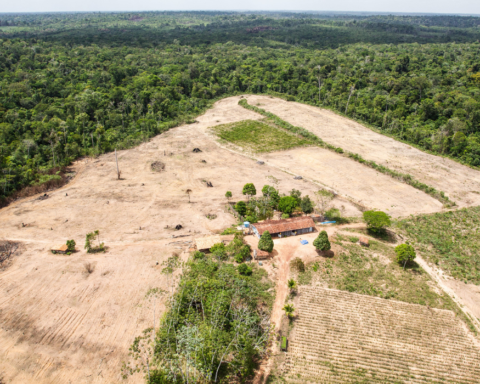

Torrance Coste spends much of his time in British Columbia’s old-growth forests, building trails, hiking and camping through the temperate seasons. It’s a dwindling expanse found across the West Coast province. Of the 25 million hectares of old forest the region once supported, now only about 11 million remain. For Coste, the associate director of the Wilderness Committee based in Victoria, British Columbia, something doesn’t add up. He has seen the scars of clear-cutting firsthand, in a territory that carries the stamp of approval of Sustainable Forestry Initiative, or SFI, one of the most widely used forestry certifications by the global timber industry.
Coste’s organization forms part of a complaint filed before the Competition Bureau of Canada challenging the integrity of SFI, a system created by the pulp and paper industry in 1994 that is meant to reassure environmentally conscious consumers. The standard applies to everything from furniture to cardboard boxes and toilet paper.
The Competition Bureau enforces the Competition Act, which prohibits false and misleading statements about products or services companies offer.
“People desperately want to believe that logging can be done well, and that we can meet our needs for timber and fibre without having a devastating impact,” Coste says in an interview. “The story that can’t be manipulated is the one told out on the land. You get out into some of these areas, into some of these clear-cuts in forests that are SFI-certified, and there’s absolutely nothing sustainable about it.”
The complaint, led by Ecojustice on behalf of the Wilderness Committee, Greenpeace Canada and several other environmental groups, was filed three years ago. The complainants say they want SFI to stop calling their certification “sustainable,” to issue public correction of their claims and to pay a $10-million fine.
SFI, a non-profit organization, has now certified more than 150 million hectares of forest in North America, of which 76% are in Canada. Products that bear its seal are understood to be sourced from forests that are responsibly managed.
But, critics argue, forestry companies certified by SFI can continue to clear-cut forests, spray glyphosate to suppress natural regrowth, and replace them with lucrative softwood plantations. Coste calls it “greenwashing.” “Some of the biggest clear-cuts in the rarest old-growth forests are in SFI-certified forest operations,” Coste says. “It undercuts the credibility of all third-party certifications.”
In an emailed statement, SFI tells Corporate Knights that “this complaint has no merit and attempts to create confusion in the marketplace,” adding that “complaints like this are used to mislead brands, governments, and the public into the real value and impact of the SFI Standard.”
Another signatory to the complaint, Peter Wood, is a professor in the Department of Forest Resources Management at the University of British Columbia. Wood has been studying forestry certification since 1999, first for the province’s Ministry of Forests and later for non-government organizations.
 “Forest certification initially held a great deal of promise, as a way to bypass government inaction in addressing unsustainable rates of logging and ease pressure on the world’s few remaining primary forests,” he says. “This is not the way that it has played out.”
In a 39-page complaint submitted to the Competition Bureau, the environmental groups argue that the SFI standard does not require specific environmental outcomes. While the framework outlines steps that could contribute to sustainable forestry, it does not mandate them.
Wood says many of the requirements are “vague and discretionary, largely aspirational.” Companies seeking certification hire the auditors who assess them, he adds, and the standards focus on whether companies have programs in place rather than whether those programs produce measurable results. As a result, Wood argues, industry-led certification systems have allowed large volumes of wood products to enter the market with sustainability labels, without significant changes to forestry practices.
SFI submitted a six-page response to the Competition Bureau, arguing that the organization is governed by an 18-member board divided equally among industry (including representatives from Canadian forest-product giants Canfor and Irving), conservation, and Indigenous and social sectors. The organization says it undertakes a standards-revision process every five to seven years, which includes review from technical experts; Indigenous groups; industry; private forest landowners and public forest managers; Canadian government agencies, including the Ministry of Natural Resources; environmental non-profits; labour unions; and others. The public is also given an opportunity to comment on the revisions.
RELATED STORIES



SFI also says that their “standards are internationally recognized methodologies” and stated that disagreement among experts does not mean that a methodology is false or misleading.
“SFI has a very slick website and associated promotional materials, and they make big claims around the label’s ability to provide assurance of sustainable forest management,” Wood says. “But if you take a close look at the forest management standards, upon which all of their claims essentially rest, there’s nothing in there that is capable of assuring a given level of performance.” To illustrate the point, Wood points to SFI’s “performance measures” that require certified organizations to protect endangered species. The problem? They require only that companies to have a program in place that “addresses” this issue, with no reflection on whether a program is effective or what impact logging has had on the species.
SFI tells Corporate Knights that “while SFI sets the standard, independent, third party-accredited certification bodies certify organizations to the SFI Standards” and that a certificate is issued only after the independent certification body determines that an operation conforms to SFI’s requirements. They also say that annual surveillance audits by certification bodies are “mandatory on all certified operations to maintain certification. So, if an organization doesn’t meet the standard, they do not receive a certificate.” Meanwhile, the complainants argue that they have not seen an SFI certification be refused or removed for not meeting the requirements of the process.
In response, an SFI spokesperson says that they are aware of 19 certificates that were relinquished between January 2022 and June 2024 by companies that could not meet new requirements.
“[The] government has a strong role to play in protecting Canadian consumers from bogus claims made in the marketplace, including the sustainability of the products they buy,” Wood says. “But this requires pressure from consumers and voters.”
Wood and the claimant environmental groups consider the Forest Stewardship Council (FSC), founded in 1993, to be a stronger option. Though smaller by comparison to SFI, certifying just 50 million hectares, Ecojustice’s submission to the Competition Bureau notes that FSC’s structure and governance were designed to give equal voting power to business, environmental and social interests, including Indigenous Peoples. But, Wood says, in the 1990s, the forestry industry put significant effort into creating other options. “It appeared that these were deliberately trying to detract from the efforts of the Forest Stewardship Council, supported by Indigenous organizations and environmental groups,” Wood says. “I hope the Competition Bureau upholds a high bar in this case and prevents corporations from greenwashing . . . It should not be left up to individual consumers to go around verifying the myriad claims that are made in the marketplace every day, or read the hundreds of pages of standards that support these claims.”
Kegan Pepper-Smith, a managing lawyer on the case at Ecojustice, notes the slow pace of resolution. In the three years since the organization brought the complaint, they have not heard anything apart from one meeting soon after the Competition Bureau’s investigation was launched. “The logging practices under the SFI standard continue, and there’s been no redress for our clients or for the consumers,” Pepper-Smith says in a phone interview.
The Competition Bureau tells Corporate Knights that the agency is legally obligated to conduct its work confidentially and cannot provide details related to the case or its status. Likewise, SFI says that no enforcement action has been taken by the Competition Bureau as of writing.
“That’s really impactful for folks who want to speak with their money and make choices about what products they buy, and are being misled to think that they’re purchasing products that are sustainably sourced,” Pepper-Smith says. “It’s not only about the impact in the forest; it’s also about the impact on the consumers and their ability to . . . [use] their money to support sustainable practices.”
Leah Borts-Kuperman is an award-winning journalist based in North Bay, Ontario. Her reporting has been published by Canada’s National Observer, The Narwhal, The Logic and The Walrus, among others.
Response from the Sustainable Forestry Initiative (SFI), sent on April 27, 2026:
“Contrary to the article’s claims, SFI’s Standard requires prompt reforestation using ecologically appropriate native species and prohibits the conversion of native forests to plantations. It also includes multiple safeguards to ensure that regenerated forests do not develop plantation characteristics, but instead resemble native or semi-natural forests at maturity.
The article’s assertion that SFI’s requirements lack measurable impact or performance is simply incorrect. Every Objective, Performance Measure, and Indicator in the Standard must be met and independently verified by a third-party auditor before an organization can achieve certification. These requirements are outcome-based, ensuring that meaningful and measurable results are delivered.
One example is SFI’s robust, performance-based requirements for the protection and conservation of old-growth forests. The Standard also mandates integrated pest management practices that minimize chemical use and prioritize the least-toxic, narrow-spectrum pesticides.”
The Weekly Roundup
Get all our stories in one place, every Wednesday at noon EST.