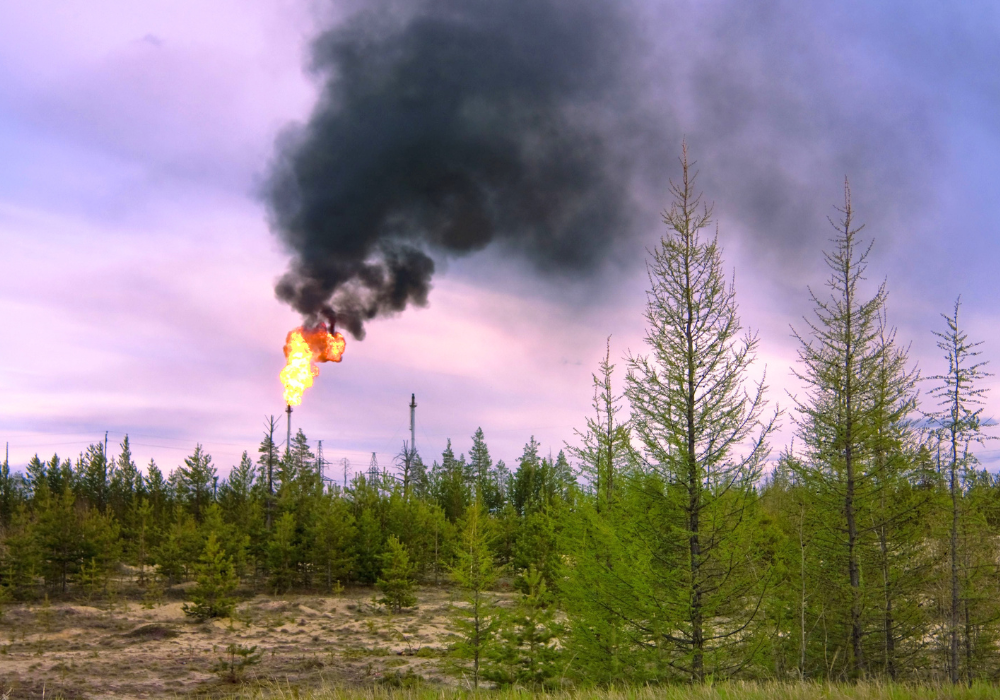
The federal and Alberta governments have reached a preliminary agreement that will allow the province to set its own regulations on climate-busting methane emissions and postpone its emission-reduction deadline by five years.
The deal’s effectiveness in putting a lid on methane pollution will depend on details that are still under development. But experts say Ottawa already traded away the equivalent of 53 million tonnes of carbon reductions last November, when it first signalled that it would allow Alberta to postpone methane controls from 2030 to 2035.
Methane carries about 84 times the global warming potential of carbon dioxide over the crucial 20-year period when humanity will be scrambling to get climate change under control. The Intergovernmental Panel on Climate Change identifies methane reductions as one of the cheapest paths to the quickest, deepest greenhouse gas emission reductions by 2030.
The agreement in principle, released Wednesday, cements a five-year postponement in Ottawa’s 2030 methane target that first appeared in the November 2025 memorandum of understanding (MOU) between Canada and Alberta. If the two governments can agree on an “outcome-based equivalency agreement” under the Canadian Environmental Protection Act, Canada will stand down its own methane regulations in deference to Alberta’s.
The two governments have also agreed to identify an independent third party “to conduct methane modelling, analysis of emissions reductions, and to assess methane reduction results.” That provision is being hailed as an important step, a week after analysis by the Calgary-based Pembina Institute concluded that Alberta’s methane emissions are up to 90% higher than the province’s official estimate, which relies on self-reporting by industry.
The agreement is to take effect on January 1, 2027, following a 60-day consultation on the draft plan.
The methane equivalency agreement was one of several commitments in the Canada–Alberta MOU that were meant to be finalized by April 1. Alberta Premier Danielle Smith now says that other elements of the deal, including a proposed new oil pipeline to Canada’s West Coast, will be delayed beyond next week’s deadline.
Canadian Climate Institute (CCI) president Rick Smith declared the agreement in principle a “positive step forward.” He called the provision for an independent third party “an important approach to reinforce policy ambition and integrity, and help ensure the regulations cover the true extent of methane pollution levels from Alberta’s oil and gas sector.”
But he cautioned that “the final details of the equivalency agreement, and follow-through on the commitment to independent and transparent verification of outcomes, will be critical to determine the agreement’s success.”
CCI senior research associate Alison Bailie says she has confidence in the agreement’s focus on “looking at the Alberta numbers, not just accepting them,” adding that methane measurement technologies have improved in recent years – with some of the gains achieved by Emissions Reduction Alberta with funding from the province’s Technology Innovation and Emissions Reduction (TIER) system. “That’s where I see the hope and the benefits of doing this properly,” she tells The Energy Mix. “It helps Alberta’s own companies,” creating a business case for methane controls in Canada and enabling them to position themselves for methane-abatement projects overseas.
Bailie adds that Canada has “tended to see greater emission reductions” when federal and provincial governments actually work together. “That can work really well,” she says. “We’d like to see more.”
Aly Hyder Ali, senior program manager of oil and gas at Environmental Defence Canada, calls the five-year delay an “unnecessary concession” that represents a “bad deal for everyone outside the oil patch.” Citing Pembina Institute modelling, he says the carve-out would pour 1.9 million extra tonnes of methane into the atmosphere, the equivalent of 53 million tonnes of carbon dioxide over a 100-year period – or far more over a 20-year span.
Amanda Bryant, manager of Pembina’s oil and gas program, agreed in a release that independent, third-party verification is a “vitally important and positive step,” allowing Alberta to “report its methane progress more credibly.” She said the agreement “signals an end to the roadblock that had been preventing progress on this crucial element of climate and energy policy,” enabling industry to “invest and hire with confidence to advance the next stage of methane mitigation work.”
But so far there’s no clarity on whether the “independent party” responsible for monitoring Alberta’s methane controls will rely on theoretical modelling or actual measurement of releases from oil and gas infrastructure, or on whose data the monitor will rely. Real measurement “will be vital, both for an effective response to climate change and to ensure ongoing access to major international natural gas markets that are demanding provably low-emissions-intensity fossil fuel imports, such as the European Union, South Korea, and Japan,” Bryant said.
Last week, a Pembina technical analysis flagged data and regulatory gaps in Alberta’s current approach to methane controls, resulting in actual emissions that have been up to 90% higher than official government figures.
“Alberta should not be afraid to modernize its measurement data and methods, including vehicle-based systems, aircraft and satellites to effectively reduce its methane emissions,” Bryant said at the time.
But Premier Smith may have a different take on what to expect from the independent third party. During an unrelated media conference Wednesday, she said the goal is to arrive at “a common set of facts” after “some other reports that have been put out there kind of put us at odds,” iPolitics reports.
The agreement in principle states that “should third party analysis determine that emissions are higher than expected, Alberta commits to take the necessary corrective actions.”
Mitchell Beer is publisher of The Energy Mix, a non-profit community news site and e-digest on climate change, energy and the shift off carbon. This article first appeared on The Energy Mix. It has been edited to conform with Corporate Knights style. Read the original article here.