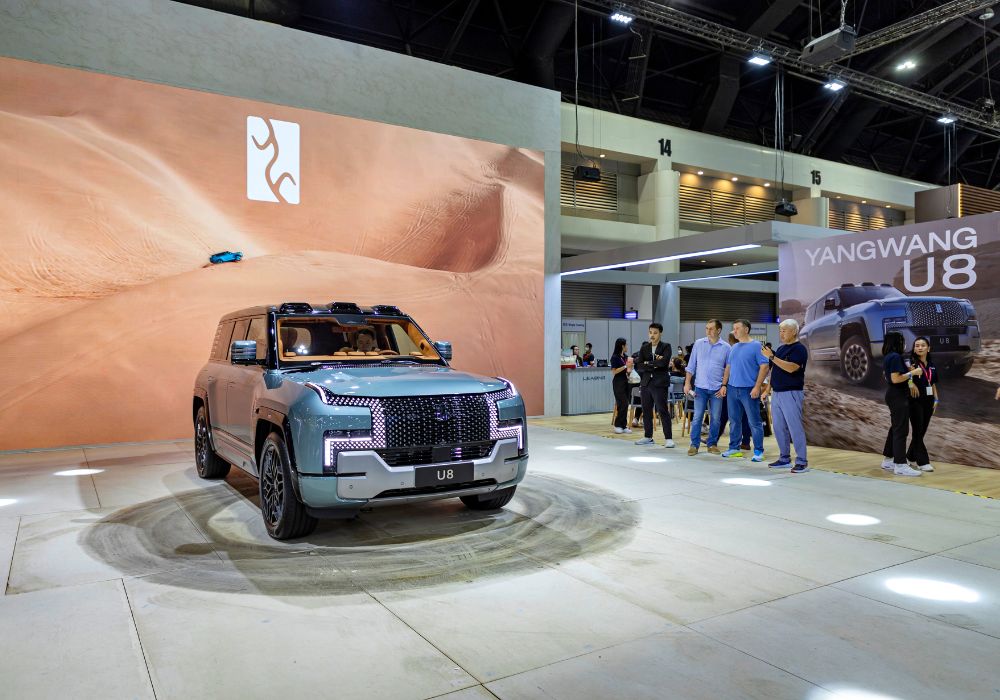
It is no secret that China is dominating the electric vehicle market. With its supply-chain advantages, access to raw materials and processing, and rapid innovation, the cleantech superpower has secured its place at the forefront of EV competition.
Corporate Knights’ annual Global 100 ranking adds more grist to that mill. Of the nine automakers on this year’s list, six are based in China: XPeng (20), Li Auto (29), Nio (30), Zhejiang Leapmotor Technology (43), Seres (63) and Yadea (60), which mainly makes electric two-wheelers. Tesla is a U.S. company, but about half of its production is in China, and BorgWarner, headquartered in Michigan, also has plants in China. A significant number of Western automakers use Chinese batteries in their EVs, too.
But China’s EV market can be hard to parse. In November, The Atlantic published an explosive article contradicting the main narrative around the growth of its industry and purporting that “China’s EV Market Is Imploding.” In the article, Beijing-based writer Michael Schuman points to the pervasive practice of selling zero-mileage “used” cars and claims that the Chinese Communist Party artificially keeps struggling manufacturers afloat.
China, with its cheap electric cars, is teaching Western automakers a lesson, as they build unaffordable, large, luxurious electric models.
– Colin Pratte, transportation researcher, IRIS
In the West, popular perception varies widely, suggesting the distorting effects of online misinformation and a lack of independent data. Chinese cars are thought to be more technologically advanced than their Western counterparts, but their production is considered dirtier than in Europe or North America because of coal-heavy electricity and pollution from upstream processes like mining and mineral processing. But Colin Pratte, a transportation researcher at the Institut de recherche et d’informations socioéconomiques in Quebec, suspects that the latter perception is influenced more by racism than reliable data and that steep tariffs on China’s EVs in Canada and the United States reflect pure protectionism, not high ecological standards.
A big lead
China isn’t the only country propping up its automotive sector, argues Thomas Hundal, a Toronto-based automotive journalist: “To some extent, subsidies are offered everywhere, and people exploit them.” That’s a problem that’s not unique to China, or to EVs, he says, adding that pre-registration, or listing new cars as used, has been a practice in Europe for ages.
According to Reuters, the top 10 countries buying China’s EVs are Mexico, Brazil, the United Arab Emirates, Israel, Belgium, Germany, Australia, Indonesia, South Korea and the United Kingdom.
RELATED STORIES
This Montreal start-up has a solution for range anxiety
New supply-chain ‘passports’ pave the way for more recycling of EV batteries
Ford’s new ‘Model T’ moment is all about EVs
China’s EV industry is more technologically advanced than the West in two main areas, Hundal says. The first is its battery supply chain: “They can produce huge numbers at low cost compared to North America. China is also years ahead of the Western manufacturers in terms of chemistry, with more impressive discharge rates and higher energy density.” China also has a big lead in charging; their stations are substantially more powerful than North America’s, according to Hundal. Broadly, China has been working on its EV market “in a larger and more serious capacity than the West has,” and for longer.
“China, with its cheap electric cars, is teaching Western automakers a lesson, as they build unaffordable, large, luxurious electric models,” Pratte says. China’s small, inexpensive cars compete directly with the big electric SUVs that Western automakers are pushing with the backing of their own governments. If governments really wanted to reduce greenhouse gases by electrifying transportation, they would welcome cheap Chinese EVs with open arms, Pratte says.
Following a pattern
As few as 15 of the 129 Chinese EV brands are predicted to achieve financial viability by 2030, according to the financial advisory firm AlixPartners. Looking at the stiff competition and excess manufacturing capacity in China’s EV sector, Hundal expects to see major upheaval. “If we go back 100 to 120 years, there were thousands of manufacturers in Canada and hundreds in [the United States]; some survived but most didn’t. I expect that to be the sort of trajectory we will see in China,” he says.
The threat posed by companies like Nio, Li Auto and XPeng is reminiscent of Toyota’s introduction to the West, when it rapidly gained market share by focusing on affordability and fuel efficiency. Western carmakers at the time emphasized size, power and styling, but Toyota’s big challenge pushed them to overhaul their manufacturing processes and improve their quality and durability. Chinese automakers could force a similar overhaul today by exposing weaknesses in the Western firms. However, its disruptive potential must first overcome the nationalist and protectionist tendencies that have long been the hallmarks of the auto industry.
Ophélie Dénommée-Marchand is a Quebec-based independent journalist with a focus on fact-checking and investigation. She’s also an encyclopedist for the Canadian Encyclopedia.
The Weekly Roundup
Get all our stories in one place, every Wednesday at noon EST.