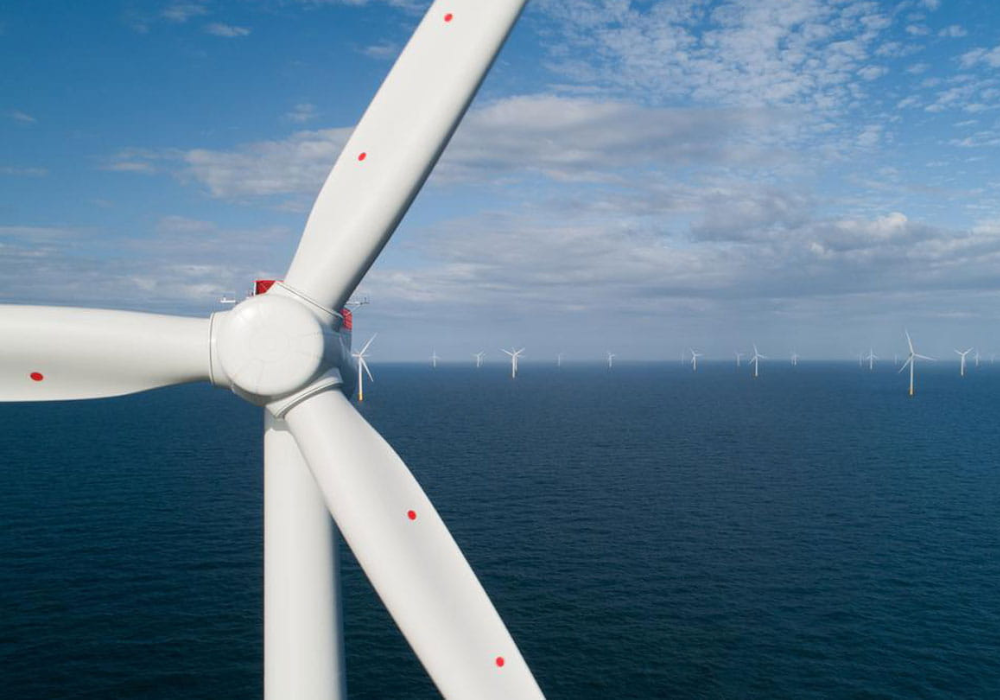
Even before Donald Trump took office and declared his war on renewables, the wind industry was fighting an uphill battle. The Biden administration helped fast-track low-carbon energy in the United States, but other factors like persistent inflation, supply chain challenges and rising interest rates – exacerbated by Russia’s invasion of Ukraine – changed the economics of once-promising wind projects.
Adding insult to injury, Trump has moved to roll back funding for the industry, tried to halt new wind projects (a federal judge later vacated the pause), and delayed $25 billion worth of already-approved offshore wind projects that were set to provide electricity to millions of households. “Windmills,” Trump said in August, “we’re just not going to allow them. They are ruining the country.”
It is in this adverse context that the seven wind companies on Corporate Knights’ Global 100 ranking are operating, and it is worth noting that nearly all continued to grow their wind installations around the world through 2025.
ERG achieves balanced growth
The top-ranked company this year was ERG, an Italian power generator based in Genoa. Founded in 1938, the company bought up oil refineries through the middle of the last century. In the early 2000s, ERG launched a renewables arm, rapidly grew that side of the business, and finally sold off the last of its fossil fuel assets in 2024 to become a “pure play” wind and solar operator. According to its 2024 sustainability report, about 92% of the company’s energy output comes from wind power; the other 8% comes from solar.
 Despite offloading its oil and gas facilities, ERG’s power output increased about 25% between 2022 and 2024, from 4,460 gigawatt-hours to 5,992. “ERG not only weathered the downside, but they were also able to increase the amount of electricity they generated and sold,” notes Michael Yow, the director of rankings for Corporate Knights. “It’s a pretty impressive management feat.”
ERG has pursued a strategy of regional diversification, building and buying wind assets in nine European countries and in the United States, where it acquired a 75% stake in a 224.4 megawatt wind farm in Iowa and a 92.4 megawatt solar plant in Illinois in 2023.
Before Trump, the United States was a good place to undertake wind projects. The World Wind Energy Association reports that the country added 2.1 gigawatts of wind-power capacity in the first half of 2025, trailing only India and China. The added capacity came mainly from project pipelines secured under Biden’s Inflation Reduction Act, and much of this growth is threatened by policy changes under the Trump administration. Analysis from Wood Mackenzie and the American Clean Power Association (ACP) found that ”regulatory uncertainty drove turbine orders down 50% in the first half of 2025.”
The unpredictability in the United States has prompted ERG to take a more cautious approach. The company’s strategy now focuses on acquiring working assets with existing power purchase agreements and projects already financed through tax credits. More broadly, ERG describes its growth plan as “value over volume,” concentrating on countries where it already operates and upgrading existing installations with better equipment.
“Since 2021, ERG has nearly doubled its asset portfolio, growing from approximately 2.1 gigawatts to nearly four gigawatts of installed capacity,” CEO Paolo Merli says. “This result was achieved through a balanced mix of organic developments and acquisitions.”
Plenty of runway for growth
Of all the wind companies on the Global 100 list, Ørsted (#9) has been most affected by the difficult market in the United States, where setbacks on U.S. projects forced it to cut about 2,000 jobs, or a quarter of its workforce, and focus on European projects. Wind companies like Ørsted that primarily develop offshore projects have struggled more than onshore wind developers because installing turbines in coastal waters requires a specialized global supply chain that’s more vulnerable to bottlenecks and disruptions. As one of the cheapest ways to produce power, onshore wind is an easier sell, though offshore enjoys its own advantages, like more reliable wind speeds.
There are signs the industry is experiencing a rebound, however. The United Kingdom has recently concluded a record-breaking auction for long-term price contracts for electricity from offshore wind, enabling the construction of 8.4 gigawatts of new capacity. That’s enough to power the equivalent of more than 12 million homes, according to statements by the U.K. government, which also said the agreed prices were 40% lower than the cost of building and operating a new gas power plant. “It’s good to see that we’re back on track, and we’re seeing substantial allocations coming through again, which is what the industry really needed,” says Jonathan Cole, CEO of offshore wind developer Corio Generation.
China has far outpaced other markets in adding wind capacity, installing 51.4 gigawatts of wind capacity in the first half of 2025. Other Asian markets like South Korea, the Philippines and Japan have introduced new frameworks for permitting offshore wind projects. Suzlon Energy, a wind turbine manufacturer based in India, is new to this year’s ranking and took 10th spot. The company reported 74% revenue growth in the last quarter of 2025. On January 27, Suzlon announced it had won a major order from ArcelorMittal for 248.85 megawatts of wind energy to make low-carbon steel at its facilities in India. This is the wind-turbine manufacturer’s fourth such order for decarbonizing steel production over the past 12 months.
Even in the United States, four of the five offshore wind projects that were hit by federal stop-work orders in December have since been unpaused and the efforts to block them overturned in federal courts. So far in 2026, the logic of wind development is proving more durable than last year’s “vibe shift” against renewables.
Tristan Bronca is a magazine writer and editor based in Newmarket, Ontario.
With files by Mark Mann.
The Weekly Roundup
Get all our stories in one place, every Wednesday at noon EST.