In a bohemian neighbourhood of São Paulo, Carla Guindani was getting ready to cross an important threshold in the struggle to get small-scale farmers in Brazil the recognition they are due. Days before COP30 launched to great anticipation in the Amazonian city of Belém, Guindani’s team at Raízes do Campo was ironing out the final details of their participation in the Green Zone of the international climate conference, an area that was open to the public, with kiosks, conversation sessions and food.
“For us, it’s very important,” says Guindani, an advocate of cooperative food systems who comes from a family of farmers. The shelves of Raízes’s modest showroom were stocked with the fruits of their labour: organic white rice, chocolate made from Bahian cocoa and coffee beans from the southern reaches of Brazil’s Minas Gerais state. Plus a trendy yellow ballcap boasting “Agroecologia” on the front for good measure.
But nothing can compete with the international exposure of COP. Raízes received another boost thanks to famed Indigenous Brazilian chef Tainá Marajoara, who was in charge of catering for world leaders at the conference and had invited the start-up to showcase its products alongside her. “All the work and effort we’ve put so far into raising awareness around our brand really has been a drop in the ocean,” Guindani says.
Guindani started the Raízes do Campo project in 2018 in an attempt to help transform the food supply model in Brazil, bringing small-scale producers closer to Brazilian consumers and creating a more equitable system to deliver fair earnings to farmers. The start-up officially launched in 2022, marketing products by hundreds of cooperative producers under a single brand. Its line includes coffee, chocolate, rice, beans, sugar and fruit juices. Three years later, it now represents some 3,000 producers. Along the way, Guindani has come up against myriad challenges, everything from needing barcodes in order to sell in supermarkets to understanding product placement in the aisles. She has learned that the one of the greatest challenge revolves around storytelling – how to help consumers understand the higher costs of sustainable products that abide by an agroecology ethos.
“We couldn’t market this coffee as if it is any coffee from any hacienda,” Guindani says. So they created something called the “spiral of agroecology,” which assigns value along three pillars: social, economic and environmental. They meet with each cooperative to learn about their process, and then try to guide consumers to understand the attention that the producer places on each of those pillars. So, for example, if there are no women who are part of the management of the cooperative, it may rank lower on the social spiral. “The consumer has to understand that there is a difference,” says Guindani, who has long worked in the farming cooperative movement in Latin America. “At Raízes do Campo, our idea was to turn the families into the protagonists.”
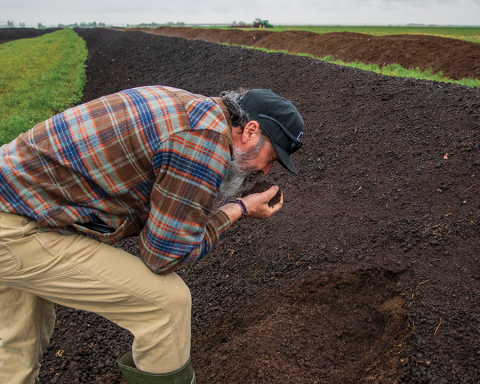
Proponents of agroecology took COP30 as an opportunity to showcase how small-scale and family farming can transform food systems and provide lasting solutions to climate change. It is the first time that family farming has occupied a formal space at the climate conference, says Paulo Petersen, a Brazilian special envoy for family farming at COP30.
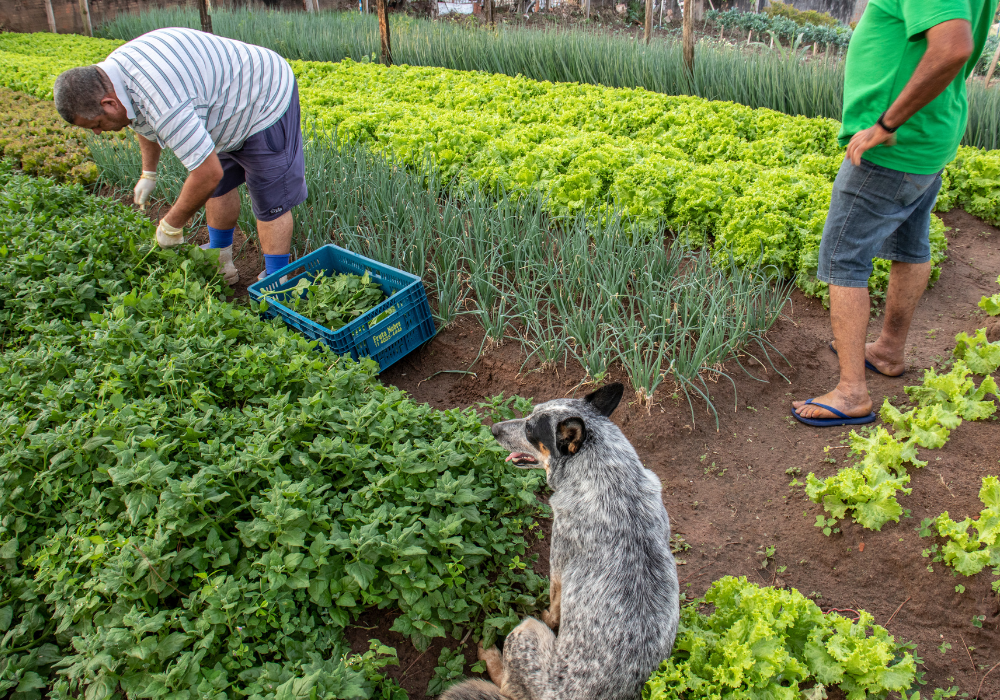
Petersen wants policymakers to recognize family farming as a “decisive actor” in restructuring food systems that are currently responsible for one-third of greenhouse gas emissions globally. In Brazil, family farming is the backbone of its food system, even if it is largely invisible. Family farms make up 77% of Brazil’s five million rural properties, according to the World Bank, and produce most of what more than 200 million Brazilians eat. While COP30 did not produce an agreement regarding agroecology, Petersen says, their voice was stronger than ever: “Our presence in different spaces at COP was about creating our own narrative.”
The role that food systems play in the climate battle has only recently joined the global conversation. But it’s Big Ag that takes up most of the room, even now as the narrative shifts into technological advances that promote “regenerative” or “climate intelligent” agriculture. Industrial agriculture has sought to encompass family farming in its messaging and lay claim to practices that support biodiversity and equity.
“Family agriculture is not part of Big Ag,” Petersen stresses. “What has happened in the last 50 years is that industrial agriculture has disconnected agriculture from its natural environment, production from consumption, and nutrition from health,” he says. Monoculture farming and commodities-based agriculture destabilize the ecological environment in a way that is then remedied with pesticides and chemical fertilizers, he says, which have their own detrimental effect.
“Family agroecology is a recognition of the peasant farmer methods of doing agriculture, that is based on diverse production, biodiversity, culture and local markets,” Petersen says. Its principles are not just ecological but economic, since a large part of the production is to feed the families themselves. That which is meant for sale requires local markets – but the farmers are at the mercy of powerful middlemen.
Guindani has seen this first-hand, and how those unequal power balances leave families with meagre returns. “Since they are small pieces of land, and small productive units, they don’t have enough of a volume to make it to the bigger market,” she says. So, it’s the wholesale buyer that ends up occupying an outsized role, scooping up the product, generating volume and leaving the earlier links of the value chain further behind.
At Raízes do Campo, our idea was to turn [family farmers] into the protagonists.
– Carla Guindani, executive director, Raízes do Campo
In order to reap the benefit of the agroecological family-farming model, it has to be integrated into food distribution systems that reduce energy consumption in processing, packaging, refrigeration and transport and shorten the chain of intermediaries. That means that public investment can’t just be directed at the small farmer; it must be invested in the entire supply chain that creates the conditions for it to make a wider impact.
Petersen points to policies in Brazil’s semi-arid region in the northeast that helped turn around an area that is home to half the country’s family farms, and is particularly vulnerable to droughts. The policies provided public services and social protection to farming families, including a cistern system with access to potable water. And it devised local chains of supply and demand that supported small-scale farms. The result is an area that is now more resilient and better able to withstand the shocks of droughts that have become more extreme.
“What we’re saying is that there isn’t a policy for the climate,” Petersen says. “There are policies for food sovereignty, and it’s those policies that generate mitigating effects around greenhouse gas emissions, that promote adaptation, food security, women’s empowerment and local economies. It’s a win-win effect.”
For Guindani, the focus continues to be on telling the story of Brazil’s family farmers, who are key to a more sustainable future.
Natalie Alcoba is a Buenos Aires-based journalist and senior editor at Corporate Knights.