The night before Kira Young and her family evacuated from Yellowknife in the summer of 2023, she wandered around her house taking photos of the rooms and the hallways and even the cabinets. Young, 17 at the time, stepped onto her deck and looked over her neighbourhood, wondering “if it was the last time I would ever see this view,” she said in a Vancouver courtroom on Monday.
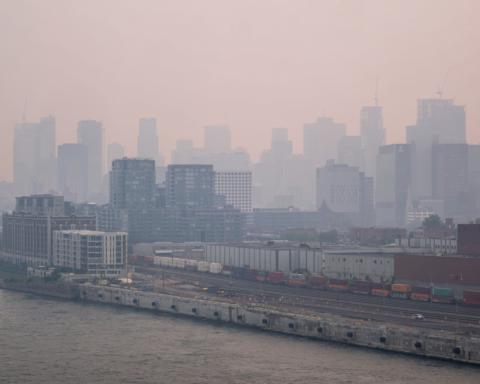
Testifying on the first day of the landmark youth climate lawsuit against the federal government, Young, now 20, recalled spending that summer living with the threat of wildfire smoke. A multi-day canoeing trip earlier in the summer had left Young and her family and friends exposed to smoke for days while they were in the wilderness. Within weeks of that trip, Young said, the sky over Yellowknife was often black or orange, and ash fell from the sky. When the family evacuated in mid-August, she said she was filled with terror, grief and “visceral anger.” Years later, she said she still carried “a lot of fear” about the future of her home and community. “Knowing the huge, huge emotional toll the evacuation took on me, I worry about experiencing something similar in the future,” she said.
Young is one of the 15 young Canadians who are suing the federal government over its climate policies. The youth applicants argue that their rights are being violated by the government’s inadequate action to reduce greenhouse gas emissions and fight climate change.
The historic case is the first federal youth climate case in Canadian history to reach a full evidentiary trial and is one of the first youth-led climate cases against a national government. The resulting judgment could have significant implications for Canadian law and climate policy, and could lead to other climate lawsuits.
“One of the things we often talk about is the sheer power of [giving youth] the opportunity to go under oath to talk about what climate change has meant for them,” says Andrew Gage, a staff lawyer for West Coast Environmental Law and a member of the plaintiffs’ legal team, in an interview. He says it puts a “human face” on the impacts of climate change “that can sometimes seem a little nebulous.”
The trial follows a significant advisory opinion from the International Court of Justice last year, which affirmed that governments are legally required to “prevent significant harm to the environment” and “use all measures at their disposal” to fight climate change.
What do the plaintiffs want?
The plaintiffs in the La Rose vs. Canada case – who were between the ages of 10 and 18 at the time the lawsuit was filed in 2019 and have all experienced physical and mental health impacts from climate change – are asking the court to declare that the federal government’s conduct violates their rights under Section 7 of the Canadian Charter of Rights and Freedoms, which guarantees Canadians the right to life, liberty and security of the person.
They’re also asking the court to order the government to develop and implement a science-based plan to reduce greenhouse gas emissions and decarbonize the country’s energy system in line with what scientists say is necessary to achieve a safe climate system.
The lawsuit, supported by Oregon-based nonprofit law firm Our Children’s Trust, specifically targets the federal government’s Net-Zero Emissions Accountability Act and its resulting 2030 climate plan. The act, passed in 2021, sets out a legislative framework for Canada to reach net-zero emissions by 2050 and requires the government to set emission-reduction targets at various intervals based on the best available science, and make plans to meet them.
The plaintiffs are arguing that the legislation effectively determines the level of emissions that are permissible in Canada and that those levels aren’t compatible with a safe and liveable future. The plaintiffs are also arguing that the “existential crisis” of climate change creates special circumstances that impose a positive obligation for the government to take actions to protect the plaintiffs, and all children and youth, from further harms to their Section 7 rights.
A finding of positive obligation in the trial would “constitute a major development in Canadian constitutional law,” Catherine Savard, a lawyer and Canadian expert for the Sabin Center for Climate Change Law at Columbia University, wrote in a recent blog.
The impacts of climate change “will only get worse without significant reductions now,” said Catherine Boies Parker, counsel at Arvay Finlay LLP and part of the plaintiffs’ legal team, in opening remarks on Monday. “These young, vulnerable plaintiffs say that the Charter must provide them with a degree of protection from their own government’s actions that contribute to the greatest threat to personal security that humans have ever faced.”
Climate change is a global problem, and the behaviour of other countries will have an impact on the world’s trajectory, Boies Parker said. But Canada “can make it worse, [or] they can make it better.”
Gage says the plaintiffs’ argument needs to be understood in the broader context of Canada’s role in contributing to global greenhouse gas emissions. Despite holding 0.5% of the global population, Canada is responsible for 1.4% of global emissions. “The Canadian government plays a significant role in the state of things,” he says.
When the lawsuit was filed, it targeted a much wider range of government actions. After being initially dismissed in 2020 as too broad for the court to intervene, the Federal Court of Appeal ruled in 2023 that a narrowed version of the case, targeting the 2021 legislation, could go ahead.
What is the government’s argument?
The government is arguing that neither the Charter nor Canada’s international climate commitments create a legal obligation for the government to mitigate climate change.
The federal government’s legal representative, B.J. Wray, argued that the Charter only protects against government action depriving Canadians of their Section 7 rights, rather than creating an obligation for the government to take specific actions to protect those rights.
Wray also argued that the plaintiffs’ contention that Canada isn’t doing enough is incorrect and that the country has been on a trajectory to reduce its emissions since 2005. The climate crisis is a global problem, Wray said, and what the plaintiffs are seeking “can’t be achieved through legal orders. It can only be achieved through complex international statecraft over many years.”
Who are the experts testifying in the case?
In June, the plaintiffs were granted the right to bring more than five expert witnesses to the trial, because of its complexity. Eight experts will be called to testify in the coming weeks:
- Kirsten Zickfeld, a professor of climate science at Simon Fraser University and the lead author of the seventh assessment report of the Intergovernmental Panel on Climate Change (IPCC)
- Simon Donner, a lead author on the sixth assessment report of the IPCC and the former chair of the federal government’s Net-Zero Advisory Body
- Elizabeth Pinsky, a pediatrician and psychiatry professor at Harvard Medical School
- Graeme Reed, a strategic adviser to the Assembly of First Nations who wrote a report on the impacts of climate change on Indigenous Peoples
- Thomas Gunton, a professor and the founding director of Simon Fraser University’s resource and environmental planning program
- Nicholas Rivers, associate director of the University of Ottawa’s Institute of the Environment
- Mark Jacobson, a professor of civil and environmental engineering at Stanford University and an atmospheric scientist
- Neil Craik, a University of Waterloo law professor and director of the Balsillie School of International Affairs
What other youth climate cases are ongoing in Canada?
There are three other youth-led cases in Canada, targeting a provincial government, the federal government and the Canada Pension Plan Investment Board.
In the Mathur et al vs. Ontario case, seven youth launched a Charter case against the provincial government for weakening its 2030 emissions target under the Cap and Trade Cancellation Act. The youth are making the same Section 7 argument as in the La Rose case.
In June, Ecojustice filed a challenge on behalf of three youth that is also targeting the federal government’s Net-Zero Emissions Accountability Act. The government attempted to block the case from proceeding to trial, but in September the Federal Court dismissed the government’s motion to strike the case.
Ecojustice is also leading a case by four youth against the Canada Pension Plan Investment Board, which alleges the fund is severely underestimating climate-related financial risks and worsening these risks by investing in new fossil-fuel projects. On November 12 and 13, the case will face its first test, when the CPPIB will attempt to stop it from moving ahead.
Kelsey Rolfe is a Toronto-based freelance business journalist with bylines in The Globe and Mail, Canadian Business, The Logic and the Financial Post, among others.
The Weekly Roundup
Get all our stories in one place, every Wednesday at noon EST.