

Like every other sector, artificial intelligence has the potential to revolutionize how financial regulation and supervision is managed. AI could not only make climate reporting easier for companies; it could also increase data reliability for regulators.
One of the main opportunities AI presents for financial oversight and regulation is analyzing large data sets and identifying new opportunities. Several research projects have explored how AI can assess climate risk cases from text, and how it can be used to track and disclose the environmental impact of supply chains.
But questions remain about its effectiveness and whether its energy use is worth the cost.
Central banks are experimenting with AI
Central banks are already exploring how AI can be used in their own work, including for understanding climate risks.
A Banque de France research note explores how AI could help estimate corporate carbon emissions and finds that it predicts carbon intensity in 69% of cases but struggles with extremes such as heavily polluting emitters. And in Vietnam, the deputy governor at the State Bank of Vietnam has said that AI could be used to improve ESG reporting.
Meanwhile, the Bank for International Settlements (BIS) has two projects in its innovation hub focused on AI use around climate: Project Gaia and Project Symbiosis. Project Gaia uses a large language model (LLM) to automatically extract climate-related indicators from publicly available reports. The objective, BIS says, is to overcome a lack of global reporting standards in order to compare information on climate-related risks. The Gaia project is still ongoing with additional use cases and “is relevant in a much broader context than climate-related data analysis,” a BIS summary of the project states.
Project Symbiosis builds on the work done in Gaia by using various machine-learning subsets like LLM, deep learning and natural language. The collaboration looks at how AI can be used to collect, interpret and calculate Scope 3 emissions, identify opportunities to reduce emissions, and use the data to match suppliers with funding sources to decarbonize the supply chain.
With 95% of financial sector emissions falling within Scope 3, the project aims “to showcase how novel technologies offer a viable technical pathway to positively impact core stakeholders . . . by reducing critical information gaps impeding the climate transition.”
The findings from the project are in line with other AI and risk work and could set the basis for more standardized emissions and help improve issues around standardizing Scope 3 calculations.
AI’s usefulness for assessing climate risk
Interest in the use of AI for climate risk mitigation goes beyond central banks.
Several projects are exploring how to apply AI to imagery data, such as satellites, and advancing multi-input models that compile data points from imagery and text together.
This includes aspects like using image segmentation to look at the carbon footprints of certain areas, or classifications based on which plants are known to grow in those areas, says Peter Schwendner, a machine-learning expert at the Zurich University of Applied Sciences.
If done with intention, and if the levers are applied in a focused manner using AI production, the impact can be really, really meaningful and positive.
– Mattia Romani, partner, Systemiq
From a regulatory perspective, he says, such AI use is “about improving market transparency, and then the financial market should improve the asset allocation with the objective of allocating more capital to, say, sustainable assets. This should work both in investing and in lending.”
It’s exactly the type of project that spaceborne AI firm Kuva Space hopes to expand on. The Finnish company has partnered with WWF Indonesia to explore how AI can be applied to hyperspectral imaging to understand changes to the region’s coastal ecosystem.
Hyperspectral imaging uses advanced satellite cameras to capture images in areas that are often difficult to reach. Kuva Space’s AI system is able to signal potential changes or anomalies, such as changes in the status of seagrass, an important marine carbon store, which can then be confirmed by scientists on the ground.
While the program is in a pilot stage, the project could have a larger impact for not only tracking ecosystems; it could also help regulators and investors identify and track project areas for sectors like blue carbon.
Investors and regulators are asking for this information, but they don’t have it, says Malathy Eskola, commercial director at Kuva Space. “We’re actually going to be making it more science-based or evidence-based, and provide that information so that the decision-makers can be confident.”
Needed: better data (and more of it)
But for AI to be truly effective in understanding climate risk and nature loss, more data is needed, especially from companies, Schwendner says.
Companies themselves do not need to crunch the numbers or create the models, but they do need to provide the raw data for analysis. “Academics and data providers are very eager to work with this data, so I don’t think it’s necessary for the public to invest a lot here,” he says. “This can be done by, say, collaborations between scientists and data providers, but the raw data on the company’s operations needs to be available.”
This includes information such as which companies are sourcing raw materials, at what volumes and from which locations. “At the moment, we only know this in very rough terms, and we need to know exact numbers . . . If we know that, and if we know the production volumes, if we know the energy, where it comes from at this local production facility, then we can estimate . . . the environmental consequences. Then we can estimate the climate impact.”
While more data was expected this year as a result of the European Union’s climate disclosure rules, the bloc’s sustainable omnibus measures have meant there may be less information available than anticipated.
Will AI be positive or negative for the environment?
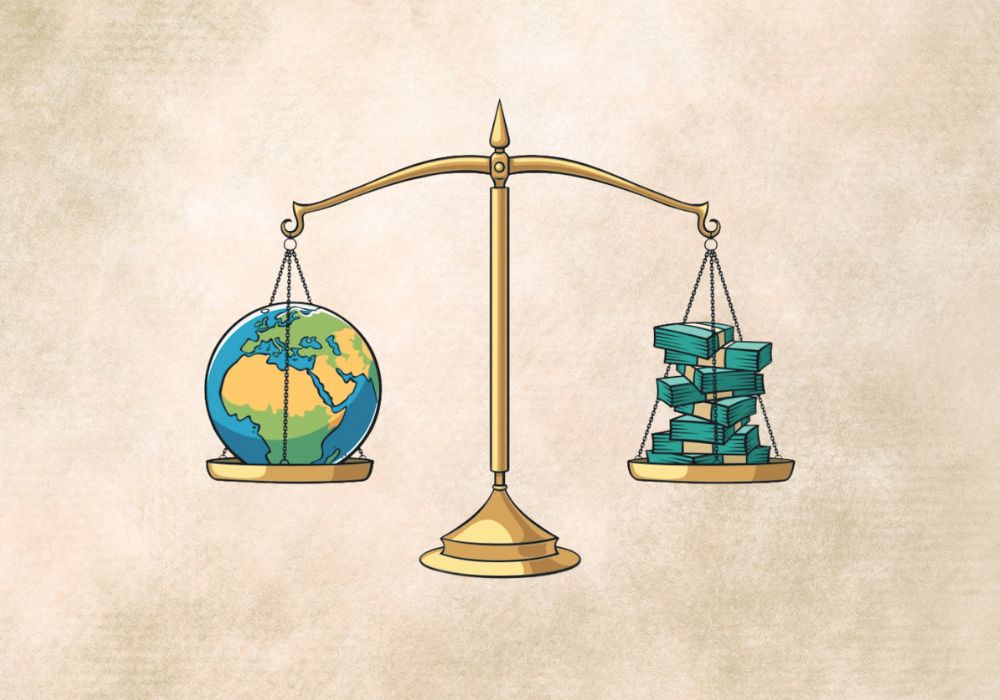
The other burning question around using AI to mitigate climate-change risk is whether it’s worth the energy use and environmental impacts.
AI consumes a lot of energy and water, and those working on AI projects in the climate space are aware of the contradiction in using something for environmental aims that itself uses a lot of natural resources.
The biggest issue with AI consumption, experts say, is the type of models being used and how they are being applied. Training models requires a lot of energy, increasing the electricity demand for data centres. It accounted for 1.5% of all demand in 2024, but is projected to account for 10% of energy demand growth by 2030.
Even researchers from the BIS innovation hub noted in their report on Project Symbiosis that “any use of AI is likely to generate significant emissions, even as electricity grids worldwide continue to slowly decarbonise at different paces.”
But some say AI could have a positive environmental impact.
RELATED STORIES
A study from the London School of Economics finds that AI could reduce global emissions by 3.2 to 5.4 billion tonnes of carbon dioxide equivalent by 2035 if applied in key areas such as innovating resource efficiency, nudging behavioural change, modelling climate and policy system interventions, and managing resilience and adaptation. “If done with intention, and if the levers are applied in a focused manner using AI production, the impact can be really, really meaningful and positive,” says Mattia Romani, a partner at Systemiq and one of the authors of the report.
AI could also be used to help streamline the collection and accessibility of company data. There is an issue around responsible data sharing, Romani says, which is where regulators can step in to ensure safe data practices to “enable private actors to contribute data without risking a competitive or legal exposure.”
If AI is used for practical applications like emissions reductions, then its intentional use could justify the added cost of energy, Romani says. “If you continue to use AI to sell you more stuff on Instagram, then the emissions associated with the additional power, I’m afraid, are going to be substantial.”
Moriah Costa is an award-winning U.S. journalist based in Paris.
This article was originally published by Green Central Banking. It has been edited to conform with Corporate Knights style. View the original here.
The Weekly Roundup
Get all our stories in one place, every Wednesday at noon EST.