In late 2025, the global meat giant Tyson Foods agreed to a landmark settlement that bars it from describing its beef as “net‑zero” or “climate‑smart” for five years unless those claims are backed by expert-verified evidence. The deal is the outcome of a lawsuit launched by the Environmental Working Group (EWG) and is part of a growing legal crackdown on climate‑friendly meat marketing that has also compelled rival JBS to reframe its “Net Zero by 2040” pledge as a mere “goal.”
EWF alleged that Tyson’s promise to reach “net-zero” greenhouse gas emissions by 2050, and its sale of “climate-smart” beef, could not be credibly substantiated. Before pulling its Brazen Beef line in 2024, Tyson had marketed the product as “the first climate friendly beef with 10% greenhouse gas reduction,” a claim that Matthew Hayek, an environmental scientist at New York University, says he never believed. Echoing what he told Corporate Knights in 2024, Hayek reiterates that “10% just seemed like such a fine-grained amount of emissions reduction that was well within the margin of error.” He is “skeptical that anyone had the information that could ‘prove’ that when that consumer went to the grocery store, they were actually getting 10% fewer emissions than the steak right next to it.”
“The decision to settle was made solely to avoid the expense and distraction of ongoing litigation and does not represent any admission of wrongdoing by Tyson Foods,” a company spokesperson told Reuters.
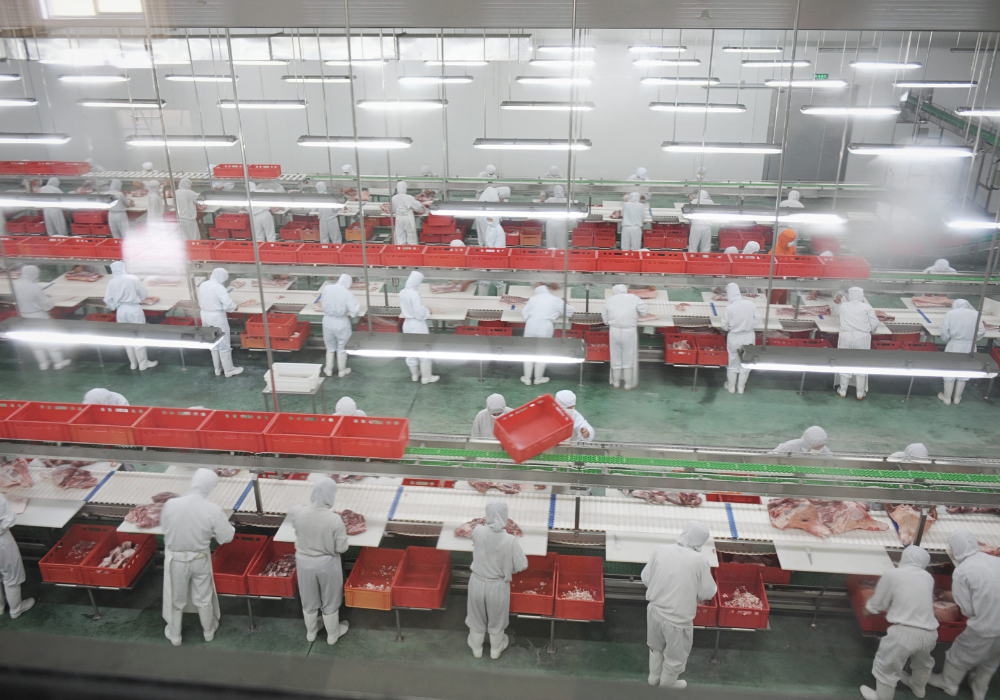
EWG claims that Tyson spent less than 0.1% of annual revenue on actual emission-reduction efforts, and that was “mostly on research – $50 million out of a total annual revenue of roughly $53 billion.” It adds that Tyson spends about “three times as much on advertising as it does on research.”
All the while, according to EWG, Tyson is producing greenhouse gas emissions that “exceed those of Austria or Greece,” with its beef production responsible for 85% of those emissions.
A particularly polluting food
One third of global greenhouse gases are linked to agriculture, with beef remaining disproportionately responsible. According to the Institute for Agriculture and Trade Policy, “the global livestock sector is estimated to be responsible for between 12% and 19% of total human-caused greenhouse gas (GHG) emissions, making it one of the world’s highest emitting sectors.” This has led some major meat-industry players to invest heavily in climate-friendly marketing campaigns and carbon offsets – not in reducing production.
For example, Canada’s Maple Leaf Foods, which produces pork and poultry, has claimed since 2019 to be “the world’s first carbon neutral food company.” It relies in part on offsets, according to its website, “that help us neutralize our remaining, unavoidable emissions.” The company has also pledged to reduce its Scope 1 and 2 emissions “by 30% by 2030 against a 2018 base year” and the “intensity [per tonne of product produced] of our Scope 3 GHG emissions by 30% by 2030 against a 2018 base year.” Scope 3 emissions account for roughly 90% of Maple Leaf’s total reported footprint, with third-party pork and poultry suppliers responsible for the majority, more than 30%, of those emissions.
Fellow meat giant JBS USA had also made similar promises, to “reach net zero by 2040.” But in early November, New York State’s attorney general found the company lacked any credible plan to meet that promise. As a result, JBS agreed to remove or revise its “Net Zero by 2040” statements on U.S. consumer-facing websites so that the target is presented as a “goal,” not a firm pledge or commitment. The company’s website now describes it as an “ambition.” It will also pay US$1.1 million to support climate-smart agriculture programs.
Hayek, who has long been vocal about so-called climate-friendly meat claims, says that while “greenwashing is not going away anytime soon,” he hopes these cases “bring a little bit more attention to the fact that meat is a particularly polluting food.” Hopefully, he adds, this “discourages unfounded climate marketing, and not the important work of climate-target setting and value-chain decarbonization.” What is ultimately required, he says, is to “make animal production less polluting and to shift away from animal production.”
Jessica Scott-Reid is a freelance writer covering animal rights and welfare and plant-based food topics. She is also the culture and disinformation correspondent for Sentient.
The Weekly Roundup
Get all our stories in one place, every Wednesday at noon EST.