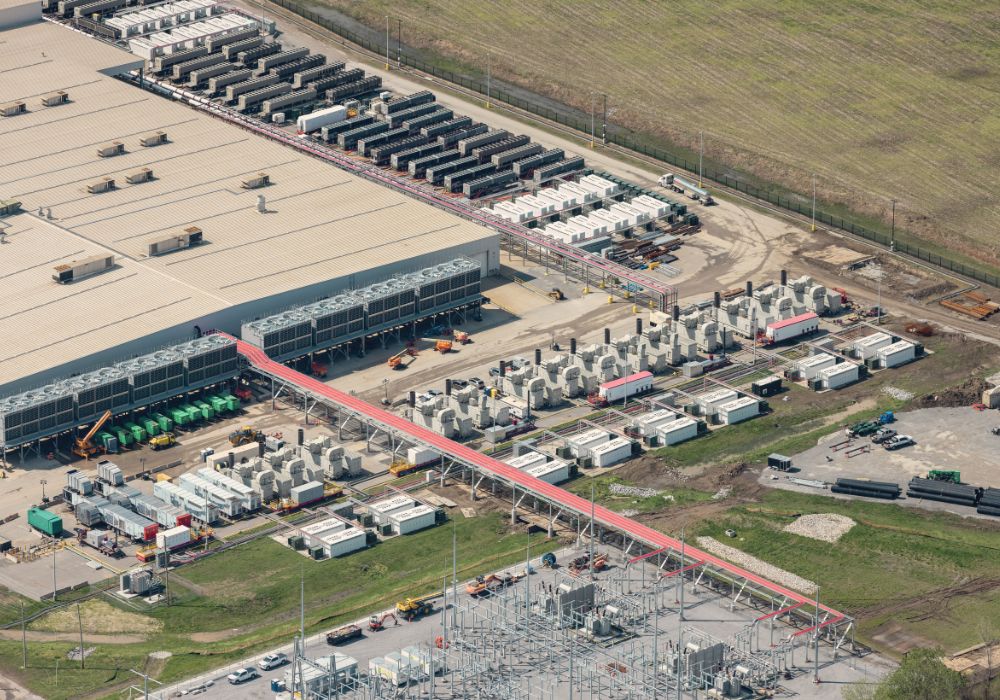
Celebrity investor Kevin O’Leary’s proposed $70-billion data centre, designed to run on 7.5 gigawatts of gas-fired power, could raise Alberta’s greenhouse gas emissions to levels not seen since the coal era, according to estimates obtained by The Energy Mix.
Planned in an area battling drought, the project’s water needs would also be vast, rivalling the annual use of hundreds of thousands of Alberta households.
Called “Wonder Valley,” the project is still nowhere near getting off the ground. But if it ever gets built as planned, it could pump out 25.7 to 30.5 megatonnes of emissions a year, depending on what turbines and gas are used, and whether or not it includes carbon capture, found Pembina Institute senior analyst Jason Wang, who crunched the numbers for The Mix.
“It would be the equivalent of a return to the era of mostly coal-fired electricity,” said Wang.
The reversal would set the province and Canada back about 20 years, matching the 27 megatonnes of coal emissions Alberta phased out between 2005 and 2023.
The data centre complex, which O’Leary claims will be the “largest on Earth,” would require the equivalent of about 10% of all gas supply in Alberta once fully operational.
It’s still just a concept, but in the Municipal District of Greenview where it’s planned, local officials are confident it will be built. “We’re about to pull off the largest project in Canadian history in this sector, and I think Greenview should be really proud of that,” chief administrative officer Stacey Wabick told council members at a budget review meeting in November.
Wonder Valley was announced with great fanfare last December, a few days after the Alberta government unveiled a new data centre strategy designed to attract $100 billion in investments.
At the time, Innovation Minister Nate Glubish said data centres would play a “significant role” in Premier Danielle Smith’s plan to double oil and gas production by increasing domestic demand for gas.
The land designated for Wonder Valley is south of Grande Prairie, about 460 kilometres northwest of Edmonton. It’s located on the massive Montney Formation, one of North America’s, and perhaps one of the world’s, largest gas reservoirs.
Wang said the first phase of the project, requiring 1,400 megawatts (MW) of power, would generate about 4.7 megatonnes of carbon dioxide per year using shale gas to run a combined-cycle gas turbine, the most efficient type of gas power. That would make it one of the largest industrial facilities in the province, he said.
OpenAI selects Argentina for its first data centre in Latin America
Carbon capture and storage has been promised for Wonder Valley, but not necessarily at start-up. Wang said a carbon pipeline would need to be built between the facility and an injection site. “With carbon-capture efficacy at about 80%, it would still mean the first phase of Wonder Valley would be 1.3 megatonnes per year of greenhouse gas emissions,” Wang said.
Another requirement for data centres is the large amount of water they use for cooling. But water is also needed to run gas power plants. Even though the Grande Prairie area is known for longer, colder winters, Wang estimated that the water needed for the fully completed data centre, including both cooling and for the power plant, would be between 112 and 195 billion litres per year. That is roughly one-third to two-thirds of the total annual water consumption of all the households in Alberta.
Multiple communities in the region are struggling with drought and water supply issues. Greenview itself declared an agricultural disaster due to drought this past summer, and that same day, its council approved adding more land to the purchase agreement being negotiated with O’Leary.
This story is part of the Hidden Wonder Valley investigative series by The Energy Mix. It has been edited to conform with Corporate Knights style.
Jody MacPherson is a freelance journalist based in Calgary.
The Weekly Roundup
Get all our stories in one place, every Wednesday at noon EST.