
Since taking office, Donald Trump and his officials have conducted a swift and ruthless campaign to cancel U.S. climate policy and replace it with a patronage system tailor-made for the fossil fuel industry. These measures run the gamut, from billions in cancelled wind contracts to new coal subsidies, vast drilling licences for oil and gas companies, and so on.
Scarcely a week passes without another handout to add to the pile.
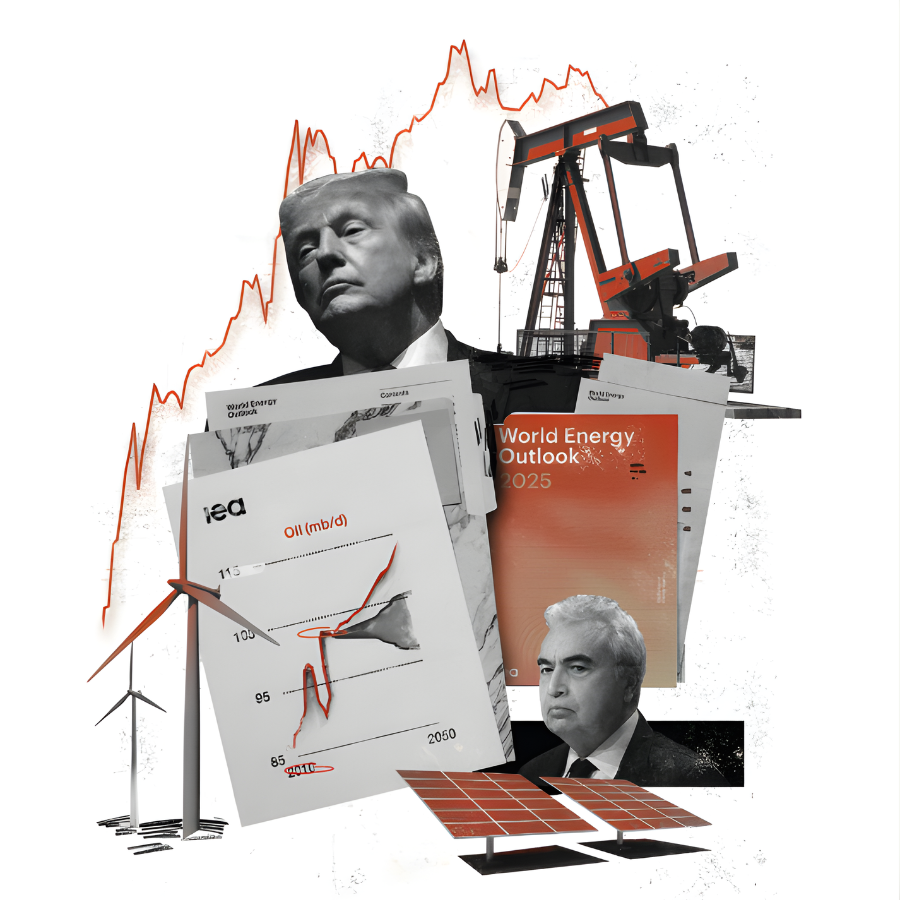
Most of this work has involved undermining anything that promotes renewables and electric vehicles or puts regulatory constraints on large emitters. But the Trump regime has also surreptitiously opened up a somewhat unexpected front in its denialist war: the International Energy Agency’s annual modelling exercise, widely seen as the definitive prognosis for long-term power demand and its impact on the earth’s climate.
Recognizing that forward-looking scenarios help shape the futures they describe, fossil fuel lobbyists and their allies in government mounted a back-channel pressure campaign. They threatened to withhold the United States’ 14% contribution to the IEA’s budget unless the multi-lateral agency stopped talking about third-rail topics like peak oil and instead put out forecasts that muddied the energy transition waters. Their primary target: restoring the IEA’s reliance on an innocuously named energy model, known simply as the “current policies scenario” (CPS), which the Paris-based organization dropped back in 2021, at a radically different political moment.
Guerrilla warfare
When the IEA released its World Energy Outlook (WEO) in October 2021, the agency sketched out two versions of the future: the “stated policies scenario” (STEPS) and the more ambitious “announced pledges scenario.” Together, they provide a view of what 2050 would look like, either with modest progress or bolder ambition, respectively.
Yet in a move that channelled the spirit of that fleeting moment, the IEA added something new and exciting: the “net-zero emissions by 2050 scenario.” This model, it stated, “charts a narrow but achievable roadmap to a 1.5 °C stabilisation in rising global temperatures and the achievement of other energy-related sustainable development goals.” Climate advocates were thrilled by both the IEA’s big goal and its instructions for how to get there. Meanwhile, the Organization of the Petroleum Exporting Countries and U.S. oil and gas interests fumed about all these models forecasting their demise.
It took five years for the backlash to reach IEA’s analysts. For the 2025 edition of the WEO, released in November, the agency’s most ambitious scenario is now STEPS, which scoped out the least aggressive energy transition in 2021. The CPS scenario – which anticipates a catastrophic 3°C increase in global warming by 2050 – was back, while net-zero by 2050 had vanished without a trace. The NZE remains, for now, but Neil Grant, senior climate policy analyst at Climate Analytics, worries about whether it will be excised next year. “If the IEA caves there and gets rid of it, I think you will start seeing people saying, ‘what’s the point?’”
In a lengthy blog post accompanying the new WEO, two senior IEA officials explained the differences between STEPS and CPS with the example of vehicle efficiency standards in Japan. “Under CPS, these policies continue after their end-date but are assumed not to be strengthened,” they wrote. “The STEPS assumes they continue and are strengthened in line with the previous ambition.” The current Japanese policy aims to improve vehicle efficiency by 20% by 2030. Both scenarios reflect the bump, but STEPS predicts that efficiency will continue improving after 2030, while CPS doesn’t assume any more momentum.
“None of the scenarios in the WEO are a forecast,” the authors wrote in a commentary outlining their methods. Nor did the IEA’s use of CPS indicate the presence of a finger on the scale. The IEA’s aim, they said, is to rationally explore the consequences of different policy choices.
It’s clear that there’s been quite a lot of pressure this year in terms of their funding.
— Guy Prince, head of energy supply for Carbon Tracker
But critics didn’t buy the IEA’s wonky explanations about the renewal of empirical rigour, pointing out that CPS ignores the inevitability of continuing technological innovation, takes uninterrupted growth in oil and gas demand as a given, and foresees no drop in emissions. “What the CPS does is take that Trump administration worldview that we’re seeing implemented the U.S. and assumes its dominance across a whole range of other sectors and across the rest of the world,” adds Grant.
In effect, the CPS provides a road map to 2050, but with 2024 policies frozen in place. IEA watchers claimed that its presence is meant to deliver cover to the fossil fuel backers in and around Trump and MAGA congressional Republicans. Indeed, on the eve of the new WEO’s release, which coincided with COP30 in Brazil, a pair of senior congressional Republicans rewarded the embattled agency with a bit of mobbish praise. In a letter, they congratulated IEA executive director Fatih Birol for freeing the agency from the evils of “activism”: “This course correction, which U.S. House Committee on Energy & Commerce leadership has been requesting, will help restore the IEA’s credibility and impartiality.”
“It’s clear that there’s been quite a lot of pressure this year in terms of their funding,” says Guy Prince, head of energy supply for Carbon Tracker. He describes the return of CPS as “a subtle re-positioning” with enormous consequences.
Dave Jones, chief analyst at U.K.-based Ember Energy Research, says that by restoring CPS and situating it as the counterpart to STEPS, the energy agency is signalling a problematic equivalence to global policymakers and investors. “The biggest issue I have with it is that the IEA have used it as equal weighting to the STEPS scenario,” he observes. “I don’t think people expected that to happen.” Most analysts, policy experts and investors would have expected to see CPS offered as a secondary scenario, he says.
The realpolitik here is about buttressing the oil and gas industry’s ability to raise capital and continue operations in the face of an increasingly efficient and inexpensive clean-electricity industry dominated by China, explains Keith Stewart, Greenpeace Canada’s energy analyst. “Adding this scenario is part of that guerrilla warfare going on to try and support an oil and gas industry that is fighting for its life,” he says. “They’re not going to disappear tomorrow, but they can see the writing on the wall unless they can somehow get enough political muscle behind them to stop the transition.” (The Canadian Association of Petroleum Producers did not respond to a request for an interview.)
Slow-walking the energy transition
Trump’s targeted attack on the IEA’s long-range models operate in lockstep with his administration’s shocking assault on science. Since January, a series of moves across the U.S. government have hobbled environmental policy by choking off climate data and cancelling climate science. Agencies that gather and analyze empirical information – the Environmental Protection Agency, the National Oceanic and Atmospheric Administration (NOAA), the Department of Energy, as well as countless university scholars – have had their research budgets slashed, their websites raided and their data streams blocked.
A major concern is access, says Mark Winfield, a professor of environmental studies at York University. “If you were doing observational atmospheric science, for example, are you going to lose data from NOAA satellites and the kind of thing that they use on an ongoing basis? That applies to things like the Intergovernmental Panel on Climate Change, because U.S. science and data underlies an awful lot of that work.”
In the case of the IEA’s models, scenarios aren’t climate science, per se, but they involve complex economics, deep policy research and assumptions about how all sorts of industries will evolve over coming decades; the IEA even publishes a 143-page technical document showing how it builds its scenarios. Like so many other forms of climate data, these models become critical decision-making tools for government officials, investors and other stakeholders, including the fossil fuel industry itself. “They have significant weight,” says Grant. “They’re used a lot in the investment community to decide where we should be putting capital.”
The Trump administration is trying to pull every lever it can to help support its own narrative.
— Dave Jones, chief analyst at Ember Energy Research
Greenpeace’s Stewart points to the various scenarios developed by Suncor for investors back when it was more rhetorically engaged in energy transition debates. The energy giant’s 2022 ESG report talked about how it would adjust its capital investments based on high- or low-demand oil scenarios. “There was a section on how Suncor should change its business model depending on which scenario,” he says, noting that the company walked investors through both high- and low-carbon outlooks, as well as a business-as-usual version, to show their thinking about asset allocation. (Suncor didn’t respond to requests for an interview.)
The IEA’s use of the CPS assumes sluggish innovation in the clean-energy world, but all evidence points to the contrary. “CPS doesn’t reflect the reality of what is happening in terms of new technological deployment,” says Prince at Carbon Tracker. It’s a bit like someone in the 1950s imagining a long-range air pollution forecast that anticipates that leaded gasoline would always be the default vehicle fuel and that nothing like the 1963 Clean Air Act would ever become law. Indeed, CPS isn’t even a business-as-usual scenario; it’s more of a long look in the rear-view mirror at a world that is fast receding into the distance.
The IEA, which stresses that its scenarios aren’t forecasts, defends the reintroduction of the current policies scenario by arguing that as-yet-unforeseen constraints might drag on the current dynamic of change, such as “insufficient infrastructure, grid integration costs, a lack of institutional capacity or financing, or the absence of continued policy support.” As a result, its authors acknowledge, it projects a slower adoption of new technologies than recently seen.
The problem, as history has repeatedly shown, is that neither technological innovation nor economies of scale run in reverse, so CPS doesn’t even function as a bracing worst-case scenario. Stewart points out that Chinese-made solar panels now produce the cheapest energy on the planet, with extraordinary deployment rates, especially in Asia. (China is building an eight-gigawatt solar farm in inner Mongolia that will be 30 square kilometres larger than New York City.) Trump strong-armed constraints on U.S. renewables producers, even as the rest of the world’s nations beat a path to China’s doorstep to place their own mass orders for inexpensive panels and EVs. Such is economics: the evidence suggests that demand for renewables is growing, not slipping.
The bottom line is that the CPS may become the oil and gas sector’s aspirational anchor, a plausible version of the future that it can tout to fossil fuel investors. But the industry will eventually have to confront the implacable fact that it no longer produces a cost-competitive product, much less an environmentally friendly one – regardless of what the IEA’s dubious model envisions.
Jones at Ember Energy Research takes the wide view. The IEA’s decision to bring back CPS, he says, feeds into a broader push to put fossil fuels back to a place of energy primacy – a place the industry feared it had surrendered during the peak oil days. It’s about storytelling, not what’s actually going to happen, Jones observes. “The evidence is the Trump administration is trying to pull every lever it can to help support its own narrative.”
Like so many global institutions that have found themselves under siege from this president, the IEA may find its reputation as an honest information broker broken, which is a scenario no one wants to see.
John Lorinc is a journalist and author specializing in urban issues, business and culture.
The Weekly Roundup
Get all our stories in one place, every Wednesday at noon EST.