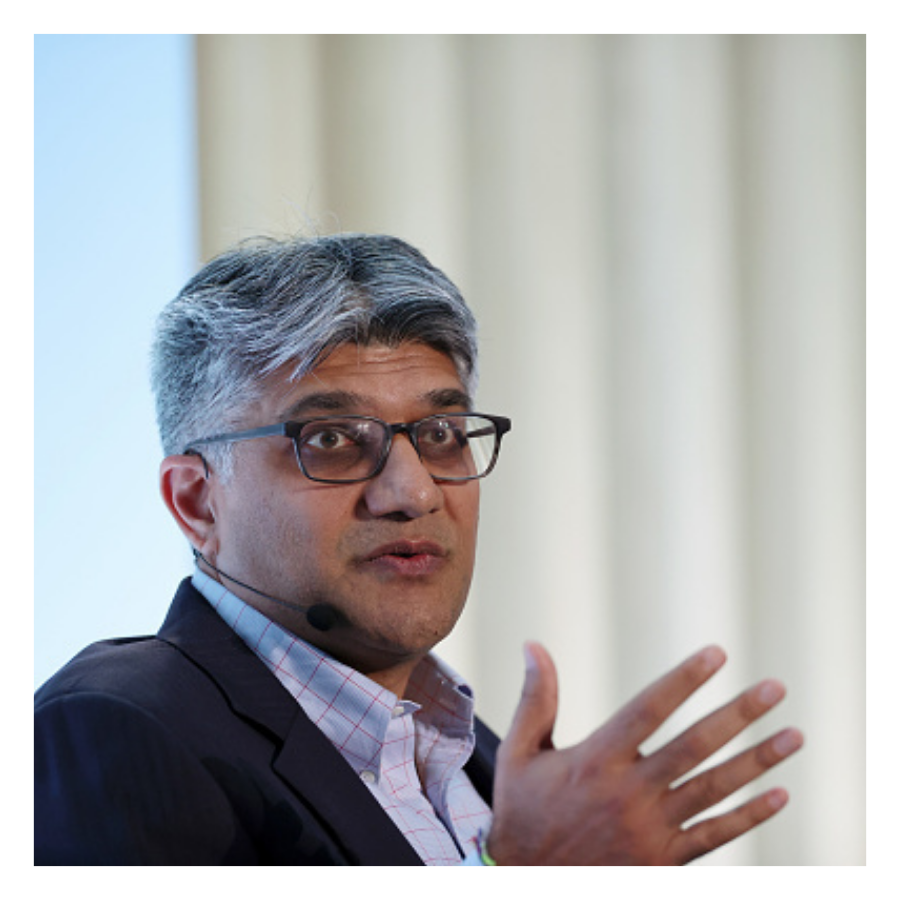

For several decades, Jigar Shah has managed to stay out front in the long race to a clean-energy economy. Few people in the world have a better grasp of the mechanics of scaling new technologies and transforming the electricity system. In 2003, Shah founded SunEdison, once the largest deployer of renewable energy in the world, and more recently, under Joe Biden, he led the U.S. Department of Energy’s Loan Programs Office, where he was authorized to dole out well over $200 billion to spur the clean-energy buildout. He’s a doer, not just a talker, and his outlook on the sector provides a rare confluence of width, depth and granularity. He spoke with Corporate Knights publisher and CEO Toby Heaps. The interview has been edited and condensed.
Toby Heaps: Some people think the Inflation Reduction Act was a spectacular success. There are other views as well. What’s your take? Did the policy work?
Jigar Shah: I’m sure everybody is right. I think that we all have to be honest about the fact that the United States had chosen to allow its manufacturing sector to dwindle in a very big and material way, right from 30% of gross domestic product down to about 10% of GDP. I don’t think that what we were doing under the Inflation Reduction Act was going to be solely responsible for changing that trajectory.
I have a lot of friends who are doing very large, audacious things in the cleantech space, and every single one of them, without exception, when they hit a certain milestone, decided to build their manufacturing facility or their first-of-a-kind plant in Asia. A few of them decided to go to Europe or to India or to South America. In general, not a single one of them thought Tennessee or Georgia or Texas was the right place to scale up their plant.
That all changed over the last four years. We got every one of them to consider the United States, and I’d say close to 70% of them ended up choosing the United States after evaluating all of the situations. So from that perspective, we have made a material difference.
TH: That’s encouraging. In Canada, the current government led by Prime Minister Mark Carney has introduced a pack of investment incentives that, through the capital expensing of 100% and tax rebates, amount to about 50 cents on the dollar. So if you invest in most clean-economy investments, you’ll get back half that money in the same year. Do you think that is going to be enough for Canada to become a magnet?
JS: I would suggest that this is not really about numbers. I think that ultimately this is about the animal spirits of the cleantech sector. So the question is, are CEOs looking to Canada to build a facility? And I think right now, the answer is no.
And I don’t think Canada’s ever reached out to them and asked them to come to Canada. And the thing that bothers me the most – not just about Canada, but the U.K. or EU, Australia – is that they believe that the policies themselves are enough to attract companies. And I’m like, no, you need to make some phone calls. You need to reach out proactively to the top 400 companies and say, “Have you looked at Canada? Can I keep you on the phone for 45 minutes and explain it to you? Can I introduce you to a front-door person that will guide you through the entire Canadian process and introduce you to all of the three-letter acronyms and help you find the right programs?”
I’m focused on people who have raised at least $200 million of corporate capital. We’re not talking about the long tail of companies that have raised a seed round. We’re talking about people who’ve been able to get all their milestones reached, and now they’re at a very clear inflection point where they need public policy to be able to get to the next level.
TH: A lot of coverage in Corporate Knights magazine has focused on how the private sector and private capital can turbocharge this energy revolution. Do you think it’s capitalist Kool-Aid, this idea that the private sector is going to make up the bulk of the capital that gets deployed? Or do we really need the public sector to pony up, like they are now for the military spending?
JS: It’s an ongoing argument. I don’t know that I am smart enough to know what the conclusion is, but if you look at the solar, battery storage, critical minerals, EV sector in China, I would say that at least 70% of all the capital that China has put into that sector has been completely and utterly wasted right now. You may say, well, look at what they got for it: they have all this commanding market share and all this other stuff, right? But they haven’t ever raised their prices to the point where the profits of the winners are paying off the losses of the losers. China has no home runs. The question is, do you want to copy that exactly in the United States or Canada? My sense is no. So what do you want to do that’s different?
What we did in the United States was we said we’re going to be private-sector-led, government-enabled. We said the private sector has to vote with the $200 million worth of cash that they’ve given these companies, and then we’re going to match them with public-sector dollars that they need to get to the next stage, to really be able to get their costs down. And that worked really well. I would say the losses out of the U.S. system from the Inflation Reduction Act have been remarkably low. Let’s say we awarded 100 projects. Maybe 40 of them have failed, but of those 40, we’ve released almost no money because they had to meet certain milestones to get the money.
TH: You’re someone who doesn’t just focus on what’s already here but imagines what could be possible. Let’s say we’re sitting in our rocking chairs in 2050. What’s the prize? What could things look like?
JS: Well, I think we already see it. The beauty of our space is that every single thing worth talking about takes 50 years. We started seeing cellphones in the 1970s, but the technology didn’t really become powerful until the iPhone came out in 2007. Solar panels are the same.
When you look at where we are today, we’re in a place where there was disruption in Pakistan, in Nepal, in Ethiopia, and instead of choosing to move to diesel fuel, the entire country chose to move to solar and battery storage. So now, 20% of the entire grid in Pakistan has been transformed in three years into solar power.

You see the same potential in Canada or in the United States. Balcony solar means that you buy the solar panel from Home Depot, you unbox it, and you just stick it on your balcony, and then you plug it into the outside wall socket. And it’s super cost-effective, even in places that don’t get as much sun.
Now the question becomes what else is going to be cool? It is very obvious that everyone is moving to electric vehicles. Whether it’s 10% a year, or 25% or 50% a year, they’re all moving to electric vehicles. If you have 40 gigawatts of batteries, which is what we have already in the United States, and then you end up with 400 gigawatts of batteries [with the addition of EVs], which we will have here in the next few years – that backs up the entire U.S. grid during the spring and the fall. What do you need to unlock that? Vehicle-to-grid technologies. Why do people want to install those technologies? Because 15% of U.S. households already have backup gas or diesel generators, so they’ve already voted with their pocketbooks to pay for that.
Now if you have a car, and that car is a 125-kilowatt-hour battery, you can back up your whole house with that car. And once it’s backed up that way, well, now the utility can send it a signal saying, “We’re going to pay you 30 cents a kilowatt-hour, because otherwise we’ll have rolling blackouts because the natural gas plant that we were counting on failed, and so we’d like to pay you to basically save the grid.”
We’re in this situation where that technology works today, and when we’re in our rocking chairs in 2050, everyone will have them. They will be ubiquitous. And our children will say, “Well, duh, like, obviously.”
TH: When I talk to older utility guys, they kind of roll their eyes at the vehicle-to-grid idea and say, “Okay, well, tell me where that’s actually happening.”
JS: It’s happening at complete scale in the United Kingdom. It’s at a point where Octopus Energy is giving people free power on a regular basis to charge their electric vehicles. Because there’s a lot of excess wind and solar during certain times of the day. Remember, 90% of everything we need to do with the grid with electric vehicles can be done with managed charging, what they call V1G. Then there’s another 8% of what can be done with vehicle-to-home, where you never export back into the grid, you just take the home off-grid. So we could get 98% of the value without updating any of our standards that are in place now.
TH: Do you think geopolitically, has China sort of got themselves in a dominant spot that’s going to be pretty significant for this next century?
JS: China has clearly overplayed their hand. I think they don’t know it yet, but they have. Xi Jinping has been in power too long. And now he’s pissed off everybody. He’s pissed off India, Turkey, Malaysia, Vietnam – anyone who manufactures stuff, he’s pissed off all of them. So now the question becomes how long can they continue to lose money?
Remember, we have many more iterations of technology that you and I know about. Like, solar panels are not done, right? We got perovskites and other things that are coming in. Electric vehicles are not done. We have technologies in the queue that’ll double the energy density of lithium-ion batteries. We have no reason to share any of that technology with China now.
So when we decide not to share that technology with them and instead share it with India or Mexico or other places, we’ll see where it goes. Yes, it’s going to take us a solid 10-year effort to actually diversify the supply chain, which is exactly how long it took after the Arab oil embargo for us to diversify the supply chains for oil. We know how to do it. It’s a playbook. We’re executing on it now, and I think in 10 years’ time, we’re going to be quite a bit more diverse.
Toby Heaps is co-founder and publisher of Corporate Knights.
The Weekly Roundup
Get all our stories in one place, every Wednesday at noon EST.